



Can a Steel Arch Bridge Span Wide Rivers with Fewer Supports?
2026-10-10 13:00:01






Yes — a steel arch bridge can absolutely span wide rivers with minimal intermediate supports. The arch transfers vertical loads into horizontal compression along its curved ribs, pushing outward toward abutments rather than downward through piers. This load path lets engineers eliminate mid-river supports entirely on crossings exceeding 500 meters. High-strength steel grades like Q420qE make this possible by offering a favorable strength-to-weight ratio, allowing slender arch profiles that resist wind, traffic, and seismic forces without the bulk that concrete alternatives require.
Understanding Steel Arch Bridges and Their Structural Capabilities
How the Arch Transfers Loads
Any curved steel bridge is held together by the arch rib. It does almost all of its work by compressing, sending gravity loads along its shape toward the abutments. Engineers can make longer gaps with less material than a normal beam system needs because compression is the best load state for steel. The system is finished off with spandrels and tension ties, which keep the arch shape stable even when live loads aren't evenly distributed.
Key Components That Enable Long Spans
The arch rib cross-section, the rise-to-span ratio, and the shape of the base all affect the span potential. The Q420qE arch ribs from Zhongda have a pentagonal box section that is 3.2 m × 4.5 m. This section evenly spreads stress and can withstand the 1.5 kN/m² wind loads that are typical in river corridors that are open to the elements. The closed box shape also prevents torsional bending during construction, which is a problem that often stops long-span projects in their tracks.
Documented Span Achievements
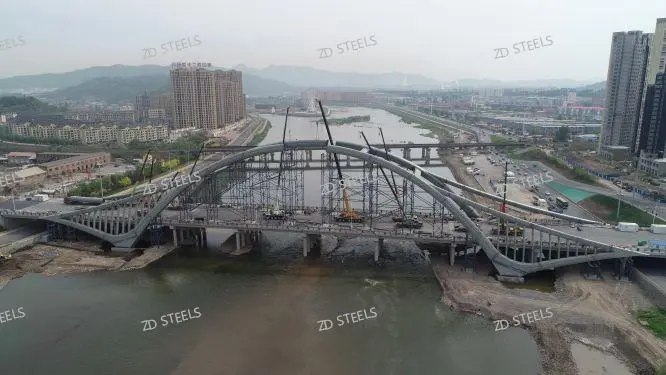
West Virginia's New River Gorge Bridge is 518 m long and doesn't have any piers in the middle of the river. In Chongqing, the Chaotianmen Bridge is 552 m long. These examples show that support-free crosses are not just an idea; they are common when the right material and shape are used together. The 18,000-ton Zhongda Shenyang Dongta Cross-Hunhe River Bridge used stentless rotation construction to do the same thing on a busy inland waterway.
Comparing Steel Arch Bridges With Other Bridge Types for Wide River Spanning
Suspension vs. Arch: Support Requirements
Some suspension bridges are longer than 1,000 m, but they need big anchor blocks and tower supports, which are pricey when the ground is soft, or there is a lot of water. An arch, on the other hand, pushes its thrust into packed abutments along the riverbanks. This cuts down on the number of structures that are submerged in water and the damage to the flow of water.
Concrete Arch and Truss Comparisons
Concrete arch and steel arch bridges work the same way, but they are much heavier per linear meter. This means that spans can only be about 400 m before the costs of the foundations go through the roof. Steel truss bridges are good at spreading out loads, but they tend to be taller and need more entry points for upkeep, which can cause problems with the clearance standards for industrial waterways. Steel arch sections stay thin and keep the space between them high.
Urban Integration and Environmental Footprint
The clean, curved shape of a Steel Arch Bridge fits along urban waterfronts without blocking views. Fewer bridges are built into the riverbank, so sediment patterns stay more like they are naturally, and fish migration routes stay open. This edge in footprint size often makes the difference between types for EPC workers who work near protected waterways or heritage zones.
Engineering and Construction Techniques for Minimizing Supports on Wide Rivers
Modular Fabrication and Stentless Rotation
At a rate of 1,203 tons per month, Zhongda sends arch ribs in 20-meter sections that are made in-house. Since each segment is CNC-cut to a tolerance of ±0.2 mm, it doesn't need much shimming when it's put together in the field. The stentless rotating method, which was used on the 8,000-ton Hunhe River arch, turns half-arches that have already been put together on pivot bearings until they lock at the crown. This means that there is no need for temporary scaffolding towers in the river canal at all.
High-Performance Steel and Welding Standards
The minimum yield strength of Q420qD steel is 420 MPa, which gives the building a lot of spare capacity for heavy traffic and flooding. A 100% CTOD (Crack Tip Opening Displacement) test is done on all of Zhongda's arch ribs to make sure they are tough at low temperatures. This is necessary for bridges in northern regions where winter temperatures drop well below freezing.
Structural Health Monitoring
Once they open, long-span bridges need to be watched over all the time. Zhongda puts in more than 200 sensors on each steel arch bridge to measure temperature, vibration, strain, and movement. The full-bridge monitoring system finds problems right away, so maintenance teams can plan fixes before small problems get worse and cause structural issues. This method lowers the costs over the whole lifetime and meets the needs of government owners who are demanding stricter asset management.
Procurement Considerations for B2B Clients Investing in Steel Arch Bridges
Evaluating Supplier Credentials
There is more value in certifications than in price lists. After getting ISO 9001:2015, EN 1090 Execution Class 4, and a Class I Steel Structure Professional Contracting Qualification, Zhongda is ready to work. These credentials show that the company meets the standards for international projects in terms of quality management, traceability, and execution. These standards are a must for government contractors and EPC firms that want to bid on public infrastructure.
Before signing a contract with a supplier, procurement managers should make sure that the following things are true:
- Material traceability: Mill certificates, heat numbers, and CTOD test records must accompany every steel batch.
- Production capacity: Zhongda's 60,000-ton annual output and 120,000 m² facility support high-volume, time-sensitive delivery schedules.
- Anti-corrosion specification: The 150 μm aluminum spray plus fluorocarbon topcoat system meets GB/T 30790 C5M — the highest marine and industrial exposure category.
- Delivery format: 20-meter arch rib segments fit standard heavy-lift transport and can ship via containerized or break-bulk cargo depending on port access.
These criteria help procurement teams go beyond just comparing prices and make choices based on value, which protects project schedules and the long-term performance of assets.
Turnkey vs. Component Procurement
Some clients would rather buy pre-made parts and handle fitting on-site themselves. Others need the full EPC service, from planning to starting up the building. Zhongda supports both types and offers OEM and ODM customization for arch rib geometry, rotation building systems, anti-corrosion requirements, and settings for tracking the health of the structure. Getting involved with the engineering team early on cuts down on expensive redesign cycles and keeps the timeline for procurement on track.
Real-World Applications and Case Studies
Shenyang Dongta Cross-Hunhe River Bridge
With a weight of 18,000 tons, this arch bridge is one of Zhongda's most difficult jobs. The stentless rotation construction method kept the active navigation channel open while the bridge was being built, which was a requirement set by the local government in the contract. With no piers in the middle of the river, the finished bridge now moves a lot of city traffic across the Hunhe River.
Jingha Expressway Expansion
The expressway project's need for a 1,200-meter span put Zhongda's logistics and fabrication schedules to the test at the same time. Tight production scheduling was needed to deliver over 1,200 tons of arch rib every month while keeping the quality of the welds and the accuracy of the sizes across all segments. The project was finished on time, and since it opened, there have been no structural problems.
International Custom Projects
Zhongda has built custom arch bridges for clients in Russia, Australia, and Vietnam. They have changed the designs to fit conditions in the Arctic, on mining sites, and in tropical areas with high humidity. This range of geographical areas shows that the engineering and anti-corrosion methods work in the real world as well as in the lab.
Conclusion
A steel arch bridge can span wide rivers with fewer intermediate supports by transferring loads through arch compression to the abutments on both riverbanks. This structural design can reduce the need for in-river piers, helping maintain navigation channels, limit disruption to river environments, and accommodate demanding infrastructure projects.
For long-span river crossings, project teams should evaluate steel grade, arch rib design, welding quality, corrosion protection, and construction methods such as stentless rotation. Supplier capabilities also matter, including fabrication precision, material traceability, production capacity, and compliance with relevant quality standards.
Working with an experienced steel arch bridge manufacturer like Zhongda can help EPC contractors and infrastructure developers coordinate customized engineering, precision-fabricated arch ribs, and project-specific delivery requirements. By considering structural performance, construction feasibility, and long-term maintenance from the planning stage, buyers can make better-informed decisions for reliable wide-river bridge projects.
FAQ
1. How wide a river can a steel arch bridge span without intermediate piers?
Without the use of mid-river supports, modern Steel Arch Bridges can frequently span 400 to 600 meters. Some designs are longer than 550 meters because they use high-quality steel and have the best rise-to-span ratios. Instead of just material strength, the realistic limit is based on the nature of the abutments, how exposed they are to wind, and how seismically active the area is.
2. What steel grade does Zhongda use for arch ribs?
The structural steel used in Zhongda's Q420qE arch bridges is Q420qD, which has a minimum yield strength of 420 MPa. Every weld is tested for 100% CTOD to make sure it is tough in cold temperatures, which is what is needed for bridges in cold northern climates.
3. How does stentless rotation construction work?
Engineers put together one half of the arch on the bank of the river and then turn it on pivot bearings until the crowns of both halves meet. There are no scaffolding towers in the river channel, so navigation stays open and there is less damage to the environment during construction.
4. What corrosion protection does Zhongda apply?
The system uses a 150 μm aluminum thermal spray base coat and then a fluorocarbon topcoat that meets the requirements of GB/T 30790 C5M, which is the standard for the harshest marine and industrial environments.
Partner with Zhongda for Your Next Steel Arch Bridge Project
Zhongda's engineering team is ready to help you with your long-span river crossing, from helping you with the design to building it and delivering it. We are a reliable steel arch bridge maker with ISO 9001 and EN 1090 EXC4 certifications and a 60,000-ton annual capacity. We produce precisely manufactured arch rib systems on time, with full material traceability and expert help after the project is finished. Please email us at Ava@zd-steels.com to talk about the details of your project.
References
1. Xanthakos, P. P. Theory and Design of Bridges. John Wiley & Sons, 1994.
2. Chen, W. F., & Duan, L. (Eds.). Bridge Engineering Handbook: Superstructure Design. CRC Press, 2014.
3. Collings, D. Steel-Concrete Composite Bridges. Thomas Telford, 2010.
4. American Association of State Highway and Transportation Officials (AASHTO). AASHTO LRFD Bridge Design Specifications, 9th Edition. AASHTO, 2020.
5. Ryall, M. J., Parke, G. A. R., & Harding, J. E. (Eds.). The Manual of Bridge Engineering. Thomas Telford, 2000.
6. Troitsky, M. S. Cable-Stayed Bridges: Theory and Design. Crosby Lockwood Staples, 1988.
YOU MAY LIKE
