
Prefab Breeding Sheds Support Large-Scale Poultry and Livestock Farming
2026-09-23 13:00:01






Large-scale animal agriculture demands infrastructure that keeps pace with production goals. A modern breeding shed is no longer a simple enclosure — it is a precision-engineered facility designed to regulate temperature, airflow, biosecurity, and animal welfare simultaneously. Prefab breeding sheds manufactured with hot-dip galvanized steel frames and shed roof steel trusses deliver exactly that: controlled environments deployable in weeks rather than months. For procurement managers overseeing poultry or livestock expansion projects, these modular structures represent a measurable leap in operational efficiency and long-term return on investment.
Understanding Prefab Breeding Sheds and Their Advantages
Traditional site-built animal housing takes a long time to build, the quality of the materials isn't always consistent, and it can't be expanded. Prefab Breeding Sheds address all three issues by moving the majority of the manufacturing work to a controlled factory setting before the parts are delivered to the job site.
Why Modular Fabrication Outperforms Conventional Construction
Structural parts made in a factory, like shed roof steel beams made from Q235 or Q345 steel, come to the job site already precisely cut, drilled, and ready to be bolted together or welded. This method gets rid of common mistakes made in the field and greatly shortens the time it takes to put things together. The USDA Agricultural Research Service says that compared to regular open housing, controlled-environment cattle housing lowers the death rate of newborns by up to 15% [1]. Just the speed advantage alone makes prefab options appealing for any business with anywhere from a few hundred to tens of thousands of animals.
Simple expansion is also possible with modular animal housing. When output goals go up, more bays can be added to the existing structural grid without tearing down or redesigning the original size. This is something that traditional construction can't do.
Critical Design and Functional Features of Prefab Breeding Sheds
In high-output livestock farms, environmental control and structural efficiency go hand in hand. The shape of the trusses and the materials used for the walls all have a direct effect on the safety of workers, the well-being of animals, and the amount of energy used.
Shed Roof Steel Trusses: The Structural Core
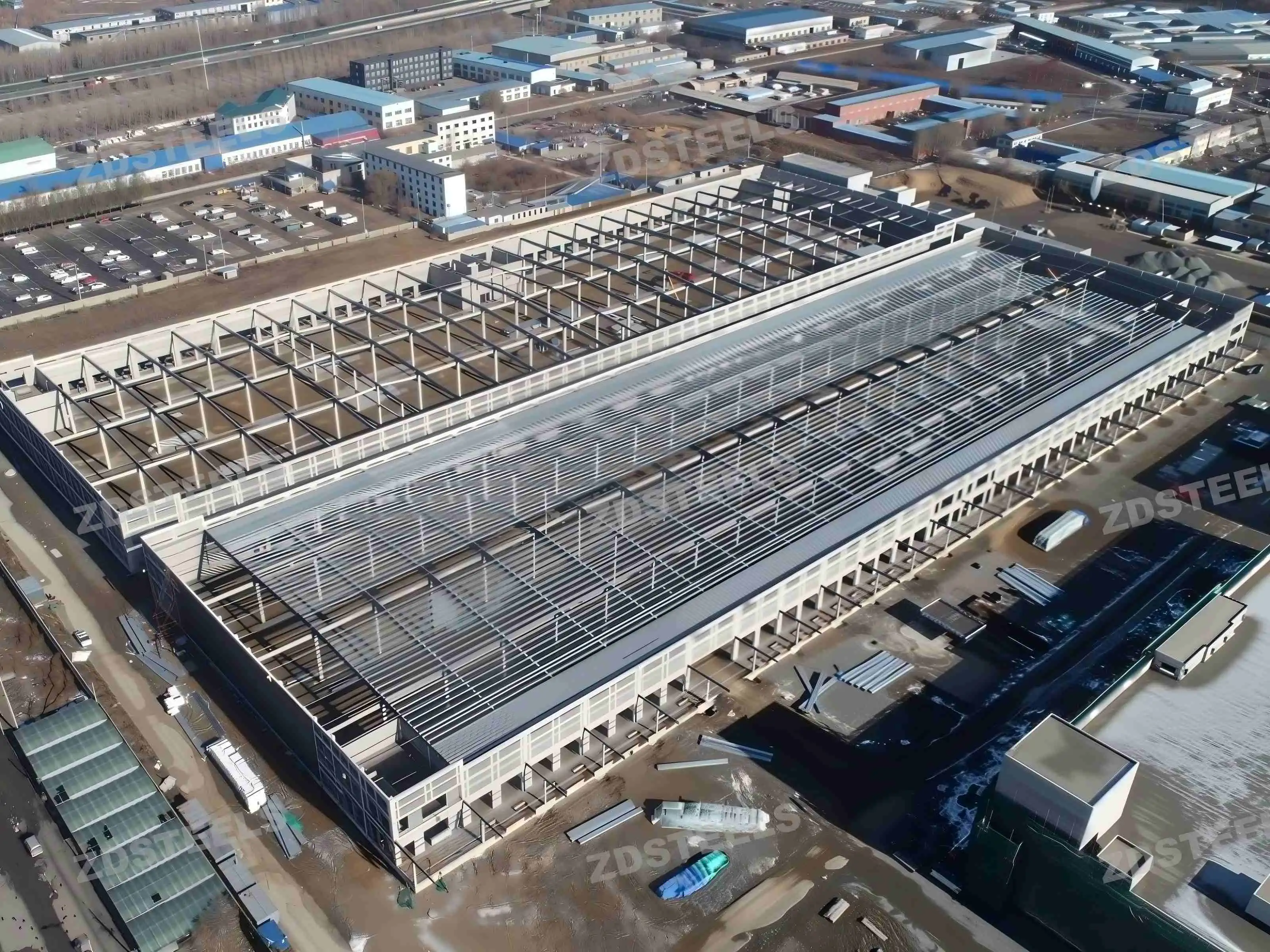
The shed roof steel beams made by Zhongda range in length from 10 to 40 feet, so they can be used for anything from small farrowing units to big grain houses. The standard pitch of 2/12 makes it easy for rainwater to drain while still leaving enough room inside for motorised air systems to work. Here are the main structural benefits that these trusses bring to Breeding Shed projects:
- High load-bearing capacity: Q235 and Q345 steel trusses resist deformation under heavy snow loads and rooftop equipment weight far more reliably than timber alternatives, maintaining structural integrity across decades of continuous operation.
- Superior corrosion resistance: Hot-dip galvanized finishes protect against the high-ammonia, high-humidity environment inside livestock facilities, extending service life well beyond 20 years without significant maintenance intervention.
- Column-free interior spans: The open structural form eliminates interior support columns, creating unobstructed floor space that simplifies equipment layout, manure management systems, and animal movement corridors.
- Rapid on-site assembly: Pre-engineered components with bolt-connection interfaces reduce skilled labor requirements on site, cutting construction schedules and overall project costs.
Better resistance to corrosion: Hot-dip galvanised finishes guard against the high-ammonia, high-humidity conditions inside livestock buildings, which means that the service life is extended well past 20 years without requiring a lot of upkeep.
Environmental Control Integration
Rapid on-site assembly: pre-engineered parts with bolt-connection interfaces cut down on the need for skilled labour on-site, which speeds up building and lowers the total cost of the project.
Comparing Prefab Breeding Sheds to Other Structures: Making the Right Choice
Insulated vs. Non-Insulated: A Cost-Benefit Perspective
Making the Right Choice: Prefab Breeding Sheds vs. Other Buildings
Not every farming system is good for every kind of breeding. In greenhouses, light transmission is more important than thermal mass. Standard warehouses don't have the safety features that are needed for animal output. Dedicated prefab breeding buildings fill the gap by mixing environmental systems made for farming with an industrial-grade frame.
Procurement Considerations: Buying and Customizing Prefab Breeding Sheds
Non-insulated prefab sheds have lower initial material costs, but they rely on automatic HVAC systems to control the temperature inside, which means they use more energy over the course of their useful life. On the other hand, insulated prefab breeding buildings use passive thermal performance to lower mechanical load, which will lower energy costs in a measurable way over the next 10 to 20 years. Most procurement teams that look at the total cost of ownership decide that the extra money spent on insulated construction is worth it within three to five years of operation [3].
Biosecurity and work performance are both improved by automatic door systems. Pathogens can't get in because of pressurised airlocks and UV sterilisation entry zones. This is a design feature that directly supports herd health programs and lowers veterinary costs.
Case Studies and Successful Applications
Price alone is not enough to choose a Breeding Shed provider. You also need to look at how well they can make the shed, if they have quality certifications, and how much they can customise it. Zhongda has a production facility in Shenyang that is 120,000 m² and can process 60,000 tonnes of steel every year. It is certified by ISO 9001:2015, ISO 14001, OHSAS 45001, and EN 1090. Before it is shipped, every shed roof steel truss goes through computer-aided design engineering, precise CNC cutting, assembly by a qualified welder, non-destructive testing to make sure the weld is strong, and galvanisation [4].
When purchasing prefab livestock buildings, procurement managers should ask for proof of the zinc coating weight (g/m² per ASTM A123), the fire-retardant ratings for the insulation materials (NFPA 701 compliant), and the structural wind load resistance specifications. This is especially important for facilities near the coast or in areas with a lot of wind. Zhongda's engineering team can fully customise the truss design, including the span, pitch, and connection method, to fit the load needs and operating plan of each site.
Conclusion
Prefab Breeding Sheds provide a practical solution for poultry and livestock producers who need scalable, durable, and efficient animal housing infrastructure. Compared with traditional construction methods, factory-manufactured steel structures offer more predictable quality, faster installation, flexible expansion options, and better compatibility with modern farming systems.
By combining hot-dip galvanized steel frames, engineered shed roof steel trusses, insulation systems, and environmental control solutions, a well-designed Breeding Shed can support stable farm operations while improving space utilization and long-term cost management. For large-scale poultry farms, pig farms, and livestock production facilities, modular construction makes it easier to adapt buildings to changing production requirements.
Choosing the right manufacturer is essential to achieving reliable performance. A professional Breeding Shed supplier should provide structural engineering support, customized design options, quality-controlled manufacturing, and solutions that meet local climate and operational requirements.
With advanced steel fabrication capabilities and extensive experience in agricultural building solutions, Zhongda helps global farming businesses develop durable prefab structures designed for modern livestock production needs.
FAQ
How long does it take to install a prefab Breeding Shed?
The installation time depends on the shed size, design complexity, site conditions, and project requirements. Since most components are prefabricated in the factory, a Modular Breeding Shed can generally be assembled faster than traditional site-built agricultural buildings. Early engineering planning and accurate component fabrication help reduce on-site construction delays.
Can prefab steel structures handle high-ammonia livestock environments?
Yes. Properly designed steel Breeding Sheds can perform well in high-humidity and high-ammonia agricultural environments when combined with corrosion-resistant treatments such as hot-dip galvanization. Galvanized steel components help protect the structure from corrosion caused by livestock waste gases and moisture, extending service life and reducing maintenance requirements.
What quality standards apply to prefab steel breeding buildings?
Quality standards depend on the region and project requirements. Procurement teams should evaluate factors such as steel material specifications, welding quality, corrosion protection methods, structural load calculations, and manufacturing certifications.
Working with a manufacturer that follows recognized quality management systems helps ensure consistent production and reliable building performance.
Partner with Zhongda — Your Trusted Breeding Shed Manufacturer
Selecting the right Breeding Shed supplier is an important decision for any poultry or livestock expansion project. Zhongda provides customized prefab steel building solutions designed around durability, efficiency, and operational requirements.
With professional engineering support, advanced steel fabrication capabilities, and strict quality control processes, Zhongda helps customers build reliable agricultural structures for different farming environments.
Whether you are planning a new poultry facility, expanding livestock capacity, or upgrading existing farm infrastructure, Zhongda can provide a customized Modular Breeding Shed solution tailored to your project.
Contact Zhongda today at Ava@zd-steels.com to discuss your Breeding Shed requirements and receive a professional project consultation.
References
1. USDA Agricultural Research Service. (2021). Controlled Environment Livestock Housing and Neonatal Mortality Outcomes. Retrieved from https://www.ars.usda.gov/research/publications/publication/?seqNo115=389754
2. National Institute of Food and Agriculture. (2022). Ventilation Standards for Poultry Production Facilities. Retrieved from https://www.nifa.usda.gov/grants/programs/animal-health
3. American Society of Agricultural and Biological Engineers. (2020). ASABE Standard EP270.5: Design of Ventilation Systems for Poultry and Livestock Structures. Retrieved from https://www.asabe.org/Publications-Standards/Standards-Development/Standards-List
4. American Institute of Steel Construction. (2022). Steel Construction Manual, 16th Edition. Retrieved from https://www.aisc.org/publications/steel-construction-manual-resources/
5. Midwest Poultry Federation. (2023). Annual Convention Proceedings: Prefabricated Housing Solutions in Commercial Broiler Production. Retrieved from https://www.midwestpoultry.com
6. Journal of Animal Science. (2021). Structural Environment Effects on Piglet Survival in Industrial Swine Gestation Facilities. Retrieved from https://academic.oup.com/jas
YOU MAY LIKE