
Steel Truss Girder Applications in Modern Infrastructure Projects
2026-09-17 13:00:01






When project engineers and procurement managers search for structural solutions that balance span capability with material efficiency, the steel truss girder consistently rises to the top. Composed of interconnected triangular members that act as a unified load-bearing system, this structural framework resists longitudinal bending and shear forces across spans where solid-web beams become prohibitively heavy. Across bridges, industrial warehouses, power facilities, and transit hubs, the steel truss girder has become a foundational component in modern infrastructure — and understanding its applications is essential for any serious B2B buyer.
Understanding Steel Truss Girders in Infrastructure
A Steel Truss Girder is more than just a beam; it's a well-planned frame. There are three sides to it, so forces don't build up in one web. Instead, they move through compression and tension parts. This cuts down on dead weight a lot while keeping the frame strong.
Key Geometric Configurations
An engineer can pick from four main types of trusses based on the load and span requirements:
- Warren Truss — Diagonal members alternate in direction, distributing loads evenly; ideal for medium to long-span bridges with uniform loading.
- Pratt Truss — Vertical members carry compression while diagonals handle tension; widely used in railway bridges due to its predictable behavior under heavy dynamic loads.
- Howe Truss — The reverse of Pratt; diagonals bear compression, making it suitable for shorter spans with higher vertical loads.
- K-Type Truss — Each panel contains a K-shaped configuration, providing enhanced stiffness for very long spans exceeding 150 meters.
A572 to Q355B or Q420 structural steel is often used to build these kinds of structures, as long as they follow the rules in AISC 360, Eurocode 3, or GB50017. Mechanical, electrical, and plumbing (MEP) systems can also run through the building because of its open-web design. The total height of the building goes down, and the cost of building it goes down too.
Core Applications Across Modern Infrastructure Sectors
You can see how adaptable the Steel Truss Girder is by seeing how many different fields use it.
Long-Span Bridges and Highway Infrastructure
For highway and railroad bridges, spans of more than 100 meters are common. Strong concrete girders cause too much dead weight in these places, so base costs rise, and substructures need to be bigger. Steel Truss Girders are the best way to solve this problem because they have a high strength-to-weight ratio, which means they can handle both steady traffic loads and dynamic wind forces. Zhongda has sent parts for Arctic-grade truss bridges to Russia for building projects, even though it gets very cold there (-60°C). With this proof, we can see that the goods can stand up to some of the harshest elements on Earth for buildings.
Commercial Buildings and Industrial Warehouses
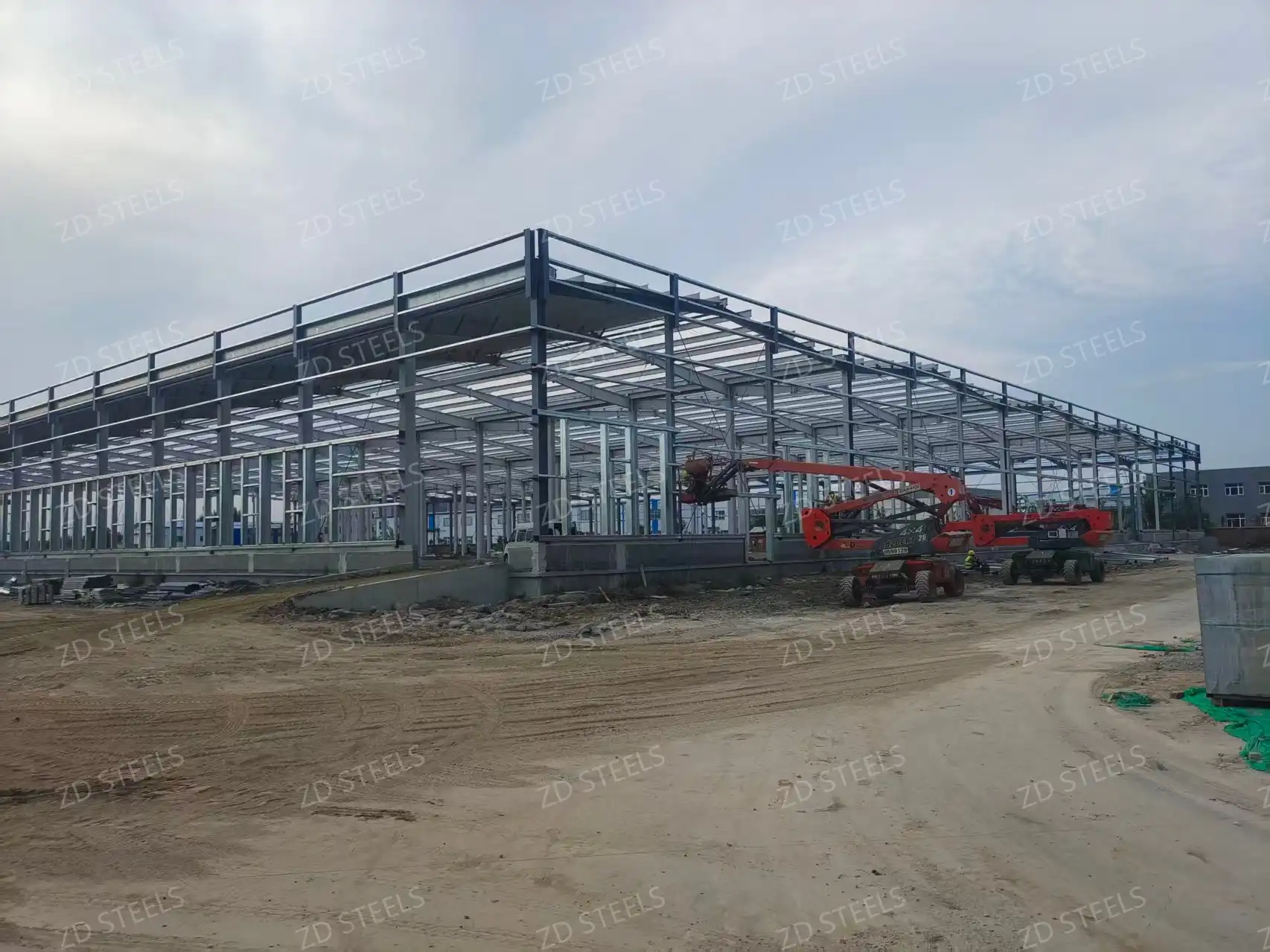
For warehouses, factories, and cold-chain distribution centers with large roofs, truss girder frameworks are an important part. This kind of building must not have any beams inside in order for high cranes, racks, and production line plans to fit. A Steel Truss Girder is necessary for overhead cranes because it gives the structure the rigidity needed to support heavy loads that are moving without letting the middle span move too much. Prefabricated truss modules are being asked for more and more by industrial park owners and EPC companies in the U.S. They want to speed up the building process and keep quality control going off-site.
Energy, Power, and Petrochemical Facilities
Power plants, substation platforms, and offshore oil and gas sites need structures that can stand up to harsh environments, shocks, and big changes in temperature. Because steel is flexible, truss construction naturally doesn't fall down during earthquakes. The structure also lasts longer in C5-M naval and industrial settings thanks to new anti-corrosion treatments, such as a duplex system that combines hot-dip galvanizing with high-build epoxy topcoats. A lot of material is saved by people who work on green energy sources by building support structures for wind turbines and big solar panels. They also use truss design to save material without lowering the load capacity.
Transit Systems and Aviation Infrastructure
It can be hard for architects and builders to work on the roofs of airport buildings, metro viaducts, and train bridges. The Steel Truss Girder holds up huge roofs in places like stadiums and airport hangars. It also creates internal spaces without columns that are both useful and attractive. Prefabrication in a controlled factory environment cuts down on work that needs to be done on-site, speeds up schedules, and makes measurements more accurate. All of these things are important for government engineering companies that are in charge of spending for the public sector.
Comparing Steel Truss Girders to Alternative Structural Systems
People rarely decide what to buy on their own. Hot-rolled solid beams, concrete alternatives, and wooden frames are some of the other choices that project teams always look at when deciding what to use for their projects.
Concrete girders are less expensive to make in some places, but they are heavy and hard to move and work with. Steel that has been formed is cheaper and easier to move than concrete for spans longer than 60 meters. Wooden trusses can work in light-duty home or business settings with low loads, but they can't compare to the strength or durability of structural steel in heavy-duty industry or infrastructure settings.
Steel truss modules that are made ahead of time are much more consistent in quality than parts that are built on-site. Shop welding makes it possible to meet stricter size standards than field assembly. This lowers the chance of fitting issues and the number of things that need to be fixed before the project is finished. With pre-made structural steel parts instead of cast-in-place choices, the American Institute of Steel Building (AISC) says that building time on-site can be cut by up to 30%.
Procurement Considerations for B2B Buyers
Not only are the prices in a brochure not enough to choose a Steel Truss Girder provider. The hiring process looks at things like certifications, the ability to make things, quality control methods, and past work on projects of the same size.
When people in charge of buying things are looking for providers, they should pay attention to these things:
Certifications and standards: Look for ISO 9001, ISO 14001, OHSAS 45001, and EN 1090 certifications. These show that the company is good at managing quality and building structures.
- Certifications and standards compliance — Verify ISO 9001, ISO 14001, OHSAS 45001, and EN 1090 certifications, which confirm both quality management and structural fabrication competence.
- Material traceability — Suppliers should provide Mill Test Certificates (MTCs) with confirmed heat numbers, verifying that steel chemistry and yield strength match design specifications.
- Non-Destructive Testing (NDT) capability — Critical node welds require Ultrasonic Testing (UT) and Magnetic Particle Inspection (MPI) to detect subsurface defects before components leave the factory.
- BIM integration — Suppliers offering BIM-driven prefabrication reduce coordination errors between design and fabrication, particularly on complex multi-trade projects.
- Coating inspection — Dry Film Thickness (DFT) measurements and galvanizing thickness per ISO 1461 must be documented and submitted as part of the quality dossier.
We need Ultrasonic Testing (UT) and Magnetic Particle Inspection (MPI) for critical node welds to find flaws below the surface before the parts leave the plant. This is called "Non-Destructive Testing" (NDT).
Maintenance, Durability, and Long-Term Performance
A well-built Steel Truss Girder should last more than 50 years if it is taken care of properly. Your links, how well they resist rust, and how often you check the structure for damage all play a role in how long something lasts.
High-strength friction-grip bolting at field splices and modern shop welding work together to make connections that will hold up over time when loads are changed. To control fatigue, you need to make sure that the shapes of nodes are adjusted to lower stress concentrations and that AWS D1.5 bridge welding rules are followed when there are moving loads. Expansion joints and rocker bearings at support points handle thermal expansion. This keeps secondary stress from building up when the weather changes with the seasons.
It's important to do regular checks on infrastructure that include seeing how the coating is looking, measuring how thick the coating is, and checking the load every so often. This is because people's use of infrastructure changes over time. When conditions for service get tougher, it is still possible to strengthen the node after installation through member plating or external post-tensioning, as long as structural analysis is used to confirm the node's capacity again.
Conclusion
Steel Truss Girders are an important part of modern infrastructure because they save the most space, are the most flexible, and last the longest in buildings like factories, energy plants, transportation systems, and bridges. For B2B buying teams, for a project to go well, they need to carefully vet sellers, make sure items can be traced back to where they came from, and know exactly what the design and service needs are. Whichever fabricator you choose—one with approved methods, proven capacity, and proven global experience—is what makes the difference between a successful project and a failed one.
FAQ
What factors most influence the cost of a steel truss girder?
The price per unit depends on how long it is, what kind of steel is used, how hard the geometry is, what kind of link is used, and how the anti-corrosion system is designed. Higher-grade steels like Q420 and longer spans that need K-type setups make it take longer to make and use more materials.
How does prefabrication improve project timelines?
Bad weather delays are no longer a problem with factory-controlled fabrication. Welds are also more consistent, and parallel scheduling is possible. This means that the foundation can be poured while the trusses are being made, which cuts down on the overall schedule.
Can truss girders be customized for unusual project geometries?
Yes. Modern builders use BIM models to deal with lines that aren't straight, depth patterns that change, and different loads on each side.
What anti-corrosion system suits coastal or marine environments?
A two-part system is required for settings with a C5-M rating. It includes hot-dip galvanizing according to ISO 1461 and a polyurethane or epoxy finish. This shields you even more from salty air.
Can an existing truss girder be strengthened after installation?
Some structural improvements, like member armor or outer post-tensioning, can make the building stronger, but the node's capacity needs to be checked again by a professional structural engineer before any work is done.
Partner with Zhongda for Certified Steel Truss Girder Solutions
ISO, EN 1090, and OHSAS certifications are on every package from Zhongda Steel. This shows that the company is a reliable name in the Steel Truss Girder business. Our engineering team is ready to help you with your purchase from the time you specify the details until the goods are delivered. This is true whether you need weatherproof steel that can handle the cold Arctic conditions or precise BIM-prefabricated modules. To get technical help or a price quote for your project right away, go to zd-steels.com or email us at Ava@zd-steels.com.
References
1. American Institute of Steel Construction (AISC). Steel Construction Manual, 16th Edition. AISC, 2023.
2. Galambos, T. V., & Surovek, A. E. Structural Stability of Steel: Concepts and Applications for Structural Engineers. Wiley, 2008.
3. Gorenc, B., Tinyou, R., & Syam, A. Steel Designers' Handbook, 8th Edition. UNSW Press, 2012.
4. Owens, G. W., & Knowles, P. R. (Eds.). Steel Designers' Manual, 7th Edition. Wiley-Blackwell, 2012.
5. Troitsky, M. S. Tubular Steel Structures: Theory and Design. James F. Lincoln Arc Welding Foundation, 1990.
6. Chen, W. F., & Duan, L. (Eds.). Bridge Engineering Handbook: Superstructure Design, 2nd Edition. CRC Press, 2014.
YOU MAY LIKE