
18 m Round-Tube Truss HJ-1: φ478 Chords, φ219 Webs, Q235B
2026-11-14 14:50:27






18 m Round-Tube Truss HJ-1: φ478 Chords, φ219 Webs, Q235B
English Version
Title: 18 m Round-Tube Truss: φ478×10 Chords, φ219×7 Webs, Q235B Spiral Tube
Overview
A round-tube truss carries long spans without a heavy solid beam. Chords take the tension and compression; the webs split the load into short, predictable diagonal members. Because every member is a tube, the section looks clean and weighs less than a plate girder over the same 18 m.
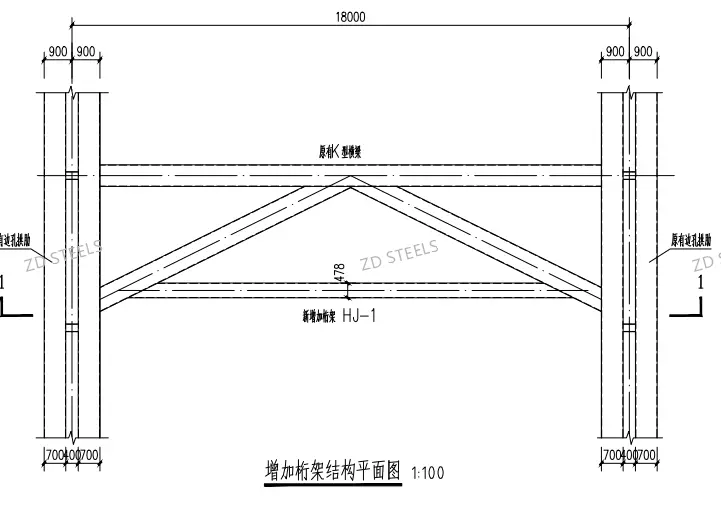
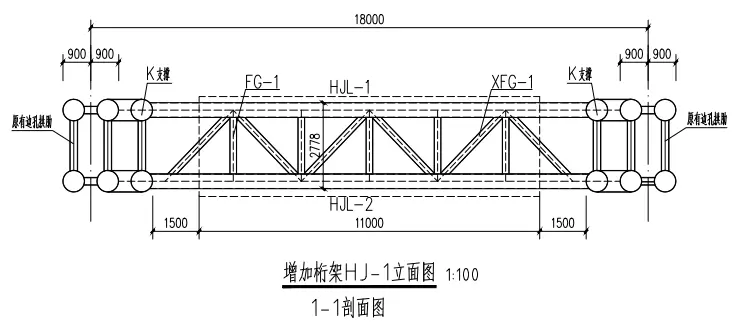
This member is HJ-1, added to an existing frame. The drawing set covers the plan, the elevation, and section 1-1: a 18,000 mm span, 2,778 mm deep, with φ478×10 chords and φ219×7 webs in Q235B spiral-welded tube.
Geometry (from Drawing)
表格
| Item | Value |
|---|---|
| Truss mark | HJ-1 |
| Span | 18,000 mm |
| Truss depth | 2,778 mm |
| Middle panel zone | 11,000 mm |
| End segments | 1,500 mm each side |
| Connection | Existing side-hole haunch at both ends |
| Existing member above | Original K-type cross beam |
| Drawing scale | 1:100 — plan, elevation, 1-1 section |
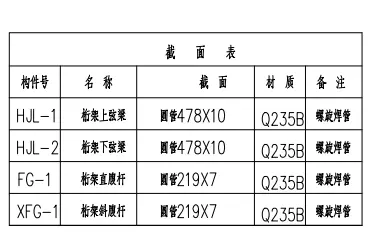
Section Table (from Drawing)
| Mark | Name | Section | Grade | Remarks | kg/m* |
|---|---|---|---|---|---|
| HJL-1 | Top chord | Round tube φ478×10 | Q235B | Spiral-welded tube | 115.4 |
| HJL-2 | Bottom chord | Round tube φ478×10 | Q235B | Spiral-welded tube | 115.4 |
| FG-1 | Vertical web | Round tube φ219×7 | Q235B | Spiral-welded tube | 36.6 |
| XFG-1 | Diagonal web | Round tube φ219×7 | Q235B | Spiral-welded tube | 36.6 |
*kg/m calculated from the tube dimensions at 7,850 kg/m³; the drawing lists sections only.
How the Truss Works
- Chords carry the span. HJL-1 and HJL-2 are the two φ478×10 tubes running the full 18 m. One works in compression, the other in tension; the moment between them sets the 2,778 mm depth.
- Webs split the load. FG-1 verticals and XFG-1 diagonals, both φ219×7, transfer panel loads to the chords. Diagonals carry shear; verticals hold the panel spacing.
- Tube nodes are welded. Tubes meet at welded gusset or directly at the chord; round sections reduce the node surface and wind drag.
- Added to an existing frame. Both ends tie into the existing side-hole haunch; the truss replaces or supplements the original K-type beam above.
Advantages
- Light for an 18 m span — tube chords and webs use steel where the force is; a solid beam at this span would weigh far more.
- Open section — no enclosed box to inspect inside; every member is visible and paintable.
- Round tubes resist wind — circular sections have low drag, which matters for exposed roof and outdoor trusses.
- Standard spiral tube — φ478×10 and φ219×7 are produced in volume; availability and pricing are predictable.
- Bolted or welded end connections — the end zone can be bolted to the existing frame, so the retrofit does not require shutting the building down.
Disadvantages / Limitations
- Node welding is skilled work — round tubes cut to angle and welded to a chord or gusset need qualified welders and fit-up jigs.
- Hollow tubes need sealing — water and condensation collect inside an open tube; venting and end caps are required.
- Flexible against a solid girder — a truss deflects more than a plate girder of the same weight; deflection and vibration control matter for live load.
- Web members carry slenderness limits — φ219×7 diagonals must be checked as tension/compression members; long diagonals buckle if over-compressed.
- Retrofit load path — an added truss must transfer forces into the existing haunch; the old structure has to be checked for the new load.
Typical Use Cases
- Existing-frame reinforcement — adding HJ-1-type trusses to strengthen an old roof or platform, as in this drawing.
- Long-span roof trusses — sheds, warehouses, and canopies over 15–20 m.
- Platform and gallery spans — walkways, equipment platforms, and pipe racks needing an open truss underneath.
- Exposed outdoor structures — where wind drag and appearance both count.
- Bridge and trestle spans — light steel truss between supports.
Fabrication and Erection Notes
- Tube: Q235B spiral-welded; check mill certificate and roundness before cutting.
- Chords: mark panel points from the 11,000 mm middle zone and the two 1,500 mm end segments.
- Node: cut web tubes to the true angle; check fit-up before welding; weld all around at each node.
- Ends: connect to the existing haunch; verify the old column and beam take the new truss reaction before loading.
- Internal protection: seal tube ends, provide vent holes; coat the exterior after fabrication.
- Erection: lift the truss as one piece where weight allows, or erect chords and webs in sequence; brace the truss before releasing the crane.
Bottom Line
An 18 m round-tube truss on Q235B: two φ478×10 chords, φ219×7 verticals and diagonals, 2,778 mm deep, added to an existing frame. It covers the span with a fraction of a solid beam's weight. Get the node fit-up, the tube sealing, and the old-frame load check right, and the truss will carry what it was designed for.
**WhatsApp**: +86‑13889862778, +86‑18242444407
**Email**: eddie@zdsteels.com, wells@zdsteels.com
YOU MAY LIKE