
8 Tapered Welded Girders, 4,644 kg: S275 Plate, 250 mm Flange
2026-11-15 18:58:12






8 Tapered Welded Girders, 4,644 kg: S275 Plate, 250 mm Flange
English Version
Title: 8 Tapered Plate Girders RF2: S275, PL20×250 Flange, PL8×760 Web, 4,643.54 kg Total
Overview
A tapered welded plate girder is cut from flat plates: two flanges, one tapered web, stiffeners between the panels. The section deepens where the moment is high and narrows at the ends, so the steel follows the load instead of sitting in a constant-size beam.
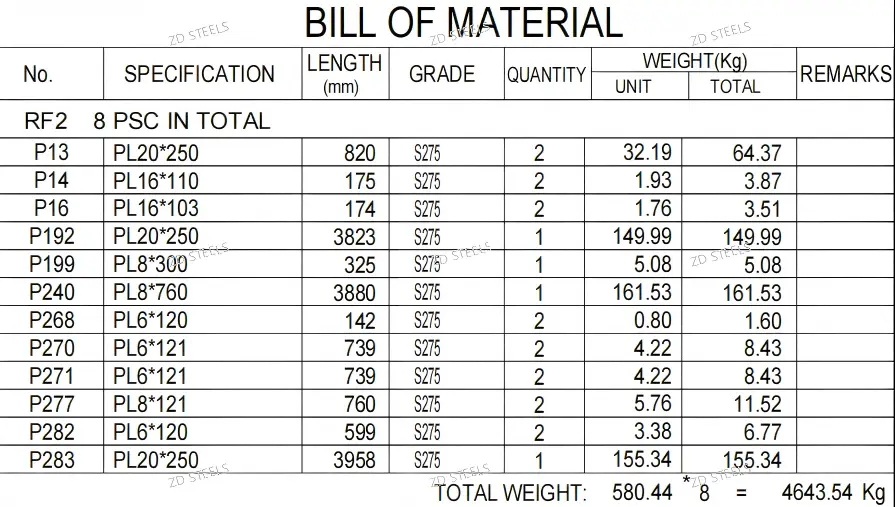
This RF2 girder is an export-style Eurocode member: every plate in S275, an English bill of material, sections D-D / E-E / F-F at 1:10. Eight pieces were fabricated; each weighs 580.44 kg and the set totals 4,643.54 kg.
Main Geometry (from Drawing)
| Item | Value |
|---|---|
| Mark | RF2 |
| Quantity | 8 pieces |
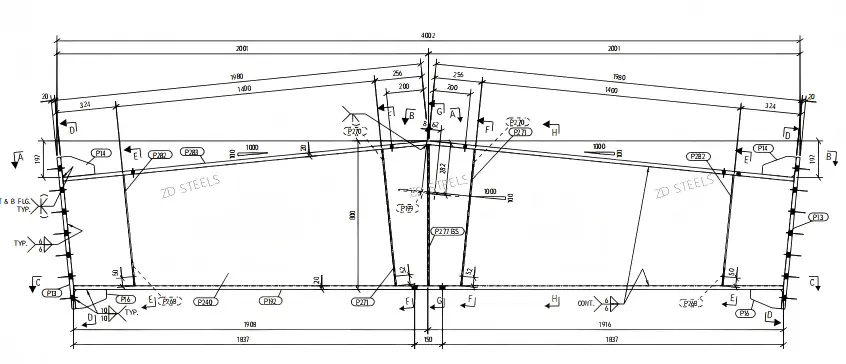
| Overall length | 4,002 mm (two halves, 2,001 mm each) |
| Bottom chord dimensions | 1,837 + 150 + 1,837 mm |
| Maximum web depth | 760 mm |
| End depth | 197 mm (end plate zone) |
| Section views | D-D, E-E, F-F, scale 1:10 |
Bill of Material (from Drawing, S275)
表格
| No. | Section | Length (mm) | Grade | Qty | Unit (kg) | Total (kg) |
|---|---|---|---|---|---|---|
| P13 | PL20×250 | 820 | S275 | 2 | 32.19 | 64.37 |
| P14 | PL16×110 | 175 | S275 | 2 | 1.93 | 3.87 |
| P16 | PL16×103 | 174 | S275 | 2 | 1.76 | 3.51 |
| P192 | PL20×250 | 3,823 | S275 | 1 | 149.99 | 149.99 |
| P199 | PL8×300 | 325 | S275 | 1 | 5.08 | 5.08 |
| P240 | PL8×760 | 3,880 | S275 | 1 | 161.53 | 161.53 |
| P268 | PL6×120 | 142 | S275 | 2 | 0.80 | 1.60 |
| P270 | PL6×121 | 739 | S275 | 2 | 4.22 | 8.43 |
| P271 | PL6×121 | 739 | S275 | 2 | 4.22 | 8.43 |
| P277 | PL8×121 | 760 | S275 | 2 | 5.76 | 11.52 |
| P282 | PL6×120 | 599 | S275 | 2 | 3.38 | 6.77 |
| P283 | PL20×250 | 3,958 | S275 | 1 | 155.34 | 155.34 |
| Per girder | 580.44 | |||||
| 8 girders | 4,643.54 |
Member Roles (from Sections)
| Part | Mark | Role |
|---|---|---|
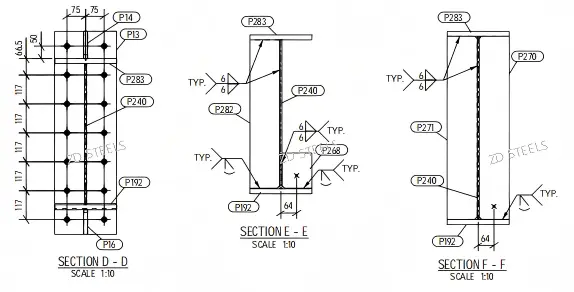
| Top flange | P283 PL20×250×3,958 | Upper chord, full length |
| Bottom flange | P192 PL20×250×3,823 | Lower chord |
| Web | P240 PL8×760×3,880 | Tapered web, 8 mm thick |
| End plate | P13 PL20×250×820 | Connection plate at each end |
| Stiffeners | P270 / P271 PL6×121×739, P282 PL6×120×599, P268 PL6×120×142, P277 PL8×121×760 | Panel stiffeners |
| Small plates | P14 PL16×110×175, P16 PL16×103×174, P199 PL8×300×325 | End and edge fittings |
Welds: 6 mm fillet typical along the web-to-flange seams; 10 mm fillet at the typical end; continuous weld where marked.
How the Tapered Girder Works
Flanges take bending. Two 20 mm × 250 mm flanges carry the top compression and bottom tension; the moment between them sets the required depth.
Web takes shear. The 8 mm web transfers panel shear between the flanges; its 760 mm maximum depth drops toward the ends where shear and moment are lower.
Stiffeners keep the web straight. PL6/PL8 verticals at panel points prevent web buckling and carry the concentrated connection forces.
S275, not a Chinese grade. S275 is the EN 10025 delivery grade; the BOM and weld marks read in Eurocode terms, which is the format expected for export steelwork.
Plate-built, not rolled. Every member is plate cut and welded; sections D-D, E-E, F-F show how the flanges, web, and stiffeners meet.
Advantages
Steel follows the moment — tapered depth cuts weight versus a constant-depth rolled beam; 580 kg for a 4 m girder.
Eurocode grade — S275 with an English BOM suits export projects and European tender documentation.
Flat plate procurement — 6, 8, 16, 20 mm plates are standard stock; no special rolled section is needed.
Connection-ready ends — P13 end plates at 820 mm length take bolted or welded site connections; stiffeners back the bolt group.
Repeatable set — 8 identical girders from one drawing; the BOM works out per piece and per set.
Disadvantages / Limitations
Welding-heavy — two flange seams, a web, and every stiffener are welded in the shop; distortion and camber need checking.
Plate-built cost — fabrication labor and inspection cost more per tonne than a standard rolled section.
Web stability governs — an 8 mm web over 760 mm depth needs stiffeners at the right spacing; a missing stiffener is a local buckling risk.
Tapered fit-up — the web is cut to a slope; each panel must match the flange angle, not a straight line.
Grade must match the spec — S275 needs the mill certificate to EN 10025; substituting a domestic grade without confirmation risks rejection on an export job.
Typical Use Cases
Export steelwork frames — beams detailed to Eurocode S275 with English BOM.
Portal-frame rafters — tapered members over short-to-moderate spans, as this 4 m unit.
Industrial platform and mezzanine girders — bolted end plates, plate stiffeners.
Road and rail secondary beams — where a shallow end and deeper mid-span suit the supports.
Replacement or retrofit members — plate-built girders matching an existing bolt pattern.
Fabrication and Erection Notes
Plate: S275 to EN 10025; verify mill certificate before cutting.
Cut: web P240 to the taper profile; mark panel points from the 2,001 mm halves on the 4,002 mm length.
Fit-up: set flanges and web on a jig; check the 64 mm weld access and the 250 mm flange width.
Weld: 6 mm fillet typical, 10 mm at end zones; balance the two flange seams to limit distortion; record weld procedure and inspect.
Stiffeners: PL6/PL8 plates at the panel points; both sides welded where marked.
End plates: drill or prep the P13 connection to the matching frame detail; check plumb and level before loading.
Bottom Line
Eight S275 plate girders, 580.44 kg each, 4,643.54 kg for the set. Two 20×250 flanges, an 8×760 tapered web, stiffeners per panel, and end plates ready for connection. The taper saves steel, the English BOM keeps it on a Eurocode job, and the plate-built detail comes down to weld control, fit-up accuracy, and a valid mill certificate.
**WhatsApp**: +86‑13889862778, +86‑18242444407
**Email**: eddie@zdsteels.com, wells@zdsteels.com
YOU MAY LIKE