
29.94 m Span, 37.9 m Wide: Multi-Cell Steel Box Girder
2026-11-11 20:18:15






29.94 m Span, 37.9 m Wide: Multi-Cell Steel Box Girder
English Version
Title: 29.94 m Span, 37.9 m Wide: Steel Box Girder That Crosses a Live Highway
Overview
A steel box girder is the go-to choice when a bridge has to cross something that cannot be closed — a motorway, a canal, a rail line. The girder is fabricated off site, lifted in a few nights, and the traffic below never stops for long.
This is the first span of such a bridge: 29.94 m, 37.9 m wide, multi-cell boxes under each half, 2.2 m deep at the supports and 2.0 m at mid-span.
Geometry (from Drawing)
| Item | Value |
|---|---|
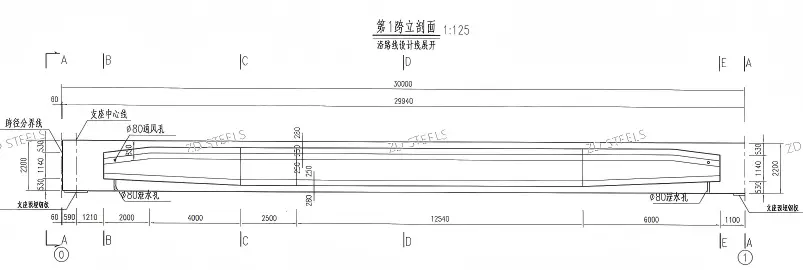
| Span | 29,940 mm |
| Drawn length | 30,000 mm (incl. 60 mm at each end) |
| Girder depth | 2,200 mm at supports / 2,000 mm at mid-span |
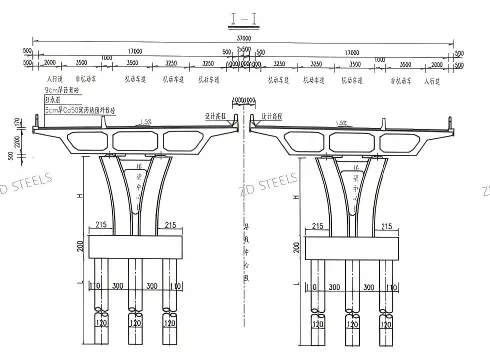
| Overall width | 37,900 mm |
| Half width | 17,000 mm each side |
| Cross fall | 1.5% |
| Vent holes | φ80 |
| Drainage holes | φ50 |
Deck Layout (from Drawing)
| Item | Value |
|---|---|
| Footway | 2,000 mm |
| Cycle lane | 3,500 mm |
| Motor lanes | 3,500 / 3,250 / 3,250 mm per half |
| Wearing course | 9 cm asphalt concrete |
| Waterproofing | membrane between asphalt and concrete |
| Leveling layer | 8 cm C50 concrete |
Box Section and Segments
表格
| Item | Value |
|---|---|
| Section | Multi-cell box, three cells per half plus cantilever |
| Webs | Inclined |
| Segment chain | 60 / 590 / 1,210 / 2,000 / 4,000 / 2,500 / 12,540 / 6,000 / 1,100 mm |
| Bearings | Bearing center lines marked at both ends, with bearing pads |
Substructure (from Drawing)
| Item | Value |
|---|---|
| Cap beam | 200 mm deep, 215 mm cantilever each side |
| Column | Tapered (vase-shaped) pier |
| Piles | D1.0 / D1.2, spaced 300 mm apart in the group |
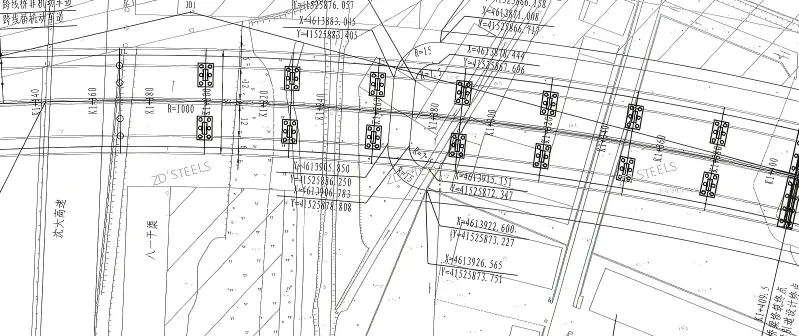
| Site | Bridge crosses the Shenyang–Dalian expressway and the Bayi canal |
Advantages
Erection without closing the road — segments are lifted at night; the expressway below stays open.
Light for its span — a 29.94 m steel box weighs a fraction of a concrete girder, so smaller cranes and lighter temporary works.
Multi-cell stiffness — three cells per half resist torsion and local buckling; the deck does not need a thick slab.
Shallow depth — 2.0–2.2 m for a 30 m span leaves room for clearance and approach grades.
Factory quality — welding and coating are done indoors, inspected before the girder leaves the shop.
Disadvantages / Limitations
Welding volume is huge — every cell, diaphragm, and stiffener is welded; distortion control is a full-time job.
Fatigue at details — box girders live with cyclic traffic load; weld details at diaphragms and stiffeners need careful design.
Coating maintenance — a box interior is hard to inspect and repaint; closed cells need dehumidification or sealed access.
Erection needs road closure windows — even night lifts need permits, cranes, and traffic management.
Cost — steel box girders are expensive per tonne and per square metre compared with a concrete deck.
Typical Use Cases
Expressway overpasses — crossing a live motorway, as in this drawing.
Canal and river crossings — spans where a concrete girder would need too much temporary support.
Urban viaducts — wide decks (37.9 m here) over traffic that cannot stop.
Rail and metro overpasses — short erection windows, high precision.
Bridge replacement — new steel span lifted into an existing alignment.
Fabrication and Erection Notes
Fabricate the box in cells: bottom plate, webs, diaphragms, top plate; check camber before closing the top.
Vent holes φ80 and drain holes φ50 per drawing; keep them clear and locate them at low points.
Coat the interior before closing; seal cells and record access points.
Leveling layer: 8 cm C50 over the steel deck, then waterproofing, then 9 cm asphalt — cure before paving.
Bearings: set pads on the bearing center lines at both ends; check the 2,200 mm end depth against the support.
Erection: night lifts with a road closure permit; check the cross fall (1.5%) before releasing the crane.
Bottom Line
29.94 m of span, 37.9 m of width, three cells per half, 2.0–2.2 m deep — this is a box girder built to cross a highway without stopping it. The steel does the work; the 8 cm C50 layer, the waterproofing, and the 9 cm asphalt keep the deck serviceable. Fabricate it straight, coat it inside, and lift it at night
**WhatsApp**: +86‑13889862778, +86‑18242444407
**Email**: eddie@zdsteels.com, wells@zdsteels.com
YOU MAY LIKE