
75 mm Six-Layer Steel Deck Surfacing: 40 mm SMA-13 + 35 mm RA-05, EBCL Waterproof Bond on Sa 2.5 Steel Plate
2026-11-17 19:07:12






75 mm Six-Layer Steel Deck Surfacing: 40 mm SMA-13 + 35 mm RA-05, EBCL Waterproof Bond on Sa 2.5 Steel Plate
English Version
Title: 75 mm Six-Layer Steel Box Deck Surfacing: SMA-13 40 mm, RA-05 35 mm, EBCL Epoxy Bond — Highway Class I, 2×17 m Clear Deck
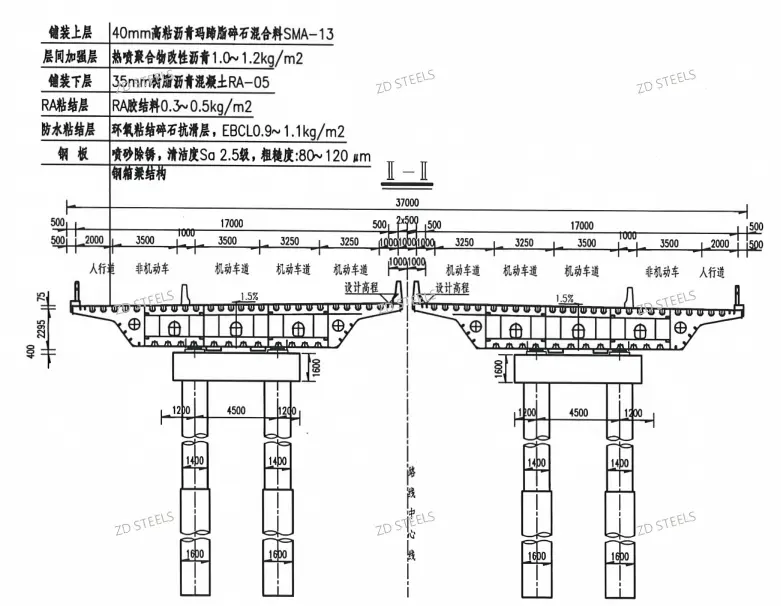
Data note: thicknesses and application rates below are read from the II-II detail and design notes. Units: layer thickness in mm; coat rates in kg/m². Steel plate grade, deck plate thickness and weld details are not listed on these screenshots.
Overview
This is the surfacing system on a steel box girder highway bridge. A blast-cleaned steel plate carries a six-layer build-up: epoxy waterproof bond, resin asphalt lower layer, polymer modified asphalt interlayer, and SMA wearing course. The bridge carries Highway Class I traffic on a 2×17 m clear deck; the 55 m third unit is a simply supported steel box girder, the other four units are prestressed concrete box girders.
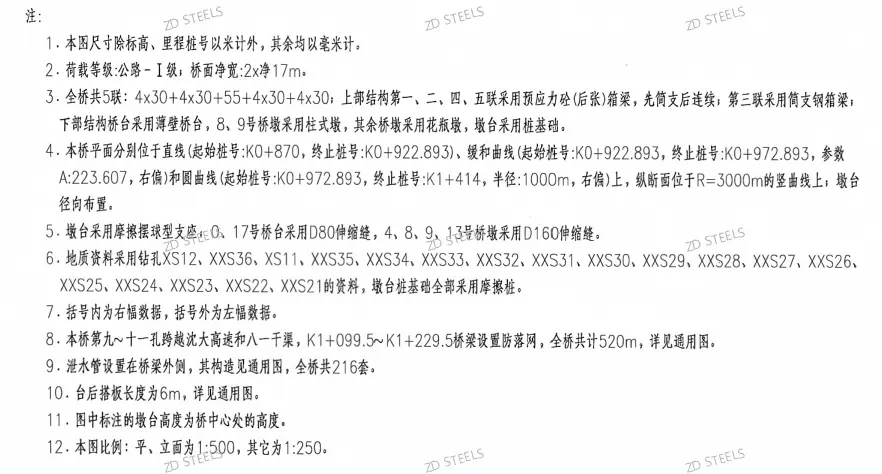
Bridge Context (from Design Notes)
| Item | Value |
|---|---|
| Load grade | Highway Class I (公路 -Ⅰ 级) |
| Clear deck width | 2 × 17 m; total width 37.0 m |
| Span layout, 5 units | 4×30 + 4×30 + 55 + 4×30 + 4×30 m |
| Steel box girder | Third unit, 55 m, simply supported |
| Other units | Post-tensioned prestressed concrete box, simply supported then continuous |
| Horizontal alignment | Straight K0+870–K0+922.893; transition A=223.607; circular curve R=1000 m, right |
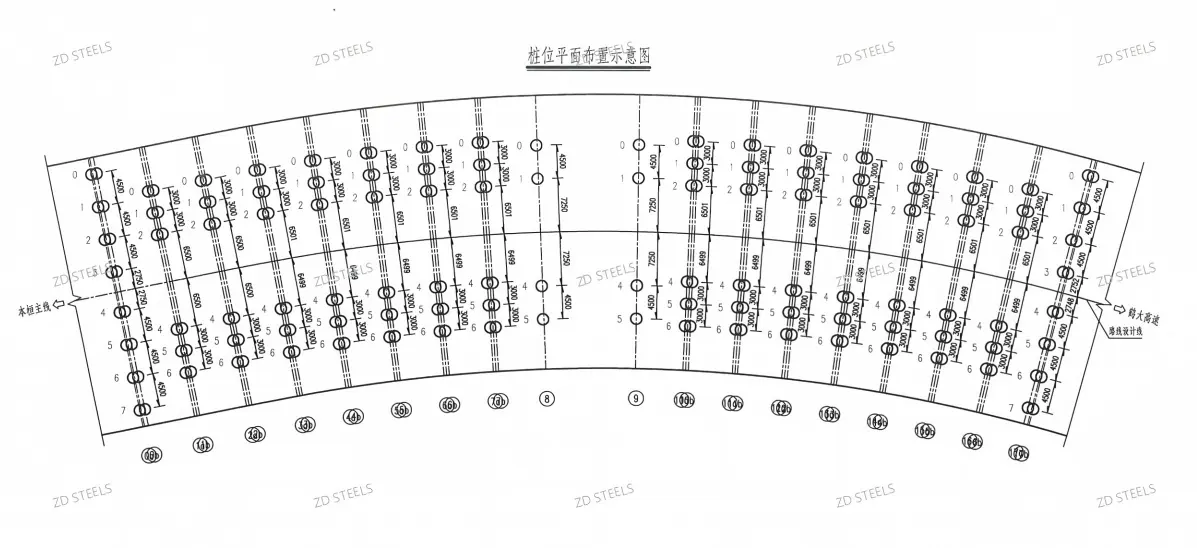
| Vertical alignment | Vertical curve R=3000 m; piers laid radially |
| Bearings | Friction pendulum spherical bearings |
| Expansion joints | D80 at abutments 0, 17; D160 at piers 4, 8, 9, 13 |
| Drainage | 216 drainage pipes on the outer side; 6 m approach slab |
| Fall-arrest net | 520 m over K1+099.5–K1+229.5 |
Surfacing Layer Stack (top to bottom)
| # | Layer | Material / specification | Thickness or rate |
|---|---|---|---|
| 1 | Upper wearing course | High-viscosity asphalt mastic crushed stone, SMA-13 | 40 mm |
| 2 | Interlayer bond | Hot-spray polymer modified asphalt | 1.0–1.2 kg/m² |
| 3 | Lower surfacing course | Resin asphalt concrete, RA-05 | 35 mm |
| 4 | RA binder layer | RA binder | 0.3–0.5 kg/m² |
| 5 | Waterproof bond layer | Epoxy bonded crushed-stone anti-slip layer, EBCL | 0.9–1.1 kg/m² |
| 6 | Steel plate surface | Blast cleaned, cleanliness Sa 2.5, roughness 80–120 μm | — |
| — | Base structure | Steel box girder | — |
Total paved thickness: 75 mm (40 mm SMA-13 + 35 mm RA-05). The three coats are applied by area rate, not fixed thickness.
How the System Works
- Steel plate anchor. Blast to Sa 2.5 with 80–120 μm roughness gives the epoxy a mechanical key; a smooth or rusty plate cannot hold the bond.
- EBCL waterproof bond. Epoxy binder with embedded crushed stone seals the steel and provides a rough shear-transfer surface between steel and the RA layer.
- RA binder ties the lower layer. RA binder bonds RA-05 to the EBCL and keeps the resin asphalt layer from sliding under traffic.
- RA-05 lower course. Resin asphalt concrete flexes with the orthotropic steel deck and acts as a second waterproof line.
- Polymer modified interlayer. Hot-spray PMB bonds RA-05 to the SMA wearing course and absorbs differential strain between the two mixes.
- SMA-13 wearing course. High-viscosity mastic stone resists rutting, skidding and wear under Highway Class I traffic.
Advantages
- Functions split by layer. Waterproofing, bonding, flex and wear are handled by separate layers; no single coat carries every job.
- Follows steel deck movement. RA resin asphalt is more flexible than ordinary asphalt, better suited to an orthotropic steel plate that deflects under load.
- Strong skid and rut resistance. SMA-13 high-viscosity stone matrix suits heavy truck traffic and slow curves.
- Epoxy shear bond. EBCL crushed-stone layer transfers horizontal shear and reduces the risk of surfacing delamination.
- Surface prep is specified. Sa 2.5 cleanliness and 80–120 μm roughness are measurable checks before coating.
Disadvantages / Limits
- Six layers, tight sequence. Each coat and course must follow the correct order; one missed cure window delays the whole deck.
- Material temperature and pot-life sensitive. Epoxy EBCL and resin asphalt mix depend on ambient temperature, moisture and epoxy working time.
- Coverage must be inspected. Rate per m² and full coverage matter; a thin or missed spot becomes a leak or debond point.
- Local repair is involved. Delaminated or cracked areas must be cut back to the plate and rebuilt layer by layer.
- Does not solve steel deck fatigue. Surfacing bonds and protects the top plate; orthotropic deck rib-to-plate fatigue still needs design and inspection on its own.
Typical Use Cases
- Steel box girder highway and expressway bridges with an orthotropic top plate.
- Heavy-truck deck crossings where rutting and skid resistance are controlled by design.
- Curved ramp and interchange bridges where the bond layer must resist horizontal shear.
- Steel decks requiring full waterproofing over exposed or navigable crossings.
- Urban elevated steel decks needing a quieter, skid-resistant wearing surface.
Construction Notes
- Prepare the plate: blast to Sa 2.5, hold 80–120 μm roughness, remove dust and contamination before coating.
- Apply EBCL at 0.9–1.1 kg/m² with the specified crushed stone; follow with RA binder at 0.3–0.5 kg/m².
- Place RA-05 at 35 mm; spray polymer modified asphalt interlayer at 1.0–1.2 kg/m²; place SMA-13 at 40 mm.
- Check air temperature, surface moisture and rain forecast before each coat; do not pave over a wet or dirty plate.
- Coordinate layer ends with expansion joints, drainage pipes and barrier embedments.
- Inspect bond and coverage between layers; record coat rates and surface roughness for the deck file.
Bottom Line
A 75 mm six-layer surfacing on a steel box deck: 40 mm SMA-13 wearing course, PMB interlayer, 35 mm RA-05, RA binder, EBCL epoxy waterproof bond, over Sa 2.5 blasted steel at 80–120 μm roughness. The system separates waterproofing, bond, flexibility and wear, and is sized for Highway Class I traffic on a 2×17 m deck. Layer thicknesses and rates come from the drawing; plate grade and structural details remain on the original bridge design.
**WhatsApp**: +86‑13889862778, +86‑18242444407
**Email**: eddie@zdsteels.com, wells@zdsteels.com
YOU MAY LIKE