
A Bolted End-Plate Beam Joint: 22 mm Plate, Two Bolt Columns
2026-11-10 13:30:38






A Bolted End-Plate Beam Joint: 22 mm Plate, Two Bolt Columns
Title: 22 mm End Plate, 350 mm Wide: The Beam Joint You Bolt On Site
Overview
Beam-to-column joints decide whether a steel frame goes up in three weeks or six. The two options are welding and bolting: welding needs a welder, a permit, and weather; bolting needs a spanner and a torque wrench.
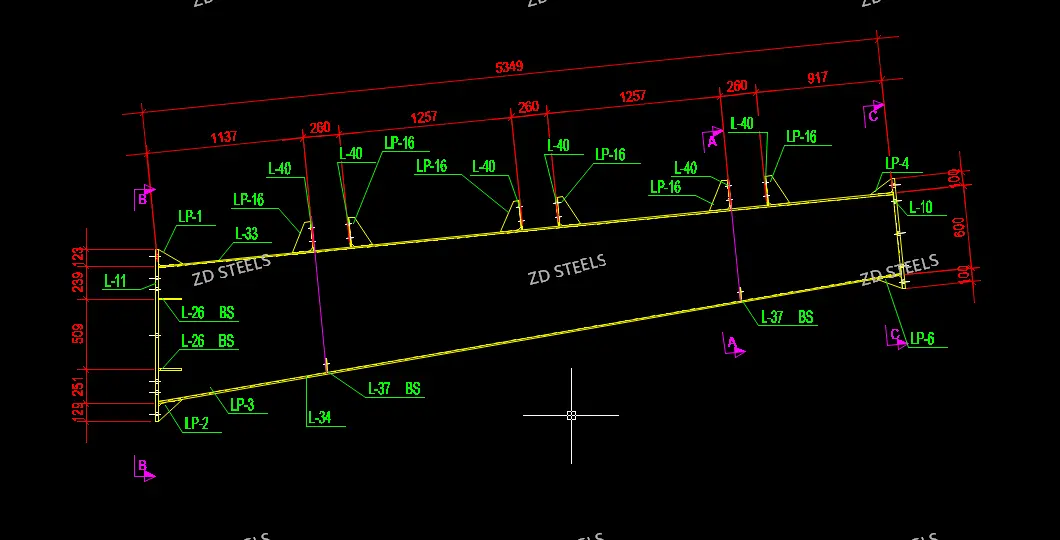
This project uses bolted end plates. The beam carries a thick plate on each end that bolts to the column, with stiffeners behind the plate to keep it from bending. The drawing gives the plate sizes, hole layout, and stiffener positions for both ends.
Beam Data (from Drawing)
| Item | Value |
|---|---|
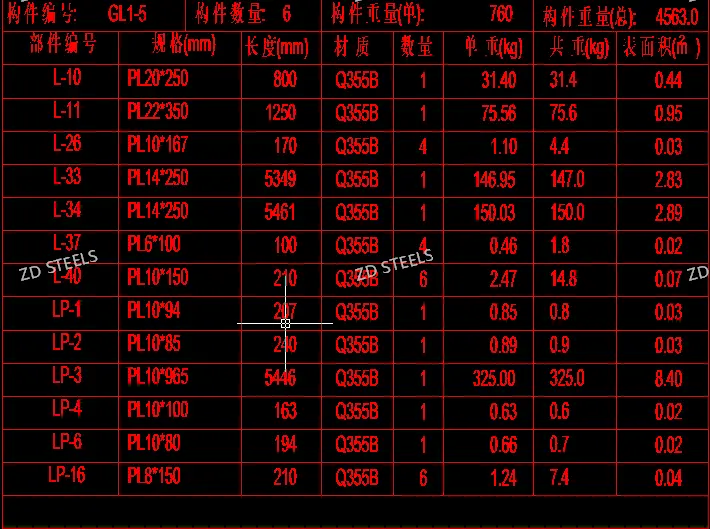
| Member | GL1-5, 6 pieces |
| Weight | 760 kg each, 4,563.0 kg total |
| Material | Q355B |
| Flanges | PL14×250, 5,349 / 5,461 mm long |
| Web | PL10×965, 5,446 mm long |
| Deep end depth | ~993 mm |
| Shallow end depth | 600 mm |
Joint Data — Deep End (B-B)
| Item | Value |
|---|---|
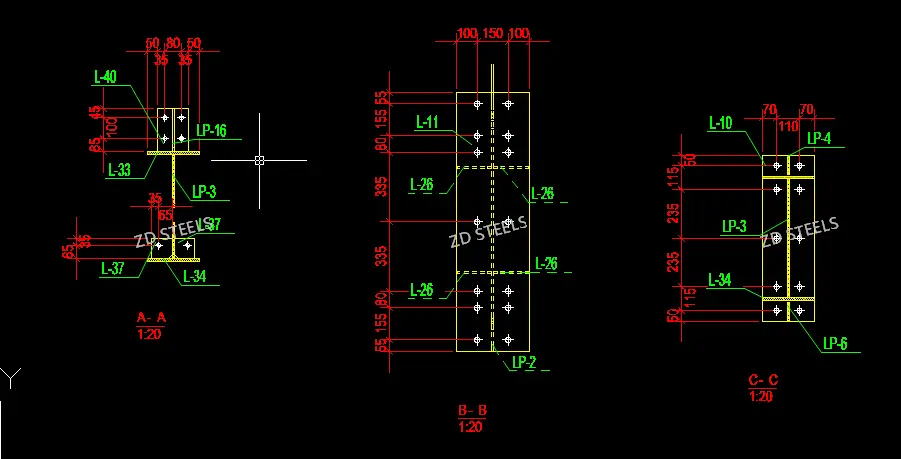
| End plate | L-11, PL22×350, 1,250 mm long |
| Plate thickness | 22 mm |
| Bolt columns | 2, at 100 / 150 / 100 mm across the 350 mm width |
| Vertical hole chain | 65 / 55 / 55 / 80 / 335 / 335 / 80 / 55 / 55 / 65 mm |
| Stiffeners behind plate | L-26 PL10×167, 4 pcs; LP-2 PL10×85 |
| Edge plates | L-37 PL6×100, 4 pcs |
Joint Data — Shallow End (C-C)
| Item | Value |
|---|---|
| End plate | L-10, PL20×250, 800 mm long |
| Plate thickness | 20 mm |
| Bolt columns | 2, at 70 / 110 / 70 mm across the 250 mm width |
| Vertical hole chain | 50 / 115 / 235 / 235 / 115 / 50 mm |
| Chain total | 594 mm — matches the 600 mm end depth |
| Edge plates | LP-4 PL10×100, LP-6 PL10×80, L-34 flange |
How the Joint Works
The plate is the joint. The 22 mm end plate is welded to the beam flanges and web; the bolts pass through it into the column's mating plate.
Stiffeners stop plate bending. A bare plate bends between bolt rows; L-26 PL10×167 stiffeners sit behind the plate at the hole lines and carry the load into the web.
Two bolt columns, even spacing. The 100/150/100 and 70/110/70 layouts put bolts symmetrically about the web, so the joint does not rotate under load.
Thickness follows depth. The deep end gets 22 mm; the shallow end gets 20 mm. Deeper section, bigger moment, thicker plate.
Rigid joint, no site weld. Bolted end plates behave close to a rigid connection when the plate and stiffeners are sized right.
Note: bolt grade and diameter are not called out on this sheet — they follow the connection design, not the fabrication drawing.
Advantages
No site welding — no welder, no hot work permit, no weather window; bolting goes on in rain or cold.
Fast erection — a beam end goes on with a spanner and a torque wrench; a 760 kg beam lands and is fixed in minutes.
Inspectable — torque checks and visual inspection after erection; weld quality behind a plate is invisible, bolt torque is not.
Fabrication-friendly — plates are cut and drilled in the shop; hole positions are set by a drill line, not by a welder's hand.
Replaceable — a damaged beam can be unbolted and swapped; a welded beam means cutting the joint out.
Disadvantages / Limitations
Plate thickness drives cost — 22 mm and 20 mm plates plus stiffeners are a lot of steel for two joints.
Hole alignment is unforgiving — mis-drilled holes mean re-drilling or field-fitting; there is no weld gap to absorb error.
Slip and fatigue — bolted joints can slip under vibration; fatigue design must account for the bolted detail.
Stiffener welding is hidden — L-26 plates sit behind the end plate; their welds cannot be inspected visually after assembly.
More parts to track — plates, stiffeners, bolts, and torque records; a welded joint is one operation.
Typical Use Cases
Portal-frame beam-to-column joints — the standard bolted joint for light-steel frames.
Tapered roof beams — deep-end and shallow-end plates sized to the section, as in this drawing.
Prefabricated and exported structures — flat-packed beams bolted on site, no welding crew needed.
Cold-climate and remote sites — bolting avoids preheat and wind protection for welding.
Buildings that may be relocated — unbolt, move, re-erect.
Fabrication and Erection Notes
Plate: L-11 PL22×350×1,250 and L-10 PL20×250×800; check flatness before welding.
Holes: drill per B-B (100/150/100) and C-C (70/110/70); drill the beam plate and column plate as a matched pair.
Stiffeners: L-26 PL10×167 ×4 behind the deep-end plate; weld both sides, and check weld access before assembly.
Weld: plate to flange and web, full penetration where the drawing requires; grind flush at the bolt lines.
Erection: set the beam, align holes with drift pins, bolt from the centre outward, torque in the specified sequence.
Records: keep hole positions, bolt batch, and torque values — the joint's quality lives in the paperwork.
Bottom Line
A 22 mm end plate with 2 bolt columns and 4 stiffeners is a joint you can build, ship, and bolt without a welder on site. The plate carries the moment, the stiffeners stop it bending, and the bolt pattern keeps it square. Get the hole alignment and the torque right, and the joint will do what the section was designed for.
**WhatsApp**: +86‑13889862778, +86‑18242444407
**Email**: eddie@zdsteels.com, wells@zdsteels.com
YOU MAY LIKE