
Back-to-Back Angle Beam (GL-1): Two L125×80×8, 388 kg
2026-11-09 22:57:54






Back-to-Back Angle Beam (GL-1): Two L125×80×8, 388 kg
English Version
Title: Back-to-Back Angle Beam: Two L125×80×8, 12.9 m Long, 388 kg
Overview
A back-to-back angle beam s a light-steel member made of two equal-leg angles welded back to back. Put together, the two angles form an I-like section with two webs; the gap between them takes stiffener plates. It is the standard light-steel beam for purlins, roof bracing, and secondary framing in portal-frame buildings.
This member, GL-1, is 12.88 m long and weighs 388.2 kg — two L125×80×8 angles with PL8 stiffener plates and end plates.

Material Data (from Drawing)
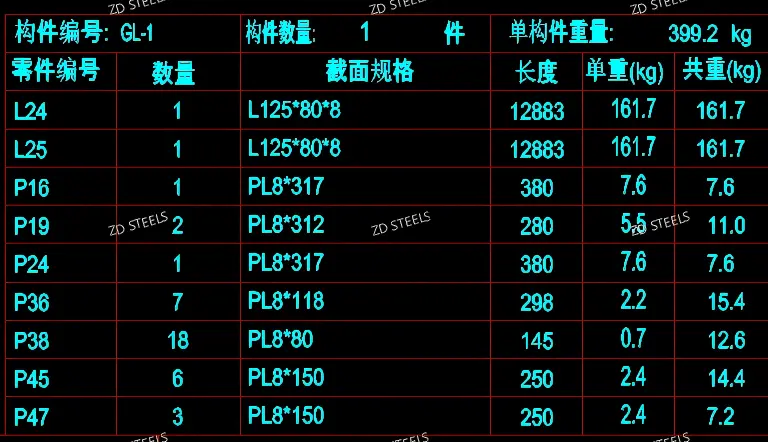
| Mark | Section | Qty | Length (mm) | Unit (kg) | Total (kg) |
|---|---|---|---|---|---|
| L24 | L125×80×8 | 1 | 12,883 | 161.7 | 161.7 |
| L25 | L125×80×8 | 1 | 12,883 | 161.7 | 161.7 |
| P16 | PL8×317 | 1 | 380 | 7.6 | 7.6 |
| P19 | PL8×312 | 2 | 280 | 5.5 | 11.0 |
| P24 | PL8×317 | 1 | 380 | 7.6 | 7.6 |
| P36 | PL8×118 | 7 | 298 | 2.2 | 15.4 |
| P38 | PL8×80 | 18 | 145 | 0.7 | 12.6 |
| P45 | PL8×150 | 6 | 250 | 2.4 | 14.4 |
| P47 | PL8×150 | 3 | 250 | 2.4 | 7.2 |
| GL-1 total | 1 pc | 388.2 |
Drawing shows member length segments 2,021 / 3,004 / 3,003 / 3,004 / 1,200 mm and a member depth of 400 mm.
Construction Details (from Drawing)
表格
| Item | Value |
|---|---|
| Angle legs | L125×80×8, two, back to back |
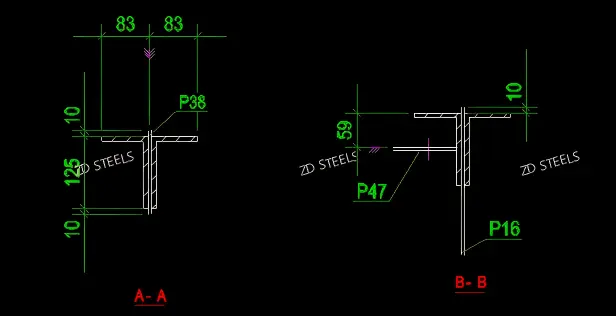
| Back spacing | 83 + 83 = 166 mm (per A-A section) |
| Cover plates | 10 mm thick, top and bottom (P38 zone) |
| Web connector | P47 PL8×150 at 58 mm from the flange |
| End plates | P16 / P24, PL8×317 |
| Stiffener plates | P36 PL8×118, P38 PL8×80 |
How the Section Works
- Two angles = two webs: back-to-back angles give a section with two webs and four flanges — better torsional stiffness than a single angle.
- Stiffener plates between webs: PL8 plates at intervals keep the two angles from separating and act as web stiffeners.
- Cover plates top and bottom: 10 mm plates close the top and bottom, adding bending capacity at the ends and at load points.
- End plates: PL8×317 plates at the member ends for bolted connections to the frame.
- Long slender member: 12.9 m at 388 kg is about 30 kg/m — light enough for two men to handle, stiff enough for roof bracing.
Advantages
- Cheap section — two standard angles and offcut plates; no rolled H-section needed.
- Light and strong in torsion — the twin-web box-like form resists twisting better than a single angle or a channel.
- Easy to fabricate — cut angles to length, weld plates on a jig, no complex fit-up.
- Easy to handle — 388 kg for 12.9 m means a small crane or a few workers can move it.
- Works with standard connections — end plates take ordinary bolts; no special castings.
Disadvantages / Limitations
- Welding distortion — two angles welded back to back pull during cooling; straightness needs checking and correction.
- Corrosion in the gap — the space between the angles traps water and dirt; coating and drainage details matter.
- Lower capacity than a rolled section — for the same depth, a hot-rolled H has more area and better local buckling behavior.
- Fatigue at stiffener welds — repeated load cycles can start cracks at the PL8 stiffener welds.
- Manual labor heavy — many small plates (18 + 7 + 6 + 3) mean hours of cutting and welding.
Typical Use Cases
- Portal-frame purlins and bracing — light-steel roof and wall members, 12–13 m spans (this member).
- Roof truss chords — back-to-back angles as light truss members in industrial sheds.
- Canopy and awning beams — long slender beams where weight matters.
- Temporary and site structures — beams that can be fabricated from stock angles on short notice.
- Secondary framing — girts, ties, and struts in light-steel buildings.
Fabrication Notes
- Angles: L125×80×8, two lengths of 12,883 mm — check straightness before fit-up.
- Back-to-back assembly: hold the 83 + 83 mm spacing with a jig; tack, then weld with a balanced sequence to limit distortion.
- Stiffeners: P36 PL8×118 and P38 PL8×80 at the drawing intervals; weld both sides.
- Cover plates: 10 mm top and bottom; weld at the ends and at load points, not continuously.
- End plates: P16 / P24 PL8×317; drill to match the frame bolt pattern.
- Coating: blast and prime before assembly where possible; seal the gap between angles against water entry.
Bottom Line
A back-to-back angle beam is the light-steel answer to a long, cheap, torsion-resistant member: two L125×80×8 angles, PL8 stiffeners, 10 mm cover plates, 388 kg for 12.9 m. It is fabricated from stock, handled by two men, and bolted like any other member. Watch the weld distortion and the gap corrosion, and this section will do the work of a heavier rolled beam at half the cost.
**WhatsApp**: +86‑13889862778, +86‑18242444407
**Email**: eddie@zdsteels.com, wells@zdsteels.com
YOU MAY LIKE