
Airport Steel Structure for Large-Span Aircraft Maintenance Hangars
2026-09-08 13:00:00






When aviation projects demand clear-span interiors exceeding 100 meters, an Airport Steel Structure becomes the only engineering answer that truly delivers. Large-span aircraft maintenance hangars require column-free floor areas wide enough to accommodate wide-body aircraft like the Boeing 777 or Airbus A380, overhead crane systems, and complex mechanical, electrical, and plumbing (MEP) routing—all simultaneously. At Zhongda, we engineer these structural frameworks using high-strength steel grades, BIM-driven prefabrication, and precision fabrication tolerances of ±0.2mm, ensuring every hangar we deliver meets the operational demands of modern aviation.
Understanding Airport Steel Structures for Large-Span Hangars
Hangars for aircraft maintenance represent one of the most difficult types of buildings to design and build. Heavy roofs and fixed cranes put dead loads on the structural framework. Maintenance platforms and staff put live loads on it. It also has to handle natural loads like wind, snow, and earthquakes, which are very different across different U.S. airport locations.
Key Structural Systems Used in Hangar Design
There are three main types of structural systems used to build large hangars, and each one is best for a different span size and set of operating conditions:
- Space frame systems spread loads out across a latticed grid in three dimensions, making them ideal for lengths longer than 80 meters. To get the best structural depth and headroom space for tail-height needs, grid measurements and rise height are figured out. Their flexible design also speeds up both prefabrication and assembly on-site by a large amount.
- Long-span truss systems use carefully placed web members and node configurations to move roof loads to perimeter columns in an efficient way. At Zhongda, we use Q355B or Q420 grade steel for the main truss members because it has yield strengths above 355 MPa and great impact toughness at low temperatures, which is very important for airports in the northern U.S.
- Rigid portal frame systems work well for medium-span hangars when cost and speed of construction are important. During planning, beam height-to-span ratios are tweaked to use the least amount of steel without affecting the structure's performance.
Advanced software tools like BIM modeling and finite element analysis (FEA) allow our engineers to simulate load combinations across all three systems before a single component of the Airport Steel Structure leaves the factory, ensuring that the work is precise and meets AISC 360 and ASCE 7 standards. This advanced engineering approach helps optimize the structural performance, safety, and reliability of every Airport Steel Structure, allowing potential design issues to be identified and resolved before fabrication begins. By applying detailed digital simulations throughout the planning process, Zhongda can ensure that each Airport Steel Structure is engineered to withstand complex loads and demanding operating conditions.
Comparing Steel Structures with Traditional Alternatives in Airport Hangars
Concrete has been used in aviation infrastructure for a long time, but large-span hangar construction has decisively shifted toward structural steel. This is because of both scientific and financial reasons.
Why Steel Outperforms Concrete for Hangar Spans
Concrete has a hard time making column-free spans longer than 30–40 meters without using post-tensioning systems that are too heavy to handle. Steel, on the other hand, can usually span 100 to 200 meters with a lot less weight. This edge in weight lowers foundation loads, speeds up building, and lowers costs over the product's lifetime. A steel hangar frame can be put up in weeks instead of months like cast-in-place concrete does, minimizing airport operational disruption.
Steel can also be bent in ways that concrete cannot match. A steel hangar can be expanded or strengthened physically with bolted improvements without having to be torn down when an airline gets bigger planes. Because it is flexible, the initial investment in cash is protected over many years of use.
When it comes to ecology, structural steel can be recycled over and over again. According to the American Iron and Steel Institute, steel is the most recycled material in North America. On average, over 90% of structural sections are made from recycled steel. With energy-efficient insulated panel covering systems, a well-designed steel hangar can meet LEED certification standards, which are becoming more and more important in how airport authorities buy things.
Construction Process and Quality Control for Airport Steel Hangars
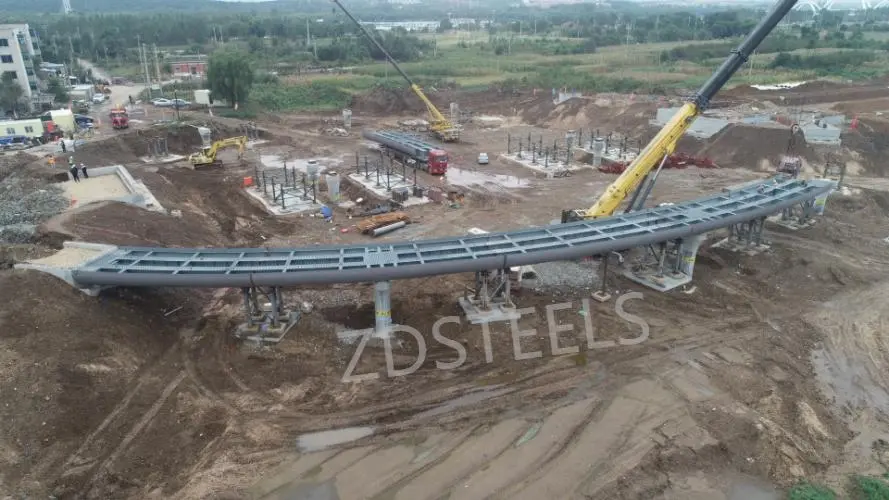
During the whole building process of a large-span hangar, the design, fabrication, and assembly teams must work together very closely to ensure the successful delivery of an Airport Steel Structure. Zhongda starts the process with a thorough meeting to find out the specific needs of the project, such as the types of airplanes, the capacity of the crane, the sizes of the door openings, and the wind zone classification of the site. These requirements provide an essential foundation for designing an efficient and reliable Airport Steel Structure that can meet both operational and environmental demands. Throughout the planning and construction stages, close coordination among all teams helps optimize the performance, safety, and long-term durability of the Airport Steel Structure.
Prefabrication and Quality Assurance Standards
Prefabrication is the key to building a hangar quickly and efficiently. When parts are made in a controlled factory environment, they are more accurate in terms of size than parts that are made in the field. Every aviation project that comes through Zhongda's 120,000 m² facility in Shenyang is checked for quality in the following ways:
- 100% ultrasonic testing (UT) and radiographic testing (RT) on important tension joints, making sure the weld is strong against fatigue failure in areas with changing loads.
- 3D laser scanning of structure parts that have already been put together, then comparing the results to the BIM model to make sure they match the dimensions before shipping.
- Dry Film Thickness (DFT) testing and salt spray testing on all protection coating systems to make sure the anti-corrosion treatment meets the 25-year standard needed for coastal or high-humidity airport settings.
- Calibrated torque wrench verification on all high-strength friction-type bolted connections to make sure there are pre-tensioning forces that stop vibrations from airplane engine start-up operations.
Both ISO 9001 and EN 1090 standards are met by these processes. Zhongda has both of these standards as approved qualifications. On-site erection uses engineered lifting sequences made just for large-span space frames. This keeps the frames from bending while they are being put together and makes sure the correct shape is reached before the last bolt is tightened.
Maintenance, Durability, and Environmental Impact
If the hangar's structural system is built well, it should last more than 50 years with the right upkeep. Corrosion from jet fuel, de-icing chemicals, and ocean salt air, along with fatigue from repeated crane cycling and thermal expansion stress, are the main things that can damage steel buildings in airports.
Protective Systems and Sustainability Credentials
Zhongda's own -60°C Weathering Steel Anti-corrosion Technology is a huge benefit for hangars that are used in difficult environments. For coastal airport locations that are rated C5-M for corrosivity under ISO 12944, we use a two-part system that includes hot-dip galvanization, high-build epoxy mid-coats, and polyurethane topcoats. This gives better surface protection than single-coat systems and lasts a lot longer. Between major maintenance cycles, routine checks every five years, focused on connection zones and drainage points, are enough to keep the structure in good shape.
More than just being able to be recycled, structural steel is good for the environment. Zhongda's manufacturing process uses environmental management practices that are ISO 14001-certified, and we make sure that our steel comes from electric arc furnace (EAF) production, which leaves a much smaller carbon footprint than other ways of making steel.
Procurement Guide: Selecting and Working with Airport Steel Structure Suppliers
Picking the right Airport Steel Structure supplier might be the most important choice in a hangar project. Technical skills, quality certifications, and the ability to provide help after the sale must all be carefully examined.
What to Evaluate When Sourcing a Structural Steel Partner
Professionals in charge of buying things should give priority to suppliers who can do the following. Each measure has a direct effect on the results of the project and the long-term success of the asset:
- Verified certifications: ISO 9001, ISO 14001, OHSAS 45001, and EN 1090 all show that a supplier has quality, safety, and environmental management systems that have been checked. Along with China's First-Class Steel Structure Engineering Qualification, Zhongda has all four.
- BIM integration capability: Suppliers that offer full BIM-driven design and manufacturing workflows cut down on coordination mistakes and speed up the approval process with airport officials.
- In-house engineering teams: A supplier like Zhongda, which has more than 100 engineers on staff, can quickly adapt to changes in the design and provide the certified engineering documentation that U.S. building departments need.
- Proven project references: Completing international projects like infrastructure in the Arctic in Russia, mining structures in Australia, and industrial buildings in Vietnam shows that they have the technical and organizational skills needed for difficult aviation projects.
When negotiating a contract, it's important to be clear about the fabrication plan goals, the coating review hold points, and who is responsible for shipping damage. Engaging a source early in the design development phase, rather than at the tender stage, can save a lot of money by reducing the time it takes to get materials and making the plan more constructible.
Conclusion
Large-span aircraft repair hangars place significant demands on their supporting structures. An Airport Steel Structure is well suited to these requirements because steel provides excellent long-span capability, fast construction, design flexibility, and favorable lifecycle economics. Every stage of an Airport Steel Structure project benefits from careful planning and skilled execution, from selecting the structural system and steel grade to inspecting prefabrication quality and providing long-term corrosion protection. For large aviation facilities, a properly engineered Airport Steel Structure can improve operational flexibility while supporting the demanding spatial requirements of aircraft maintenance and repair. Since 2004, Zhongda has delivered complex steel structures across five continents. Its ISO-certified processes, annual production capacity of 60,000 tons of steel, and dedicated engineering team support accuracy and quality throughout the delivery of Airport Steel Structure projects.
FAQ
How does a large-span hangar steel structure handle fire safety?
We use intumescent finishes that don't catch fire or concrete encasings that meet ASTM E119 standards for fire ratings of 2 to 3 hours. To meet FAA and local building code requirements, all fire protection plans work with the hangar's active suppression systems.
Can a steel hangar be expanded after initial construction?
Because steel is modular, it is easy to add on in the future. Bolted additions or structural reinforcements can make room for bigger planes or more repair bays without tearing down the existing framing, protecting your initial investment.
What steel grades are typically specified for wide-body aircraft hangars?
Standard steel grades for main structural members are Q355B and Q420. These grades have yield strengths above 355 MPa and high impact toughness values, which are very important for structures that have to deal with moving crane loads and temperature changes.
How long does fabrication and delivery take for a large-span hangar?
Design, planning, and manufacturing usually take 12 to 20 weeks, depending on the size and complexity of the job. Pre-designed and pre-assembled parts cut down on the time needed to put up structures on-site, which means they don't get in the way of nearby airport activities as much.
How are wind loads determined for unique hangar roof geometries?
To find peak pressure factors, we use Computational Fluid Dynamics (CFD) research and, when needed, physical wind tunnel tests. According to ASCE 7, these data help the steel lattice design easily handle gusts of wind in the area.
Partner with Zhongda for Your Next Hangar Project
Zhongda is a well-known and reliable airport steel structure manufacturer with ISO 9001/14001/OHSAS 45001 and EN 1090 certifications, a 120,000 m² fabrication plant, and more than 20 years of experience in precision building. We provide unique structure solutions that are driven by BIM, on time, and according to the client's needs. Get in touch with our engineering team right away to talk about your needs for a large-span hangar and get a custom technical plan. You can email us at Ava@zd-steels.com or go to zd-steels.com.
References
1. American Institute of Steel Construction (AISC). Steel Construction Manual, 16th Edition. AISC, 2022.
2. American Society of Civil Engineers. ASCE 7-22: Minimum Design Loads and Associated Criteria for Buildings and Other Structures. ASCE, 2022.
3. International Organization for Standardization. ISO 12944: Paints and Varnishes—Corrosion Protection of Steel Structures by Protective Paint Systems. ISO, 2018.
4. American Iron and Steel Institute. Steel Industry Technology Roadmap. AISI, 2021.
5. Federal Aviation Administration. Airport Design Advisory Circular AC 150/5300-13B. FAA, 2022.
6. Gorenc, B., Tinyou, R., & Syam, A. Steel Designers' Handbook, 8th Edition. UNSW Press, 2012.
YOU MAY LIKE