
Bridge Steel Structure for Port Access Roads and Heavy-Load Corridors
2026-09-08 13:00:00






A Bridge Steel Structure engineered for port access roads and heavy-load corridors represents one of the most demanding applications in modern civil infrastructure. These systems must simultaneously withstand massive dynamic loads from container trucks, cranes, and rail equipment while resisting coastal corrosion, seismic forces, and high wind exposure. Unlike standard highway crossings, port-corridor steel bridges demand precision-grade fabrication, advanced anti-corrosion treatment, and compliance with international standards—making material selection, supplier credentials, and structural design the three non-negotiable pillars of any successful project.
Understanding Bridge Steel Structures in Heavy-Load Transport
Why Steel Dominates Port and Industrial Corridor Crossings
Port environments are rough, and few materials can handle them for a long time. Air that is high in salt speeds up oxidation. At weld joints, fatigue stress is caused by heavy freight cycles that cause constant shaking. Long marine trips put a lot of stress on the span-to-weight ratio of concrete. These problems can be solved by a Bridge Steel Structure, especially high-strength low-alloy (HSLA) grades according to ASTM A709 and AASHTO M270. These grades have yield strengths between 345 MPa and 690 MPa, as well as great ductility and fracture toughness, even at temperatures below zero.
Plate girder bridges, truss bridges, cable-stayed systems, and steel suspension bridges are the main types used in heavy-load port passageways. Each type of structure is designed to handle a different range of spans and loads. For crossings longer than 300 meters, suspension bridges that use Prefabricated Parallel Wire Strand (PPWS) main cables—like those made to 5.2 mm diameter and 1770 MPa tensile strength—provide the best load-transfer shape that no other system can match.
Steel can be recycled over and over again, which is also in line with ESG procurement requirements that are being put in place by U.S. government companies and port officials. The World Steel Association (2023) says that structural steel has an average recycled content of over 60%. This means that it has less carbon than concrete of the same volume.
Designing Steel Bridges for Port Access Roads and Heavy-Load Corridors
From Feasibility Study to Structural Simulation
For heavy-load passageways, good Bridge Steel Structure design starts long before the first plate is cut. The structure envelope is made up of geotechnical studies, tidal impact maps, seismic zone classification, and car load spectrum analysis. AASHTO LRFD, FHWA-NHI-07-096 U.S. Suspension Bridge Design Specifications, and EN 1090 are some of the compliance models that control every step of the design process, from the initial size estimates to the finer details of the connections.
Advanced finite element modeling (FEM) tools can simulate load combinations that are too expensive to make with physical prototypes. Wind tunnel testing is very important because bridges that serve port corridors have to deal with constant coastal winds, and before construction starts, the aerodynamic deck profiles have to be proven to be able to withstand 12-level wind speeds.
Modular Prefabrication as a Strategic Design Tool
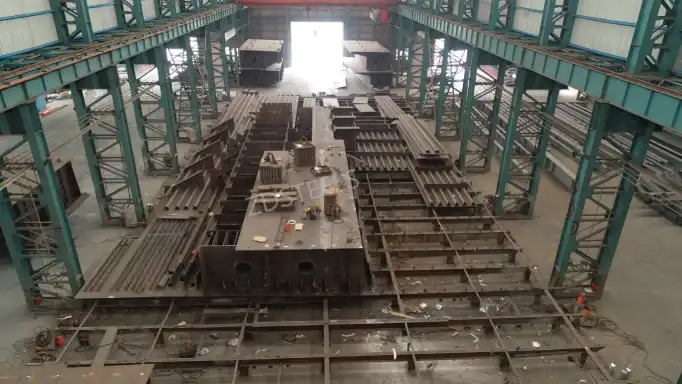
The way buying teams work on port bridge projects has changed because of prefabricated modular systems. Instead of putting together raw steel on busy port roads, 12-meter steel box girder parts are made in a controlled factory environment and then moved and placed with as little impact as possible to ongoing logistics operations. Compared to standard cast-in-place or field-welded methods, this method cuts on-site assembly times by 20–30%. This directly lowers project costs and operational downtime.
The positioning of cable clamps is a notoriously precise task in the construction of suspension bridges. Off-site preparation helps a lot with this. With 3D laser scanning technology, the placement accuracy of clamps can reach ±2mm, which means that field adjustment repairs and the safety risks that come with it are almost completely eliminated.
Construction and Maintenance Processes for Steel Bridges in Heavy-Load Applications
Precision Fabrication and Systematic Assembly
Design and planning, buying materials, CNC-controlled manufacturing, quality inspection, surface treatment, and structured shipping are the steps that are always taken in the right order when building a heavy-load Bridge Steel Structure. CNC ultra-thick plate cutting and 3-axis drilling allow for measurement accuracy of ±0.2mm, which means that field fit-up can go forward without having to pay for expensive repairs. Before parts leave the fabrication plant, non-destructive testing (NDT), especially ultrasonic testing (UT) and radiographic testing (RT) according to the AWS D1.5 Bridge Welding Code, makes sure that every important weld is structurally sound.
Here are the core maintenance practices that define long-term performance for port-corridor steel bridges:
- Scheduled corrosion inspections: Coastal bridges need to be inspected every two years to check the dry film thickness (DFT) of their coatings, look for signs of coating delamination, and make sure that their cathodic protection systems are working properly, if they have them.
- Main cable dehumidification monitoring: The main cables of suspension bridges have dehumidification systems that keep the relative humidity inside them below 40%. This significantly slows the rusting of the wires, which is a standard feature of modern bridge designs.
- S-Type galvanized wire wrapping verification: The S-type wire wrapping tape that covers the main lines acts as an extra physical barrier against salt entry and needs to be checked for mechanical damage after bad weather.
- Connection integrity checks: For high-strength friction-type bolted connections, calibrated torque tools or Tension Control (TC) bolt methods are used to make sure the connection is solid. As part of AASHTO repair rounds, the connections are re-torqued.
-
Procurement Considerations for Bridge Steel Structures
Evaluating Suppliers Beyond Price
It takes a long time and a lot of money to buy a Bridge Steel Structure for port access roads. Aside from unit price, other factors that affect the success of a project are its ability to be manufactured, its range of certifications, its dependability for delivery, and its level of technical support.
A good provider should be certified by ISO 9001/14001/45001, show that they follow both U.S. (ASTM, AASHTO, FHWA) and foreign standards (EN 1090, AWS, JIS), and have a list of completed projects in similar settings. It's also important to know how much the supplier can produce each month. For example, a supplier that can make 800 tons of steel box girder sections each month gives port development timelines the scheduling certainty they need.
The total landed cost is significantly affected by the location and transportation facilities. Suppliers with established global freight partnerships and custom protective packing practices lower the risk of damage during transit and the amount of insurance that is needed. These are factors that don't usually show up in the first price comparisons but always affect the final project costs.
Comparing Bridge Steel Structures with Alternative Materials
It is well known that a Bridge Steel Structure is more cost-effective than concrete and wood in heavy-load port uses. Long-span reinforced concrete bridges have big problems with their own weight, which raises the cost of the foundation and limits the shape of the span. For industrial load ratings and coastal humidity, wood is not at all suitable.
When it comes to span-to-depth ratios, steel suspension and cable-stayed bridges are better than concrete beam systems unless they use very complicated pre-stressing methods. Steel is also better at being fixed after an impact because broken parts can be straightened out with controlled heat or replaced in the field using welded or bolted splices. This means that port operations can keep going with little trouble after an accident involving a ship or an overload.
When it comes to the environment, structural steel's ability to be recycled at the end of its useful life lowers its lifecycle carbon footprint compared to concrete demolition waste. More and more buildings are using weathering steel types (ASTM A588), which means they don't need to be painted as often and cost less over their lifetime. This also cuts down on the amount of chemical waste that is made during finishing operations.
Conclusion
Heavy-load corridors and roads that lead to ports are long-term investments in infrastructure that communities and businesses will depend on. The load capacity, service life, and flexibility that these settings need are all provided by a well-specified Bridge Steel Structure that is built with precision, undergoes strict quality control, and is protected against corrosion. Lifecycle results are always better when purchasing professionals look at suppliers based on their level of certification, production ability, and assistance after installation, not just price. With a 20-year track record, global certifications, and state-of-the-art production facilities, Zhongda is a reliable long-term partner for steel bridge projects of any size or complexity.
FAQ
How long does a steel bridge designed for port access roads typically last?
Modern steel bridges are made to last 75 to 100 years, as long as they are well taken care of and built according to AASHTO LRFD design standards. Systems that use advanced corrosion protection, like dehumidification circuits and dual-layer coating systems, usually last longer than expected.
What certifications should a steel bridge supplier hold for U.S. port projects?
At the very least, you should look for ISO 9001:2015 certification, compliance with the FHWA-NHI-07-096 Suspension Bridge Design Specifications, ASTM A709 material certification, and AWS D1.5 welding qualification. Certifications like EN 1090 and AISC are good ways to tell how precise and disciplined a manufacturing process is.
How is corrosion managed in salt-spray port environments?
Hot-dip galvanizing or zinc-rich epoxy primer systems with topcoat barriers, main cable dehumidification systems that keep the inside humidity below 40%, and S-type galvanized wire wrapping on exposed cable surfaces are all things that work together to prevent corrosion. For some types of contact, weathering steel (ASTM A588) is another choice.
Can prefabricated steel bridge sections be customized for non-standard span requirements?
Yes, OEM and ODM manufacturing lets you make changes to the span configurations, load rates, deck geometries, and finishes. Reliable makers offer value engineering help to improve the performance of structures without adding extra costs for materials.
Partner with Zhongda — Your Trusted Bridge Steel Structure Supplier
With a manufacturing capacity of 60,000 tons per year and box girder output of 800 tons per month, Zhongda builds engineered Bridge Steel Structure systems that meet U.S. and foreign standards. Our products, like PPWS main wires with a strength of 1770 MPa and ±2mm laser-scanned cable clamps, meet the strictest port-corridor requirements. Visit zd-steels.com or email Ava@zd-steels.com to get in touch with our engineering team and ask for technical advice or a project quote right away.
References
1. American Association of State Highway and Transportation Officials (AASHTO). AASHTO LRFD Bridge Design Specifications, 9th Edition. 2020.
2. Federal Highway Administration (FHWA). FHWA-NHI-07-096: Suspension Bridge Design and Construction Guidelines. U.S. Department of Transportation, 2007.
3. American Welding Society. AWS D1.5: Bridge Welding Code. 2020.
4. ASTM International. ASTM A709: Standard Specification for Structural Steel for Bridges. 2021.
5. World Steel Association. Steel's Contribution to a Low Carbon Future and Climate Resilient Societies. 2023.
6. Transportation Research Board, National Academies of Sciences. NCHRP Report 604: Fatigue Evaluation of Steel Bridges. National Academies Press, 2008.
YOU MAY LIKE