
Bridge Steel Structure for Urban Flyovers and Interchange Projects
2026-09-19 13:00:01






A Bridge Steel Structure is the foundational engineering system behind modern urban flyovers and interchange projects. Fabricated from high-strength structural steel — including HSLA grades, weathering steel, and corrosion-resistant alloys — these systems solve critical challenges that concrete simply cannot address at scale: excessive dead load on long-span crossings, slow on-site construction cycles that gridlock urban traffic, and seismic vulnerability in high-risk corridors. Whether the application demands a suspension bridge spanning 2,000 meters or a prefabricated steel girder installed overnight above a live highway, steel delivers the precision, speed, and durability that modern infrastructure demands.
Understanding Bridge Steel Structures in Urban Infrastructure
Flyovers and junction systems in cities are very important. Every day, they move millions of commuters, support freight routes, and form the framework of towns that are growing. If you choose the wrong structural material or the wrong fabrication partner, you could end up with higher costs, safety risks, and years of maintenance obligations.
These forces can be handled by structural steel, which has a unique set of mechanical qualities that no other material can match on a large scale. According to ASTM A709 and AASHTO M270 standards, its yield strength is usually between 345 MPa and 690 MPa. It can be used in climates from the U.S. Sun Belt to the upper Midwest because it is very hard to break at low temperatures.
Common Steel Bridge Types Used in Urban Settings
When working on urban infrastructure projects, engineers and procurement managers will come across a number of main configurations, each of which is best for a certain span range and site constraints:
- Box girder bridges deliver exceptional torsional stiffness, making them the preferred choice for curved urban interchanges and elevated expressways where alignment geometry is complex.
- Truss bridges maximize the strength-to-weight ratio over medium spans, reducing foundation loads — a critical advantage in dense urban environments with underground utilities.
- Modular prefabricated steel bridges allow installation within a single overnight closure window, dramatically reducing social disruption costs in high-traffic corridors.
- Steel suspension bridges excel in super-long-span applications from 300 to 2,000 meters, combining aerodynamic deck design with high-tensile cable systems to achieve crossings that are structurally and economically impossible with reinforced concrete.
These arrangements don't rule each other out. A lot of big urban interchange projects use a lot of different types of Bridge Steel Structure along the same corridor. To handle the whole project, they need a fabrication partner with a lot of engineering knowledge.
Design Principles and Engineering Considerations
A steel bridge does more than just cross a gap; it has to deal with dynamic load cycles, thermal expansion, wind-induced vibration, and seismic energy all at the same time over an AASHTO LRFD-specified design life of 75 to 100 years. That service life is affected by every design choice, from plate thickness to weld category.
Load Capacity and Structural Integrity
Load analysis starts with wind, earthquake, and thermal forces and then moves on to dead load, live load, and dynamic effect factors. When designing urban flyovers, engineers also take fatigue cycles into account. Fatigue cycles are the damage that builds up over time when heavy vehicles cross joints and splice points thousands of times every day. Under the AWS D1.5 Bridge Welding Code, fatigue grades run from A to E'. The geometry of the weld toe is strictly controlled through non-destructive testing (NDT) to get rid of stress concentrators before a single span is put up.
Corrosion Protection for Urban Environments
Corrosion is especially bad in cities because road salt, car fumes, humidity, and industrial pollution all work together to break down surfaces faster. To meet dry film thickness (DFT) goals, which can be confirmed by pull-off adhesion tests, high-performance coating systems are needed. These systems usually include zinc-rich epoxy bases and micaceous iron oxide topcoats. A two-layer security system for suspension bridge main cables—internal dehumidification and S-type galvanized steel wire wrapping—keeps water out of the most fatigue-prone part of the structure for a long time.
Another underrated benefit of steel is that it can be fixed. A broken part can be fixed with controlled heat-straightening or replaced completely with field welding or high-strength bolts, which means the structure can hold the same amount of weight as before.
Procurement and Cost Considerations for Bridge Steel Structures
There's more to choosing a Bridge Steel Structure provider than just looking at unit prices. Procurement managers and EPC contractors need a production partner that can show they have approved quality systems, the ability to make parts with great accuracy, and dependable transportation for parts that could weigh hundreds of tons.
When expert infrastructure buyers look at a structural steel bridge maker, these are the main things they look at:
- Certified quality management: ISO 9001:2015 certification, compliance with FHWA-NHI-07-096 U.S. Suspension Bridge Design Specifications, and EN 1090 execution standards confirm that fabrication processes meet internationally recognized benchmarks.
- NDT capability: Ultrasonic testing (UT) and radiographic testing (RT) of critical welds, combined with 3D laser scanning for dimensional verification at ±2mm precision, eliminate costly field fit-up failures.
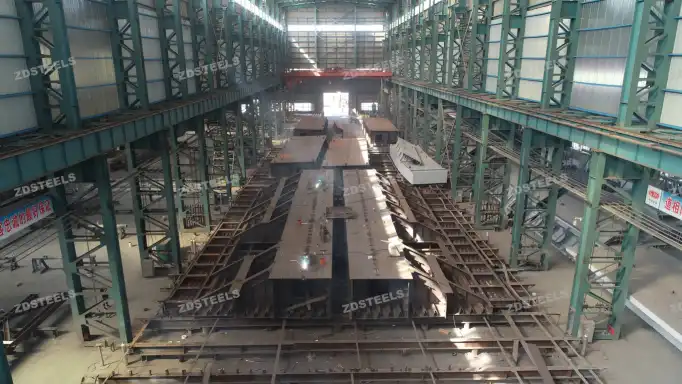
- Production capacity and lead time: A supplier capable of producing 12-meter steel box girder sections at 800 tons per month can meet the aggressive schedules typical of urban infrastructure contracts without compromising quality.
- OEM and ODM flexibility: Custom fabrication services — including tailored deck geometry, smart monitoring system integration, and value engineering — allow procurement teams to optimize both performance and project cost.
Total lifetime cost always works out better for prefabricated steel components than for standard cast-in-place methods. Steel may cost more in raw materials, but it is more cost-effective over a 75-100 year asset horizon because it doesn't need as much of a foundation, can be installed faster, and has a high residual scrap value at the end of its life.
Comparing Steel Bridge Structures with Concrete and Other Materials
Steel always does better than concrete in urban flyover applications in a number of different ways. Its strength-to-weight ratio lowers base loads, which lets smaller piers and supports be used in urban areas with limited space. Prefabricated Bridge Steel Structure superstructures can be put up during overnight closures, but similar concrete pours need longer curing times, which directly affects the cost of traffic delays and the efficiency of businesses nearby.
Steel can also be recycled completely when it's no longer useful, which is in line with the growing number of sustainability requirements in U.S. federal and state transportation funding laws. Modular steel designs help cities grow in the future because they allow spans to be widened, roads to be added, and load rates to be raised by replacing only a few members instead of tearing everything down and starting over.
Maintenance and Safety Management for Urban Steel Bridges
A structured inspection and repair schedule is important for the long-term success of a structure. AASHTO and FHWA standards say that in-depth checks should be done every two years, and routine inspections should be done once a year for urban crossings with a lot of traffic. Teams of inspectors look for weld fatigue cracks in high-stress areas, covering wear at expansion joints, and bolt tension in friction-type connections. If these problems are caught early, expensive structural fixes are avoided.
Modern structural health monitoring (SHM) systems can now track data on strain, vibration, and deflection all the time. When these devices are added to the bridge management system, they allow for predictive repair schedules. This cuts down on unplanned bridge closures and increases the time between service visits. For suspension bridges with main cables that are hundreds of meters long, dehumidification systems lower the relative humidity inside the bridge. This keeps the wire strands from wearing out due to corrosion for the whole design life.
Conclusion
For urban flyovers and interchange projects, Bridge Steel Structure solutions are needed that can be precisely fabricated, can span long distances, and have quality that can be checked from the first weld to the final inspection. Steel is the material of choice for infrastructure engineers and procurement managers working on projects the size of modern cities because it is stronger, lasts longer, and can be made in a variety of ways. Working with a manufacturer that has both qualified technical skills and real-world project experience will directly lead to lower risk, more reliable schedules, and buildings that will last for generations.
FAQ
How long does a steel bridge last compared to concrete?
A steel bridge is designed to last 75 to 100 years, which is about the same as reinforced concrete, as long as it is maintained properly and built according to AASHTO LRFD standards. One of the best things about steel is that it can be fixed. Individual parts can be changed or strengthened without having to rebuild the whole thing, which can often extend its useful life beyond what was originally planned.
What corrosion protection is used for steel bridges in coastal or high-humidity environments?
Hot-dip galvanizing and high-performance epoxy topcoats are usually used together in duplex finishing systems. Internal dehumidification systems and S-type galvanized steel wire wrapping protect suspension bridge main lines from wire wear caused by moisture in two ways.
How do I evaluate a Bridge Steel Structure supplier for a major urban project?
Give more weight to suppliers who have ISO 9001:2015 certification, can show they can do NDT (UT and RT per AWS D1.5), offer 3D laser scanning for accurate measurements, and follow U.S. standards like FHWA-NHI-07-096. For complicated urban interchange contracts, production capacity, delivery history, and OEM customization options are all very important.
How often should urban steel bridges be inspected?
FHWA rules say that checks must be done at least once every 24 months. Urban crossings with a lot of traffic usually benefit from routine checks once a year, along with systems that keep an eye on the structure's health and report any problems between official inspection rounds.
Partner with Zhongda — Your Trusted Bridge Steel Structure Manufacturer
Zhongda can handle any problem with urban infrastructure because they have 20 years of approved manufacturing experience. We are a well-known provider of Bridge Steel Structures around the world. We provide PPWS suspension cable systems, make 800 tons of precision 12-meter box girders every month, and fully meet U.S. FHWA-NHI-07-096 standards. We deliver on time because we are ISO 9001/14001/45001 certified and can handle 60,000 tons of cargo every year. Find out how much something costs by emailing Ava@zd-steels.com or going to zd-steels.com.
References
1. American Association of State Highway and Transportation Officials (AASHTO). AASHTO LRFD Bridge Design Specifications, 9th Edition. 2020.
2. Federal Highway Administration (FHWA). FHWA-NHI-07-096: Suspension Bridge Design and Engineering. U.S. Department of Transportation, 2007.
3. American Welding Society (AWS). AWS D1.5: Bridge Welding Code. 2020.
4. ASTM International. ASTM A709: Standard Specification for Structural Steel for Bridges. 2021.
5. Tonias, D.E., & Zhao, J.J. Bridge Engineering: Design, Rehabilitation, and Maintenance of Modern Highway Bridges, 3rd Edition. McGraw-Hill, 2012.
6. Brockenbrough, R.L., & Merritt, F.S. Structural Steel Designer's Handbook, 5th Edition. McGraw-Hill, 2011.
YOU MAY LIKE