



Custom Steel Cable-stayed Bridges Meet Complex Infrastructure Requirements
2026-10-10 13:00:01






When infrastructure projects demand long spans, minimal pier disruption, and structural resilience across decades, a steel cable-stayed bridge delivers where other bridge types fall short. This bridge system supports the deck through high-tension stay cables anchored to one or more pylons, creating a load path that is both efficient and adaptable. At Shenyang Zhongda, we engineer and supply Q420qE steel cable-stayed bridges configured to exact project specifications — whether for river crossings, urban viaducts, or industrial corridors across North America and beyond.
Understanding Steel Cable-Stayed Bridges: Design and Functionality
A cable-stayed bridge moves the weight of the deck directly into the pylon through inclined stay cables. The pylon then sends that force to the foundation. The structure is very stiff because of the direct load path, which is a big advantage over traditional suspension bridges for medium to long spans.
The Core Structural System
The pole is in the middle of everything. The tower in our Q420qE design is made from Q420qE steel plates that are 60 to 120 mm thick, and there can be no more than a 1/4000 error in the vertical placement. This level of accuracy makes sure that the cable's shape stays the same when it's loaded or unloaded.
Cable Arrangement Options
There are three main types of cable layouts: fan, harp, and semi-fan. Fan arrangements group wires together at the top of the pole and work well for longer distances. Harp plans run wires along the whole height of the pylon, which makes the structure look uniform. They are balanced by each other, which is why most current long-span bridge designs use them. With major spans from 200 to 800 meters, our systems can work with both double- and single-cable plane setups.
Stay Cable Technology
The OVM250 mooring systems and Φ7mm stainless steel wire that we use in our stay cables meet the standards set by EN 10138. Each wire strand has a minimum final tensile strength of 1860 MPa, which is proven by stress testing that goes through millions of cycles before it is shipped. It's not just a claim on paper; this standard is checked by lab data before any cable leaves our building.
Advantages and Challenges of Custom Cable-Stayed Bridge Systems
Pylon-and-cable structures that are made to order can solve problems that standard designs can't. They can be adjusted to fit uneven site shapes, changing soil conditions, seismic zones, and crossing widths that need to be changed to meet the needs of the navigation channel.
Here are the main engineering benefits that our Q420qE steel cable-stayed bridge system gives to teams that buy infrastructure:
- Superior strength-to-weight ratio: Q420qE steel provides a yield strength exceeding 420 MPa while keeping structural mass lower than equivalent concrete systems. Reduced self-weight means lower foundation loads and less material cost at depth.
- Seismic protection built in: LRB800 lead-rubber isolation bearings reduce seismic response by up to 40%, protecting the entire structure during ground motion events — a standard requirement for projects in California, the Pacific Northwest, and other high-seismic regions.
- 53-year corrosion resistance: Each stay cable carries a dual-layer protection system: a graphene-composite inner coating and a PE outer sheath. Independent UV testing confirms performance beyond 53 years, addressing the lifecycle cost concerns that procurement managers cite most frequently.
These benefits directly address the three issues that most EPC companies and government clients bring up: the longevity of the building, its ability to withstand earthquakes, and its overall cost of ownership over a 100-year design life.
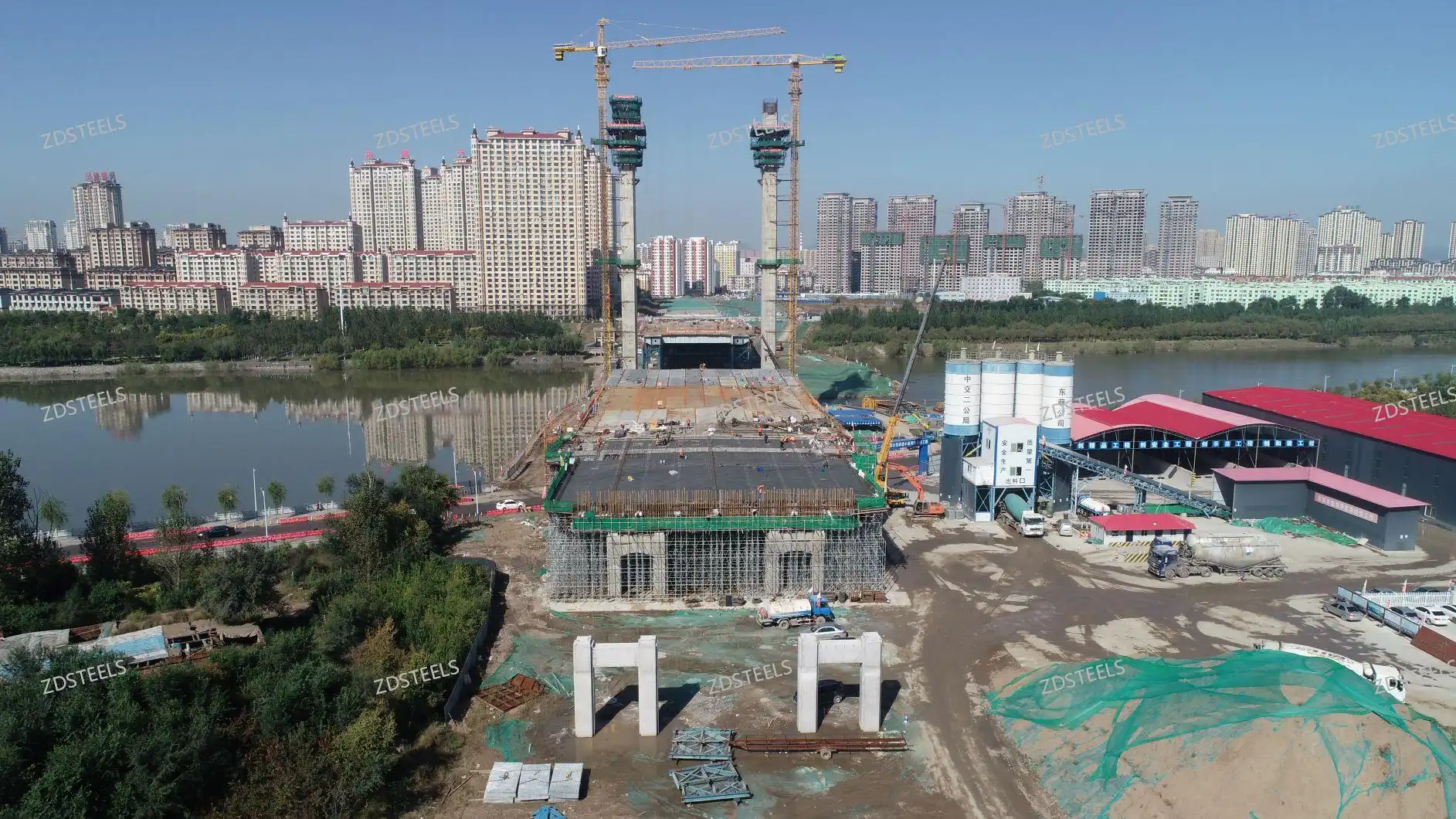
There are problems. Cable tensioning during erection needs to be closely watched, and making pylons with complicated shapes requires great accuracy. We deal with both using BIM-based digital modeling and a 0.5-inch total station for 3D coordinate detection. This is the same level of instrument accuracy that we used on the 18,000-ton steel structure project we built for a major state-owned company called the Shenyang Dongta Cross-Hunhe River Bridge.
Procurement Insights: Selecting the Right Supplier
There's more to picking a Steel Cable-stayed Bridge maker than just looking at plate types. In the United States, procurement teams looking for suppliers for government contracts, port growth, or highway projects need to find companies with certifications that can be checked and a history of on-time deliveries.
Certifications That Matter
Zhongda has a Class I Steel Structure Professional Contracting Qualification as well as ISO 9001, ISO 14001, and ISO 45001 certificates. The three most common foreign codes used in cross-border bridge contracts are EN 1090, AWS D1.1, and JIS. Our manufacturing meets all three of these standards.
Production Capacity and Lead Time
Our building is 120,000 m² and is in Shenyang's Economic-Technological Development Zone. It is the largest steel workshop in Northeast China, with a 50-ton crane and an annual output of 60,000 tons. When we compare our lead times to area industry standards, we regularly cut them by 20–30%. For big steel cable-stayed bridge projects where missing the deadline means paying extra money, that buffer is important.
Track Record With Major Clients
We've built cable-stayed buildings for China Railroad, CSCEC, CCCC, and the Jingha Expressway growth. These are government agencies with procurement standards that are on par with any U.S. federal project requirement. A 70% client retention rate means that we consistently do a good job, not just one successful delivery.
The Construction Process: From Design to Delivery
Our production sequence covers every phase from first drawing to final packaging, with no handoffs that sacrifice traceability.
Engineering and Fabrication
Each project starts with structural design review and BIM modeling. CNC cutting ensures plate dimensions meet tolerance requirements before any welding begins. Pylon sections are assembled in controlled workshop conditions, with weld quality confirmed through 100% ultrasonic testing and radiographic testing on full-penetration joints.
Cable Conduit Pre-Embedding
One detail that often causes field delays on other projects: cable conduit pre-embedding. We use 3D coordinate detection during this phase to position conduit anchors to design geometry. Errors at this stage propagate into cable angle deviations that are expensive to correct after concrete placement.
Quality Inspection Before Dispatch
Surface coating dry film thickness, pull-off adhesion tests, and cable tension calibration all occur before shipment. Custom packaging protects components during ocean or overland freight. We coordinate global logistics directly, so clients receive a single point of contact from fabrication through delivery.
Maintenance and Longevity: Keeping Structures Performing
A cable-stayed structure's service life depends on how well its maintenance program addresses the three primary degradation mechanisms: corrosion, fatigue, and bearing deterioration.
Inspection Protocols
Standard practice requires cable force verification every two to four years using vibratory frequency methods or embedded load cells, with tolerances held within ±5% of theoretical design values. Visual inspection of PE sheaths and anchorage zones happens annually. Our graphene-PE dual coating system reduces intervention frequency compared to single-layer HDPE sheaths.
Structural Health Monitoring
Sensor networks embedded during construction allow engineers to track cable tension, bearing displacement, and deck deflection in real time. Combined with drone-based visual inspection for pylon surfaces and anchor zones, these tools give asset managers early warning of anomalies before they become structural concerns.
Bearing Replacement Planning
LRB800 bearings have a defined replacement cycle. Planning this replacement into the asset management schedule — rather than responding reactively — keeps bridge closures brief and predictable. We provide technical documentation and dimensional data for all bearing assemblies to support long-term maintenance planning.
Conclusion
When spans are longer than 200 meters, seismic risk is high, or lifecycle cost is more important than initial price, steel cable-stayed bridge systems made of high-grade structural steel always do better than other options. Zhongda's Q420qE system takes care of all of these issues with designed precision: tested wire standards, seismic separation, dual-layer corrosion protection, and 3D detection to prove the accuracy of manufacturing. This is a good place to start for infrastructure procurement workers looking at long-span crossing options because it has certified quality, a documented project history, and direct access to suppliers.
FAQ
1. What span lengths can a cable-stayed bridge realistically achieve?
Modern steel cable-stayed bridges cover main spans from 200 meters up to over 1,000 meters. Our Q420qE systems are configurable from 200 to 800 meters, accommodating the majority of river crossings, port channels, and urban viaduct applications encountered in North American infrastructure programs.
2. How does seismic performance compare to concrete cable-stayed bridges?
Steel structures carry less mass than equivalent concrete bridges, which directly reduces inertial force during an earthquake. Combined with LRB800 isolation bearings — which absorb and dissipate seismic energy — our systems achieve up to a 40% reduction in seismic response compared to rigidly connected structures.
3. What certifications should procurement teams require from a bridge steel supplier?
Look for ISO 9001 for quality management, EN 1090 or AWS D1.1 for structural fabrication compliance, and fatigue test data for cable assemblies. Zhongda carries all of these, alongside a Class I Steel Structure Professional Contracting Qualification.
4. How is cable corrosion protection verified before delivery?
Each stay cable assembly undergoes dry film thickness measurement, adhesion pull-off testing, and UV resistance confirmation. Our dual-layer graphene-PE coating system is tested to a 53-year service standard before shipment.
5. Can span configuration be adjusted after initial design submission?
Yes. We support both double and single-cable plane arrangements and can adjust span geometry during the design phase. Changes after fabrication begins are assessed on a project-by-project basis depending on completion stage.
Partner With Zhongda for Your Next Bridge Project
Zhongda has been making Steel Cable-stayed Bridges for a long time and has the skills, certifications, and project experience to help with the complicated buying of infrastructure in the US and around the world. Our Q420qE bridge systems can be customized for each project, from the plan of the spans to the requirements for earthquake safety and corrosion resistance. Get in touch with our engineering team to get a technical consultation or a quote for your project. You can email us at Ava@zd-steels.com to see all of our products.
References
1. Gimsing, N. J., & Georgakis, C. T. Cable Supported Bridges: Concept and Design. Wiley, 2012.
2. Walther, R., et al. Cable-Stayed Bridges. Thomas Telford Publishing, 1999.
3. American Association of State Highway and Transportation Officials. AASHTO LRFD Bridge Design Specifications, 8th Edition. AASHTO, 2017.
4. Fib Bulletin 30. Acceptance of Stay Cable Systems Using Prestressing Steels. International Federation for Structural Concrete, 2005.
5. Chen, W. F., & Duan, L. (Eds.). Bridge Engineering Handbook: Superstructure Design, 2nd Edition. CRC Press, 2014.
6. ISO 12944-5. Paints and Varnishes — Corrosion Protection of Steel Structures by Protective Paint Systems. International Organization for Standardization, 2019.
YOU MAY LIKE
