
Galvanized Round-Tube Truss: Q235B Chords, Welded Nodes, Bolted Connection Plates
2026-11-16 18:29:48






Galvanized Round-Tube Truss: Q235B Chords, Welded Nodes, Bolted Connection Plates
English Version
Title: Galvanized Round-Tube Truss: Q235B CHS Chords, Welded K-Type Webs, Bolted Top Plates — Factory-Finished Lattice Truss
Data note: the supplied CAD screenshots are low resolution. Tube OD×wall, member lengths, panel spacing, and line-item weights are not legible; the figures below come from the readable drawing labels and the factory photo. Confirm every section and weight against the original shop BOM before quoting.
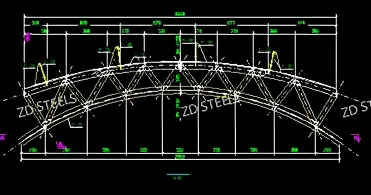
Overview
This is a hot-finished galvanized round-tube truss. Two round hollow-section chords run the span; round-tube verticals and diagonals form a lattice between them. Nodes are welded; top connection plates carry short bolted stubs for fixing roof members or purlins. The factory photo shows the silver zinc finish on the finished truss in the shop. The BOM group reads GL-1, quantity 2, grade Q235B on every member.
Readable Drawing Data
| Item | Value |
|---|---|
| Truss mark | GL-1 |
| Quantity in BOM | 2 pcs |
| Steel grade | Q235B |
| Chords | Round hollow section (CHS), size per original BOM |
| Webs | Round tube verticals and diagonals, size per original BOM |
| Connection nodes | Welded tube nodes with bolted round plates and stubs |
| Elevation | Pitched top chord, flat bottom chord, diagonal + vertical web pattern |
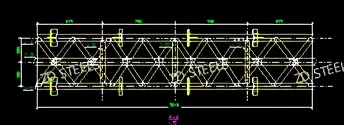
| Plan | Two chord lines with X-lattice; transverse batten frames at panel points |
| Scale | 1:50 |
| Tube sizes, lengths, weights | Not legible in screenshot — see original BOM |
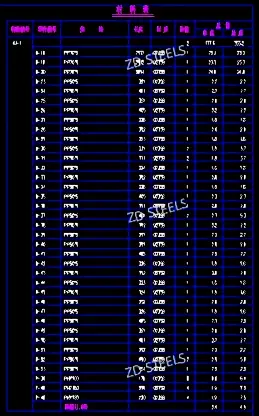
Material Breakdown (from BOM Layout)
| Category | Member type | Grade | Spec / weight |
|---|---|---|---|
| Chords | Round tube, main span members | Q235B | Original BOM |
| Diagonals & verticals | Round tube webs | Q235B | Original BOM |
| Node plates | Connection / gusset plates | Q235B | Original BOM |
| Top stubs | Short welded posts with round bolted plates | Q235B | Original BOM |
| Fasteners | Bolts at connection plates | Per BOM | Original BOM |
The BOM lists roughly 30-plus line items split between tube members and plates; exact diameters, wall thicknesses, lengths, and kg figures must be read from the original table.
How the Truss Works
- Chords carry bending. The top chord takes compression and the bottom chord tension; the depth between them resists the span moment.
- Webs split shear. Round-tube diagonals and verticals transfer panel loads to the chords; each web works in tension or compression depending on its position.
- Node plates distribute force. At each panel point the welded node and bolted plate spread the member force into the chord; top stubs carry purlin or roof reactions.
- Galvanizing protects the steel. The zinc finish slows atmospheric corrosion on an outdoor or exposed truss; damaged or welded zones are touched up after fabrication.
Advantages
- Light for the span — open lattice uses steel where the force is; a truss spans farther than a solid beam of the same weight.
- Round sections resist wind — circular tubes have low drag, which suits outdoor sheds, canopies, and exposed frames.
- Galvanized, low maintenance — the zinc finish reduces painting cycles in atmospheric exposure; bolted plates and tubes are easy to inspect.
- Clean welded nodes — round tubes meet directly or through a small plate; the exposed form reads better than heavy plate gussets.
- Standard tube supply — CHS sizes are commonly stocked; chord and web diameters can be matched to the load without a special rolled section.
Disadvantages / Limitations
- Welded nodes need skilled fit-up — round tubes cut to angle and welded to a chord or plate require qualified welders and jigs.
- Closed tube ventilation — open tube ends collect condensation; sealed ends, vent holes, and internal coating matter for long-term service.
- Galvanizing repair after site work — welding or drilling on galvanized members burns the zinc; touch-up paint or galvanizing spray is required at every touched zone.
- More flexible than a solid girder — a lattice truss deflects more than a plate girder of equal weight; deflection and vibration must be checked for live load.
- Specs cannot be read from this screenshot — tube diameter, wall, length, and total weight remain on the original BOM; capacity and price cannot be calculated from these images alone.
Typical Use Cases
- Warehouse and shed roof trusses — galvanized round-trace lattice over industrial spans.
- Canopy and entrance frames — exposed outdoor truss with bolted top plates for roof panels.
- Pipe racks and equipment platforms — open lattice where under-truss access and light weight matter.
- Outdoor walkways and galleries — round sections with low wind drag.
- Venue and space-frame supporting trusses — node-plate connections tying into roof or purlin grids.
Fabrication and Erection Notes
- Material: Q235B; verify mill certificate against the original BOM.
- Members: confirm chord and web tube OD×wall and each length from the shop drawing before cutting.
- Nodes: cut web tubes to the true angle; check fit-up before welding; weld around each node as detailed.
- Plates: match bolt holes and stub height to the roof or purlin connection.
- Protection: galvanize after fabrication; touch up welds, scratches, and drilled zones; seal tube ends and provide vents where required.
- Erection: lift per the planned scheme; brace the truss laterally before releasing the crane; align bottom chord to supports.
Bottom Line
A galvanized Q235B round-tube truss: CHS chords, round-tube webs, welded nodes, bolted top plates, finished in zinc for outdoor service. The lattice covers the span with less steel than a solid beam, and the round section handles wind cleanly. Tube sizes, lengths, and weights come from the original BOM — this screenshot does not carry those numbers.
**WhatsApp**: +86‑13889862778, +86‑18242444407
**Email**: eddie@zdsteels.com, wells@zdsteels.com
YOU MAY LIKE