
How Does a Steel Cable-stayed Bridge Achieve Long Spans?
2026-09-16 13:00:01






A steel cable-stayed bridge achieves long spans by transferring deck loads directly to tall pylons through a series of high-tension stay cables arranged in fan or harp patterns. Unlike suspension bridges, each cable connects independently from the deck to the tower, creating a self-anchoring system that distributes forces with remarkable efficiency. The use of high-grade structural steel—with its superior tensile strength and favorable strength-to-weight ratio—allows engineers to push span lengths from 200 meters to beyond 800 meters while keeping the substructure lean and foundation demands manageable.
Understanding Steel Cable-Stayed Bridges
What Makes This Structural System Unique?
The direct load transfer on the cable-stayed bridge makes it stand out. Each stay cable is like an angled strut that carries tension from the deck straight into the pylon. The pylon then absorbs that force by compressing itself. In contrast to a suspension bridge, it doesn't need big anchor blocks at each end. The deck, which is usually an orthotropic steel box girder, makes the system stiff by blocking twisting and flapping caused by wind. Steel is the best material for this job because it has a high stiffness-to-flexibility ratio, can be shaped easily under dynamic loads, and has a design life that usually lasts more than a hundred years if it is properly protected.
Why Steel Outperforms Concrete in This Application?
When there is earthquake stress, concrete pylons break. They also add a lot of dead weight, which is bad for long-span goals. Steel pylons can be put up more quickly by bolting and welding them together, and they work effectively in places with a lot of earthquakes or extreme cold. Less deck mass also means less inertial forces during earthquakes, which is very important for urban areas built across active fault lines.
Engineering Principles Behind Achieving Long Spans
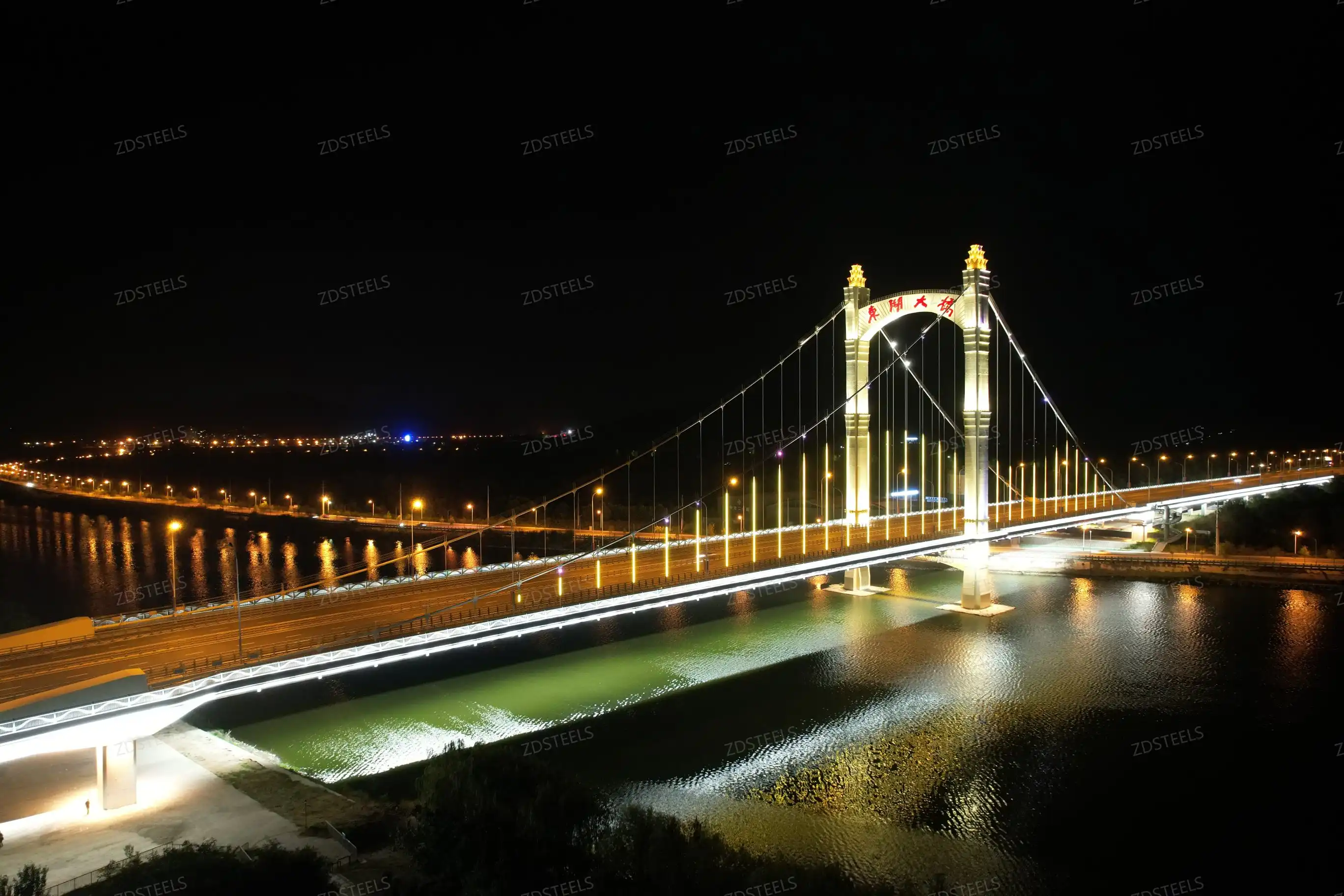
In a Steel Cable-stayed Bridge system, adding more wire doesn't just make the span longer. It needs an exact balance of pylon height, wire design, steel grade, and managing how the structure moves.
Cable Arrangement: Fan vs. Harp Patterns
In a fan arrangement, all the cables come together near the top of the pylon. This makes steep angles that maximize the vertical load components and minimize the horizontal thrust on the deck. The harp pattern spreads out the cable anchor points along the height of the pylon, which makes the bending more even. A modified fan, sometimes called a "semi-fan," is often used in modern long-span projects because it is both efficient and easy to build.
Pylon Design and High-Strength Steel Grades
The height of the pylons directly affects the curves of the cables and, by extension, the system's overall structural efficiency. When the pylons are taller, the wire can be angled steeper, and the lengths can be longer. With a minimum yield strength of 420 MPa and the ability to weld thick plates, high-strength steel types like Q420qE make it possible to build tower walls from 60–120 mm plates while still keeping tight vertical tolerances of ≤1/4000. The Q420qE cable towers from Shenyang Zhongda meet this tolerance by using 0.5′′ total station instruments and 3D coordinate detection during installation. This ensures geometric accuracy that protects the structure's long-term behavior.
Managing Dynamic Loading and Cable Tensioning
Cable wear caused by traffic and wind shaking are the two biggest problems that long-span systems have to deal with all the time. Engineers deal with them by using high-damping rubber bumpers, viscous dampers at the points where the cable and deck meet, and making the box girder more aerodynamic. Using vibratory frequency methods or load cells, each cable force is checked against the theoretical design model within a ±5% tolerance. The tensioning of the cables is done in a staged sequence that is linked to the balanced cantilever erection method.
Advantages of Steel Cable-Stayed Bridges for Long Spans
Buying a long-span bridge is based on its total lifecycle value, not just its initial cost. Steel cable-stayed bridges always do well in three areas that are most important to infrastructure owners and EPC contractors.
The following are the main performance benefits that make Steel Cable-stayed Bridges the best option for difficult long-span projects:
- Superior load capacity with reduced self-weight: Steel's high strength-to-weight ratio allows longer spans without multiplying the foundation loads. Orthotropic steel decks weigh roughly 40% less than equivalent concrete decks, directly reducing pier and foundation demands—a measurable cost advantage on soft-soil sites or deep-water crossings where foundation work is expensive.
- Extended service life through advanced corrosion protection: Zhongda's Q420qE bridge system integrates a PE outer sheath with a graphene inner coating on all stay cables, providing 53 years of UV resistance and long-term moisture exclusion. This dual-barrier technology significantly outperforms standard single-layer HDPE sheaths, reducing cable replacement frequency across the bridge's operational life.
- Environmental sustainability through material recyclability: Structural steel carries one of the highest recycling rates of any construction material—approaching 90% in North America. Choosing steel for long-span bridges aligns with ESG procurement criteria and reduces embodied carbon when sourced from suppliers with certified environmental management systems such as ISO 14001.
These benefits directly lead to lower budgets for lifecycle maintenance, lower insurance risks for bridge owners, and faster construction schedules. All of these things are very important to procurement officers who are in charge of managing complicated infrastructure schedules.
Procurement and Supply Chain Insights for Steel Cable-Stayed Bridges
Getting building parts for a long-span crossing is more complicated than just getting the best price. Quality traceability, certification coverage, and fabrication precision all play a role in whether a bridge works as planned or turns into a liability.
Key Standards and Supplier Evaluation Criteria
If a provider for a Steel Cable-stayed Bridge is certified, they should at least have EN 1090 execution class compliance, AWS structural welding training, and ISO 9001 quality management certification. For pylon anchors and girder splices, you must use non-destructive testing, which includes full-penetration welds that are inspected with ultrasonic and radiographic methods. Surface coats must pass pull-off adhesion tests and dry film thickness checks that are in line with SSPC standards.
Zhongda has a Class I Steel Structure Professional Contracting Qualification and is certified in ISO 9001, 14001, and 45001 standards. With the ability to produce 60,000 tons of steel each year, a 50-ton crane in Northeast China's biggest steel workshop, and the ability to integrate BIM-based digital designs, Zhongda can make ultra-thick plate cuts with an accuracy of within ±0.2 mm. Lead times are 20–30% shorter than the average in the industry. This is a real benefit when project milestones are legally required. China Railroad, CSCEC, and CCCC all trust Zhongda, and the fact that they have a 70% client retention rate shows that they always meet their customers' needs.
Future Trends and Innovations in Steel Cable-Stayed Bridge Spans
The cutting edge of long-span bridge engineering is going in a number of ways that are coming together. With AI-assisted structural optimization, design teams can now model thousands of different wire geometry combinations in hours instead of weeks. This helps them find the setups that use the least amount of material while still meeting the stiffness requirements set by the code. Digital twin technology lets you check on the health of a bridge's structure in real time, so you can catch signs of fatigue before they become dangerous.
Improvements in prefabrication are cutting on-site erection time by a large amount. To make millimeter-accurate cuts on water or over-traffic construction exposure, modular steel deck segments are made off-site. Cable technology is also getting better. For example, next-generation parallel wire strands with 1960 MPa UTS and better wear resistance are making maintenance intervals longer and realistic span ranges bigger. Because of these trends, procurement teams need to choose the right supplier partner early on—one that can do digital fabrication and track materials—so that projects can be delivered quickly and cheaply.
Conclusion
A Steel Cable-stayed Bridge can have very long spans because it carefully combines high-strength steel, precise cable shape, and strict manufacturing control. Every engineering detail, from Q420qE pylons with vertical limits of ≤1/4000 to OVM250 anchorages and 53-year UV-resistant graphene-enhanced cable safety, is meant to make the structure last for a long time. Material science, precision production, and approved quality systems make the difference between a bridge that works and one that just stands. This is important for EPC contractors, government infrastructure agencies, and logistics facility developers who want to build long-span structures that last.
FAQ
How does a cable-stayed bridge differ from a suspension bridge in span capacity?
The Akashi Kaikyō Bridge, which is a suspension bridge, has the longest span at over 1,990 meters. However, cable-stayed bridges are more cost-effective and more structurally sound between 200 and 1,100 meters.
What is the typical design life of a steel cable-stayed bridge?
If you protect it from rust and keep up with regular upkeep, a Steel Cable-stayed Bridge should last at least 100 years. Advanced coating systems, like graphene-enhanced PE wire sheaths, make key parts last longer and lower the cost of repairs in the middle of their useful lives.
What certifications should a steel cable-stayed bridge supplier hold?
Check to see if they have at least ISO 9001 quality management, EN 1090 structural steel performance compliance, and AWS welding skills. Suppliers who have both ISO 14001 environmental management and a Class I Steel Structure Professional Contracting Qualification show that they are better at both running their businesses and making sure they meet quality standards.
How are seismic risks managed in cable-stayed bridge design?
A lot of people use LRB (lead rubber bearing) separation methods. The LRB800 bearings from Zhongda lower the response to earthquakes by up to 40%. They separate the deck from ground motion and protect both the superstructure and substructure during earthquakes.
Partner with Zhongda for Your Next Long-Span Bridge Project
According to certificates, Zhongda is a reliable Steel Cable-stayed Bridge maker. They can make 60,000 tons of bridges every year and have completed projects for major SOEs and global infrastructure clients. Our Q420qE bridge systems are designed to fit your width needs, whether it's 200 to 800 meters, a single cable plane, or two. Visit zd-steels.com or email Ava@zd-steels.com to get in touch with our team and ask for a technical consultation or project quote.
References
1. Gimsing, N. J., & Georgakis, C. T. — Cable Supported Bridges: Concept and Design, John Wiley & Sons, 2012.
2. Virlogeux, M. — "Recent Evolution of Cable-Stayed Bridges," Engineering Structures, Elsevier, 1999.
3. Walther, R., Houriet, B., Isler, W., & Moïa, P. — Cable-Stayed Bridges, Thomas Telford Publishing, 1999.
4. Podolny, W., & Scalzi, J. B. — Construction and Design of Cable-Stayed Bridges, John Wiley & Sons, 1986.
5. Frangopol, D. M., & Messervey, T. B. — "Maintenance Principles for Civil Structures," Encyclopedia of Structural Health Monitoring, Wiley, 2009.
6. American Association of State Highway and Transportation Officials (AASHTO) — AASHTO LRFD Bridge Design Specifications, 9th Edition, 2020.
YOU MAY LIKE