
Q355NE for Steel Box Girders: Why the Grade and the Test Matter
2026-11-08 19:43:22






Q355NE for Steel Box Girders: Why the Grade and the Test Matter
English Version
Title: Q355NE Box Girder: −40°C, 34 J Impact, No Hot-Rolled Coils Allowed
Overview
A steel box girder is only as good as the plate it is made from. On a bridge, the steel has to hold a 2,200 mm deep box together in winter cold, under traffic fatigue, for a design life of a century. That is why the specification does not just say "Q355" — it says Q355NE, with impact tests at −40°C and a ban on hot-rolled coil plate.
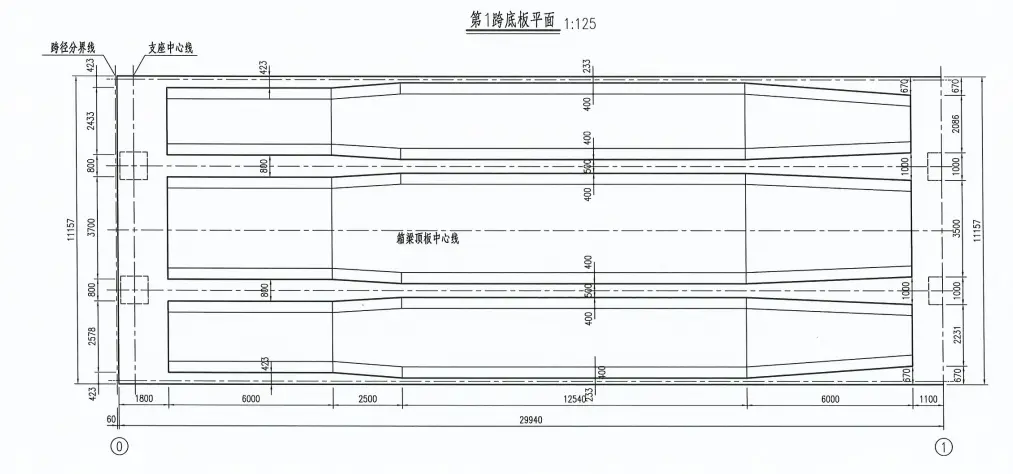
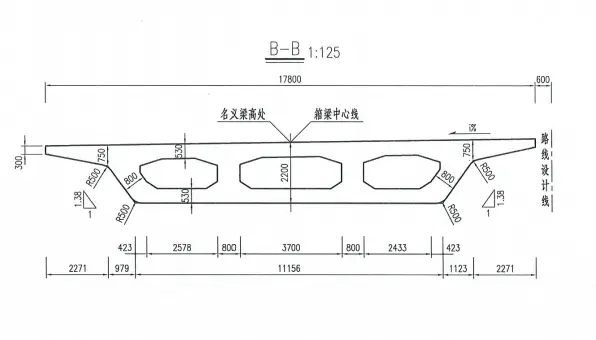
The drawings show the box section, the bottom plate layout, and the material specification that governs both.
Material Specification (from Drawing)
表格
| Item | Requirement |
|---|---|
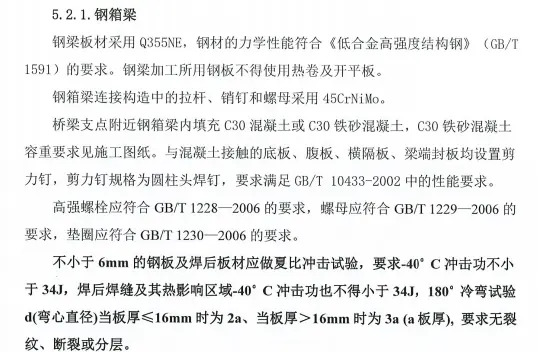
| Plate steel | Q355NE, per GB/T 1591 (low-alloy high-strength structural steel) |
| Plate source restriction | Hot-rolled coil and opened coil plate not permitted |
| Charpy impact (plate ≥ 6 mm) | −40°C, ≥ 34 J |
| Charpy impact (weld metal + HAZ) | −40°C, ≥ 34 J |
| Cold bend test | 180°; d = 2a for t ≤ 16 mm, d = 3a for t > 16 mm |
| Bend acceptance | No cracking, fracture, or lamination |
| Tie rods / pins / nuts | 45CrNiMo |
| High-strength bolts | GB/T 1228-2006 |
| Nuts / washers | GB/T 1229-2006 / GB/T 1230-2006 |
| Shear studs | Cylindrical headed studs, GB/T 10433-2002 |
| Support zone infill | C30 concrete or C30 iron-sand concrete |
Section Data (from Drawing)
表格
| Item | Value |
|---|---|
| Box width | 17,800 mm |
| Box height (centre cell) | 2,200 mm |
| Cells | Three-cell box |
| Web slope | 1:38 inclined webs |
| Cross fall | 2% |
| Span (first span) | 29,940 mm |
| Deck plate width | 11,157 mm |
| Plate zones | 2,578 / 3,700 / 800 / 2,433 mm |
Why Q355NE and Not Plain Q355
"N" means normalized or TMCP delivery. The steel is delivered in a controlled-rolling or normalized condition, which gives a fine grain structure and consistent toughness — not the variable properties of hot-rolled coil.
"E" means −40°C impact tested. The letter grade sets the Charpy test temperature. Q355E is tested at −40°C; the 34 J requirement applies to the plate, the weld metal, and the heat-affected zone. A box girder in a cold-climate bridge needs all three.
No hot-rolled coil. Coil plate has residual rolling stress and poorer through-thickness toughness. Bridge box girders use plate rolled on a plate mill, then cut and welded — not coil that has been unrolled and flattened.
45CrNiMo for pins and tie rods. These are the small, highly stressed parts — the connection pins and rods in the box. Alloy steel, not mild steel.
Advantages
- Toughness guaranteed at −40°C — plate, weld, and HAZ all tested; brittle fracture risk is controlled, not assumed.
- Consistent properties — normalized/TMCP delivery avoids the scatter of coil plate; welding procedures are more reliable.
- Cold bend test backs the toughness — 2a/3a bend at 180° without cracking proves ductility, not just strength.
- Matched connection materials — GB/T 1228/1229/1230 bolts and 45CrNiMo pins are specified as a system, not bought ad hoc.
- Composite action at supports — C30 iron-sand concrete infill plus GB/T 10433 shear studs stiffens the support zones where girder forces peak.
Disadvantages / Limitations
- Higher plate cost — Q355NE with −40°C impact and plate-mill rolling costs more than ordinary Q355B.
- Procurement discipline required — the "no coil plate" rule must be enforced at the mill and in the shop; substituting coil plate is a real risk.
- More testing — Charpy tests on plate, weld, and HAZ, plus bend tests, add inspection cost and schedule time.
- Welding procedure is stricter — low-temperature toughness in the HAZ demands controlled heat input and preheat; not every shop is set up for it.
- Infill concrete complicates fabrication — C30 iron-sand concrete and shear studs at the supports add a composite stage inside the box.
Typical Use Cases
- Highway bridge box girders — 29.94 m spans with three-cell sections, as in this drawing.
- Cold-climate bridges — projects where winter service temperature drops below −30°C; Q355E is the minimum grade.
- Rail and road composite bridges — support zones filled with C30 iron-sand concrete and studded for composite action.
- Long-span urban viaducts — 17.8 m wide box sections carrying multi-lane traffic with 2% cross fall.
- Rehabilitation of existing bridges — replacement box segments specified to the same Q355NE and impact requirements.
Fabrication Notes
- Order plate as Q355NE per GB/T 1591; require mill certificates with −40°C Charpy results.
- Reject hot-rolled coil and opened coil plate at goods receipt — check the mill's delivery condition, not just the grade stamp.
- Charpy test each plate ≥ 6 mm and each weld procedure; acceptance −40°C, ≥ 34 J for plate, weld, and HAZ.
- Bend test: 180°, d = 2a for t ≤ 16 mm and 3a for t > 16 mm; reject any cracking, fracture, or lamination.
- Use GB/T 1228/1229/1230 bolts and 45CrNiMo pins; do not substitute unlisted fasteners.
- Support zones: place GB/T 10433 cylindrical headed studs on bottom plate, webs, diaphragms, and end plates before pouring C30 iron-sand concrete.
Bottom Line
Q355NE is not a marketing grade — it is a specification with three hard requirements: plate-mill steel, −40°C impact of 34 J on plate/weld/HAZ, and a 180° bend that proves ductility. Add 45CrNiMo pins, GB/T 1228 bolts, and C30 iron-sand infill at the supports, and the box girder is built to survive cold, fatigue, and time. Skip the coil-plate ban or the impact tests, and the grade is just a stamp on a drawing.
**WhatsApp**: +86‑13889862778, +86‑18242444407
**Email**: eddie@zdsteels.com, wells@zdsteels.com
YOU MAY LIKE