



Steel Box Girders Provide Stable Support for Long-Span Bridge Projects
2026-10-15 13:00:00






When engineers face the challenge of spanning hundreds of meters over navigable waterways or complex urban corridors, the Steel Box Girder consistently proves itself as the structural solution of choice. Defined by its hollow, closed-loop cross-section formed by top and bottom flange plates connected by two or more web plates, this component delivers exceptional torsional rigidity and load distribution. For bridge projects ranging from major river crossings to elevated highway interchanges, the box girder's geometry fundamentally outperforms open-section alternatives, making it the backbone of modern long-span bridge engineering worldwide.
Understanding Steel Box Girders and Their Structural Advantages
What Defines a Box Girder Structurally
The name "box girder" comes from the shape of the bridge beam, which is rectangular and hollow. An I-beam's open shape makes it easy for it to buckle laterally, but a Steel Box Girder's closed part is several hundred times better at resisting twisting forces. This shape spreads the bending stress evenly across both sides, which keeps the material from wearing out when it's loaded with traffic and hit by moving forces over and over again.
Material Specifications That Matter
Zhongda mostly makes its Steel Box Girders out of Q345D structural steel, which has a minimum yield strength of 345 MPa and is good for main span members. Q420D steel is used in high-stress connection zones and joints because it is more notch-tough when it is cold. The grades are the same as ASTM A709 Grade 50W equivalents, and all the work is done according to AWS D1.5 bridge welding standards and AASHTO LRFD guidelines.
Weight-to-Strength Optimization
The much lower dead weight per unit of span is one reason why procurement teams choose Steel Box Girders over options made of prestressed concrete. When compared to a flat-web form, Zhongda's corrugated steel web choice makes the girder up to 20% lighter without lowering its load capacity. This lowers the demand for the substructure, which lowers the cost of the piers and the project's overall impact on the environment.
Comparing Steel Box Girders with Alternative Girder Solutions
Box Girders vs. I-Beams
I-beams are good for short and medium spans, but they can't be used for anything longer than about 60 meters. Because they have an open cross-section, they need extra lateral bracing, which takes longer and costs more to make. This is not needed with a fully welded box part, which also makes the span much more efficient. It is always better to use Steel Box Girders for projects with spans over 100 meters, according to structural math.
Box Girders vs. Concrete Girders
Prestressed concrete girders have a high self-weight, which means that span lengths can't be very long and foundation design has to be more complex. They also need longer times to cure on-site. Steel Box Girders, on the other hand, come pre-built in 12- to 30-meter modules that can be craned into place overnight as part of Accelerated Bridge Construction (ABC) programs. This can cut the time it takes to build a bridge on-site by up to 50%. With the right coating, they last longer than 30 years, often matching or beating similar concrete structures.
When Composite Systems Apply
Composite girder systems, which connect a concrete deck to a steel box section, work well for medium-to-long spans and are commonly used to build highway bridges. For single spans of 420 meters or more, like big suspension or cable-stayed crosses, a Steel Box Girder section on its own offers the aerodynamic shape and torsional stiffness that composite systems can't match. The decision is always based on the shape of the span, the type of load, and the conditions at the site.
Procurement Insights: Sourcing and Acquiring Steel Box Girders Globally
Evaluating Supplier Capabilities
When looking for a Steel Box Girder provider, B2B buying managers should check the company's yearly production capacity, list of certifications, and fabrication equipment. Zhongda has a 120,000 m² plant in Shenyang that can handle 60,000 tons of steel a year and has automated welding lines and CNC machines that can cut ultra-thick plates to within 0.2 mm of accuracy. ISO 9001/14001/45001, EN 1090, AWS, and JIS are some of the certifications that meet the needs of trade and project compliance in North American, European, and Asian-Pacific markets.
Customization and Lead Times
When Zhongda works on long-span bridge projects, these are the main ways they can be customized:
- Variable cross-section heights from 1.25m to 8m, depending on the span-to-depth ratios that the project engineers specify.
- Maximum single-span capability of up to 420 meters, which includes both cable-stayed and suspension bridge superstructures.
- BIM-based design integration that lets structural engineering teams and EPC companies work together directly, cutting down on the number of design iterations needed.
- Targeted anti-corrosion systems, such as hot-dip galvanizing or thermal-spray zinc coatings, are made for places ranging from the Arctic to the coast.
With these choices, procurement teams can do both planning and fabrication with the same provider, which cuts down on the work that needs to be done to coordinate everything. Zhongda's in-house engineering team helps clients from the idea stage all the way through delivery. They have a history of cutting project wait times by 20 to 30 percent.
Cost Drivers and Budgeting
Cost is mostly affected by the amount of steel, the shape of the piece, the number of spans, and the anti-corrosion requirements. Zhongda's vertically linked production keeps costs low from the time they receive the raw steel to the time they send the finished part for large orders. A 70% client retention rate shows how reliable delivery plans and product quality are, which have a direct effect on project costs as a whole.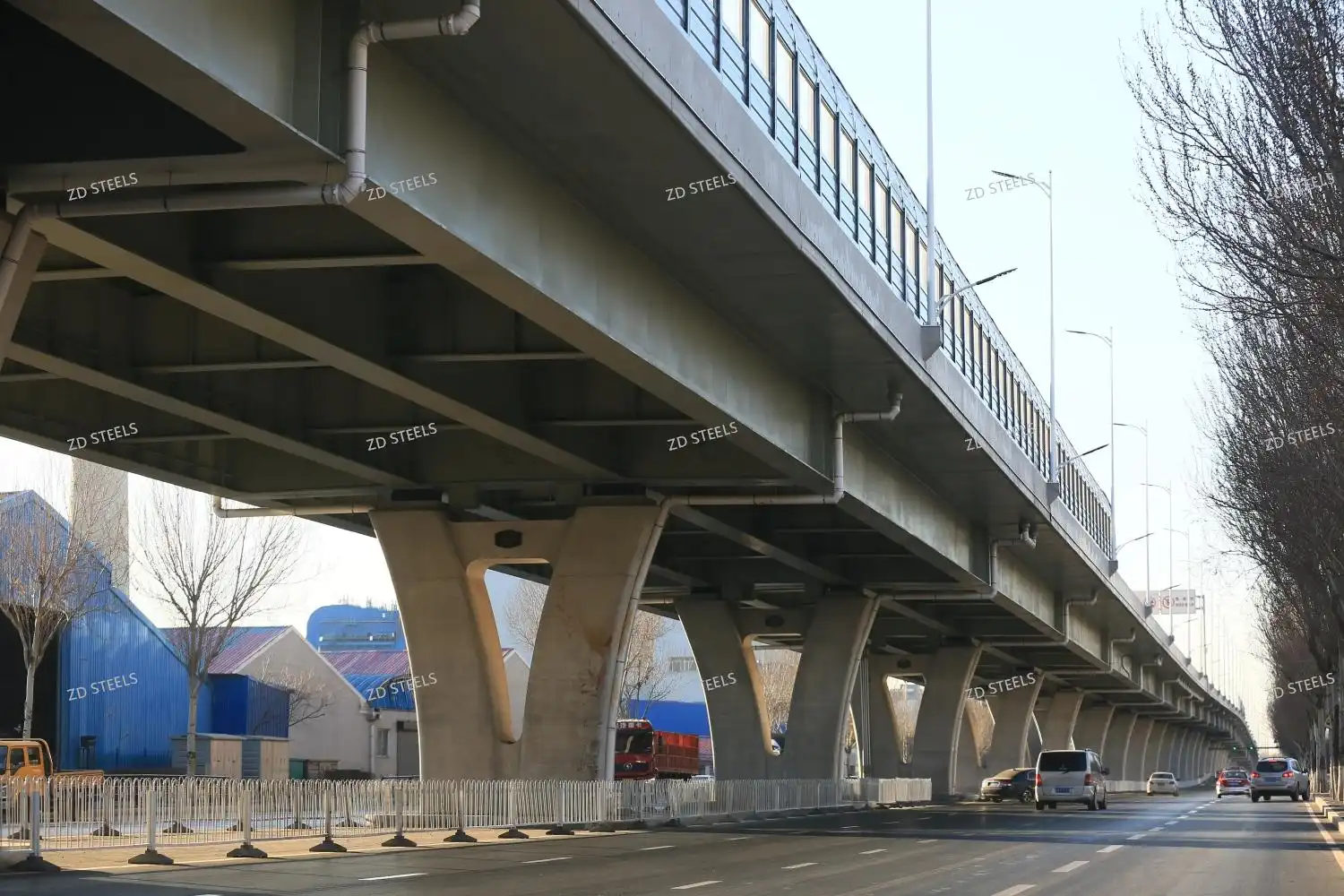
Practical Tips for Installation, Maintenance, and Longevity
Site Preparation and Assembly
Factory-made Steel Box Girder units cut down on the time needed for welding and testing on-site. Before delivering the module, crews should make sure that the bearing seats and pier caps are ready to a very high standard. Zhongda's modular pieces come in lengths ranging from 12 to 30 meters and are made to be installed by crane or launching gantry. This keeps traffic on busy streets to a minimum.
Routine Inspection Protocols
Steel bridge girders should have eye checks every six months to look for things like coating wear, surface rust, weld toe cracks, and deformation at diaphragm sites. Pay more attention to load-bearing connecting zones, especially in areas with a lot of traffic or earthquakes. If you notice a covering failure early on, you can avoid the more expensive repairs that come with section loss from rust.
Proven Project Performance
Some of the toughest projects that Zhongda's Steel Box Girder parts have been used on are the 18,000-ton Shenyang Dongta Cross-Hunhe River Bridge, the Jingha Expressway expansion, and several long-span railroad bridges. Deliveries to Russia, Australia, and Vietnam show that the company has the technical and logistical skills to work with government engineering agencies and EPC contractors around the world.
Why Steel Box Girders Are the Preferred Choice for Long-Span Bridges
As the span length goes up, it becomes clearer why a Steel Box Girder is better for the structure than other types of bridge superstructure. Better torsional resistance, less dead weight, quality control at the plant, and faster assembly on-site are all things that add up to better lifetime value. Long-term upkeep costs are also cut by anti-corrosion treatment methods that are rated to last at least 30 years.
In the future, longer service times will be possible thanks to more weathering steel types and high-performance coatings being used. Integrating BIM is lowering the number of mistakes made in design and raising the accuracy of manufacturing. The Steel Box Girder is still the best choice for long-span infrastructure investment for procurement managers and project engineers who need a tried-and-true, flexible structural solution with a history of compliance and quick technical support.
Conclusion
It is because Steel Box Girder bridges work well over long spans, are stable in twisting, and last a long time that they are used for large-scale infrastructure. This type of structure always meets the technical needs that open-section options can't, no matter if the project is a river crossing, an urban flyover, or a high-speed rail bridge. Procurement teams can be sure to move forward if they have the right supplier—one that offers certified materials, factory-controlled fabrication, and full lifecycle support. Since 2004, Zhongda has met that standard.
FAQ
1. How long do steel box girders last compared to concrete girders?
The hot-dip galvanizing or thermal-spray painting anti-corrosion treatment method that Zhongda's Steel Box Girders come with can last for at least 30 years if it is done right. In similar conditions, concrete girders often get surface cracks and rebar rust at the same time. Steel structures also let you fix specific parts without having to replace whole sections, which lowers the cost of long-term maintenance.
2. What maintenance does a steel box girder bridge require?
Visual inspections are usually done every six months. Inspectors look at the state of the finish, the strength of the welds, the links between the diaphragms, and how well the bearings work. Any damage to the coating should be fixed right away to keep the substrate from corroding. The inside of box parts should also be checked from time to time for wetness and rust caused by condensation, especially in humid or coastal areas.
3. Can box girders be customized for curved bridge alignments?
Yes. Because the cross-section is closed, it naturally resists the rotational forces that come from horizontal curves. This makes it a good choice for curved viaducts and urban interchanges. The engineering team at Zhongda creates cross-section shapes that can be changed and changes the internal diaphragm spacing to fit different load eccentricities and curving radii.
4. What certifications should a Steel Box Girder manufacturer hold?
Buyers should make sure that the seller has ISO 9001 quality management certification, EN 1090 structural steel execution certification, and welding credentials that meet AWS or similar standards. Zhongda holds ISO 9001/14001/45001, EN 1090, AWS, and JIS certifications, along with a Class I Steel Structure Professional Contracting Qualification.
Partner with Zhongda for Your Next Long-Span Bridge Project
Zhongda Steel has been supplying verified Steel Box Girders to big building projects in four countries since 2004. We work directly with EPC companies, government agencies, and engineering firms because we are a reliable Steel Box Girder maker that can make 60,000 tons of steel each year and offers full BIM-to-delivery support. Get in touch with our team right away to talk about the details of your project. You can email us at Ava@zd-steels.com.
References
1. American Association of State Highway and Transportation Officials (AASHTO). AASHTO LRFD Bridge Design Specifications. 9th ed. AASHTO, 2020.
2. American Welding Society. AWS D1.5: Bridge Welding Code. AWS, 2020.
3. Barker, Richard M., and Jay A. Puckett. Design of Highway Bridges: An LRFD Approach. 3rd ed. Wiley, 2013.
4. Chen, Wai-Fah, and Lian Duan, eds. Bridge Engineering Handbook: Superstructure Design. 2nd ed. CRC Press, 2014.
5. Highway Engineering Research Institute, Ministry of Transport of China. Technical Specification for Design and Construction of Steel Box Girder Bridges. China Communications Press, 2018.
6. Xanthakos, Petros P. Theory and Design of Bridges. Wiley-Interscience, 1994.
YOU MAY LIKE
