



What Steel Cable-stayed Bridge Design Fits Major Urban Transport Projects?
2026-10-15 13:00:00






When engineers and procurement managers ask which bridge type best suits high-density urban corridors, the steel cable-stayed bridge consistently rises to the top. Its structural system — where high-tension cables connect a steel deck directly to vertical pylons — delivers long clear spans, reduced pier counts, and a strength-to-weight ratio that concrete alternatives simply cannot match. For projects spanning 200 to 800 meters across rivers, rail lines, or urban expressways, this design balances structural performance, construction speed, and long-term serviceability in ways that matter most to B2B decision-makers.
Understanding Steel Cable-Stayed Bridges and Their Role in Urban Transport
How the Structural System Works
In a cable-stayed setup, stay wires connect the pylon to the deck directly and can be set up in a fan or harp shape. Each cable carries a load that is transferred to the pylon, which then compresses it. This load method is clear and works well. This makes a structure that can handle a lot of traffic without needing a lot of support in the middle. This is very helpful in cities where waterways, underground utilities, or other existing infrastructure make it impossible to put in piers.
Why Steel Outperforms Concrete in Urban Settings
Steel pylons and orthotropic steel beams are much lighter than their concrete versions. When the dead weight is lower, the base loads are lower, which is especially helpful in cities with soft earth. Because inertial forces increase with mass, steel also holds up better under seismic loads. The AASHTO LRFD Bridge Design Specifications say that one of the most cost-effective ways to build in high-seismic zones is to plan for less seismic mass.
Aesthetic Integration in Cityscapes
More and more, urban transportation authorities want bridges that don't take over skylines but instead blend in with them. Engineers and builders can make buildings that look light by using thin steel pylons and clean wire geometry. Because of this, the pylon-and-cable shape is now common in urban bridge planning in both North America and Europe.
Critical Design Factors for Major Urban Steel Cable-Stayed Bridges
Load Capacity and Steel Grade Selection
Bridge decks are put through a lot of stress in big cities where there is a lot of traffic. Standard structural steel cable-stayed bridges can't hit the levels of yield strength and toughness that high-performance steel grades like Q420qE can. This grade is used in Shenyang Zhongda's cable-stayed bridge system. Zhongda's cable towers are made with Q420qE plates that are 60 to 120 mm thick, and the vertical accuracy of the construction is kept within a 1/4000 error tolerance. Long-term load spread and fatigue resistance are directly affected by this level of accuracy.
Seismic Resilience and Isolation Technology
Seismic zones are very important places for isolation bearings to be used. When Zhongda adds LRB800 laminated rubber bearings to its bridge systems, the response time to earthquakes is cut by up to 40%. This level of efficiency meets or beats what is needed in California, the Pacific Northwest, and other areas with a lot of action. You can save a lot of money on project approval and construction if you choose a supplier who incorporates seismic design into the manufacturing process instead of adding it as an afterthought.
Corrosion Protection and Long-Term Maintenance
In cities, deicing salts, industrial chemicals, and UV rays can damage bridges. The Zhongda stay wire system has a PE cover on the outside and a graphene-based coating on the inside. The coating is UV-resistant for 53 years. The OVM250 mooring system uses ¥7mm galvanized wire that meets EN 10138 standards. This gives it multiple layers of protection against rust. Lifecycle maintenance costs go down when you choose a system with a documented corrosion life. This is a factor that is being used more and more to make decisions about buying public infrastructure.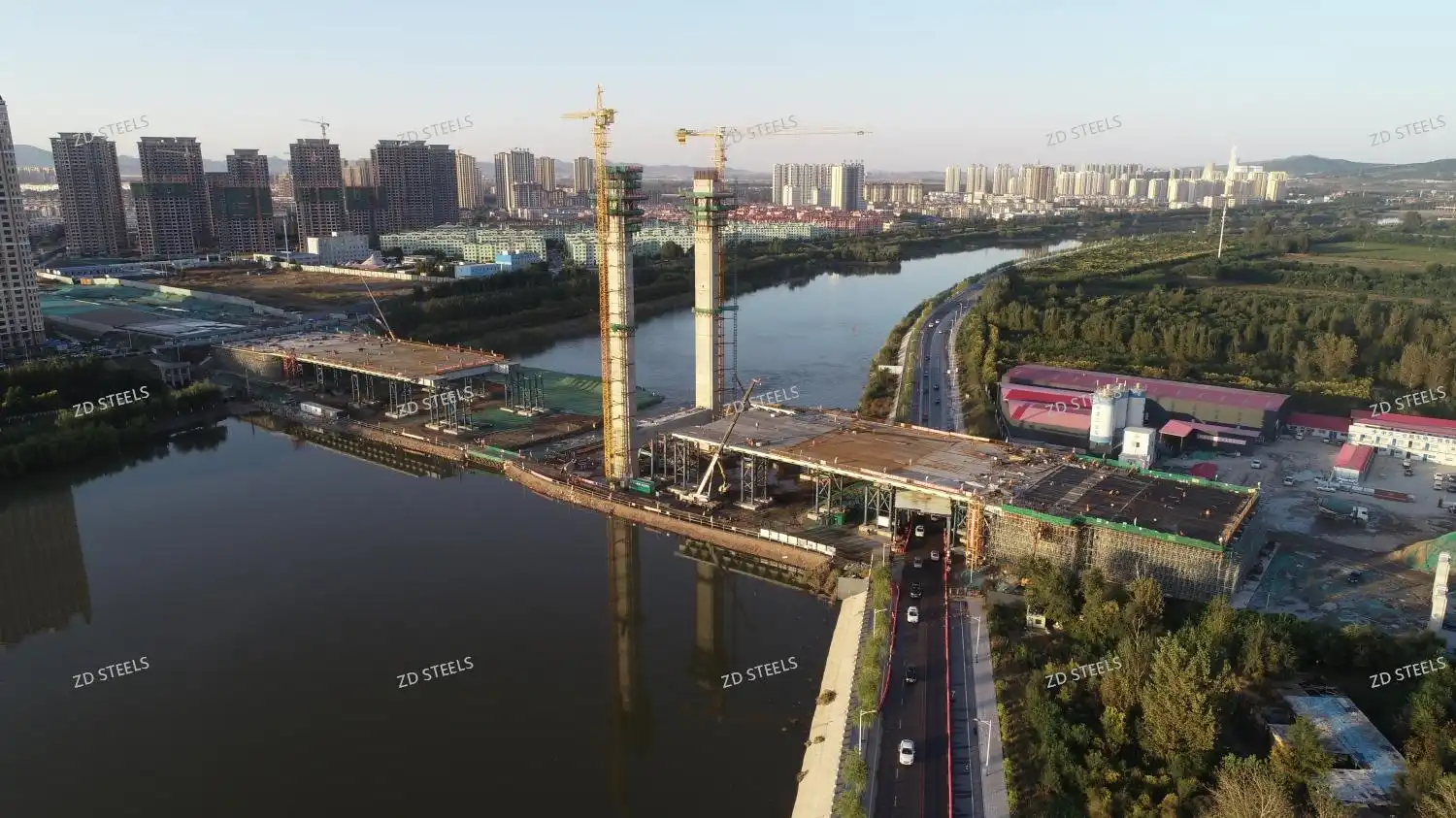
Comparing Steel Cable-Stayed Bridges with Alternative Designs
Different types of bridges are better for different types of projects. Here's how the big choices stack up when it comes to urban transportation:
- Concrete cable-stayed bridges offer lower material cost in some markets but carry a significantly higher dead load. Longer construction cycles and more complex formwork add time and cost, particularly in congested urban sites where access is limited and schedule delays are expensive.
- Suspension bridges excel at spans above 1,000 meters but require large anchorage blocks that consume substantial ground space. In dense urban cores, land availability makes this typology difficult to apply. Steel cable-stayed designs cover the 200–800m range more efficiently without anchorage land requirements.
- Arch bridges deliver strong aesthetics but demand significant lateral thrust management, which complicates foundation design in soft soil. Their construction also requires temporary falsework that can disrupt traffic for extended periods.
Steel Cable-stayed Bridges have the most practical performance range for urban transportation projects. Their modular design lets them be put together off-site before they are built, which cuts down on-site building time by up to 40% compared to cast-in-place methods. This number is backed up by accelerated bridge construction (ABC) case data. For these reasons, the steel cable-stayed configuration is the best choice for EPC contractors and government engineering clients who have to work with tight deadlines and limited space on urban sites.
Procurement Insights for Steel Cable-Stayed Bridge Projects
For a cable-stayed bridge job, finding the right provider is more than just looking at their certifications. I think you should look at sources based on three things: how technical they are, how much they can produce, and how reliable their service is.
All three of these conditions are met by Shenyang Zhongda Steel Structure Engineering Co., Ltd., which was established in 2004 and has its main office in Shenyang's Economic-Technological Development Zone. The business is certified by ISO 9001, 14001, and 45001, and it also has a Class I Steel Structure Professional Contracting Qualification. Its 120,000 m² building, which has a 50T crane and can make 60,000 tons of steel a year, is Northeast China's biggest steel workshop of this type. Compared to the rules in the industry, Zhongda's BIM-driven digital design process cuts lead times by 20–30%.
The OEM/ODM capability is important for buying teams. Zhongda can make full-span configurations with either a single or double cable plane, and the lengths range from 200 to 800 meters. The manufacturing process includes 3D coordinate detection and 0.5-inch total station inspection. Following the rules set by EN 1090, AWS, and JIS makes sure that parts meet the needs of foreign projects without having to be re-certified by a third party. Zhongda has a 70% client retention rate, which includes repeat business from China Railroad, CSCEC, and CCCC. This shows that they consistently deliver, which procurement managers can use to judge the performance of their suppliers.
Case Studies and Practical Applications in Urban Environments
Shenyang Dongta Cross-Hunhe River Bridge
The 18,000-ton steel structure for this important river crossing in Shenyang was finished being built by Zhongda. The project showed that the company could handle large-scale cable-stayed bridge parts with fine-grained control over dimensions and on-time delivery.
Jingha Expressway Expansion
For this freeway job, steel bridge parts made for heavy highway traffic loads were needed. Zhongda's participation proved that it can handle multi-structure expressway projects where supply and component consistency are essential.
Smart Monitoring and Future Trends
More and more, bridge owners in cities are using structural health monitoring (SHM) systems to keep an eye on things like deck deflection, shaking, and cable stress in real time. When they are combined with good manufacturing quality like Zhongda's, where 3D coordinate detection checks the pre-embedding of wire conduit, these tracking systems create accurate standard data. Graphene-enhanced coatings and high-grade steel are also in line with net-zero building goals because they make materials last longer and need to be replaced less often over a 100-year planned life.
Conclusion
For big transportation projects in cities with spans between 200 and 800 meters, the Steel Cable-stayed Bridge is still the best option from a technical and business point of view. It's exactly what government contractors, EPC firms, and infrastructure companies need: it has less mass, long clear spans, is compatible with earthquakes, and is built in modules. When procurement teams choose a manufacturer like Shenyang Zhongda that has a track record of successful projects, international certifications, and confirmed production capacity, they can be sure that they will be able to go from specification to delivery without sacrificing quality or time.
FAQ
1. What span range suits urban cable-stayed bridge projects?
Most crossings in cities are between 200 and 800 meters long. This range includes crossings over rivers, rail-over-highway structures, and urban viaducts. It doesn't need the big anchoring systems that suspension bridges do. This whole range is covered by Zhongda's system, which can be set up with either a single or double cable plane.
2. How do steel pylons compare to concrete pylons in seismic zones?
Steel pylons can be put up faster on-site and hold up better against lateral seismic loads. In cold places or active fault zones, steel doesn't break or crack easily like concrete pylons can when the ground moves quickly. The LRB800 isolation bearings cut the response to earthquakes by up to 40% more.
3. What corrosion protection should procurement teams specify?
Look for a cable with a copper wire core, an internal grease or wax fill, and a two-layer HDPE or PE cover. Zhongda adds an inner coating made of graphene that is rated to be 53 years resistant to UV light. This is more than the standard C5-M corrosion class requirements set by ISO 12944.
4. Can bridge decks be replaced or upgraded without full closure?
Yes. For modular rehabilitation, orthotropic steel decks are used. During off-peak hours, sections can be lifted and put back in place, which keeps the bridge open. One big benefit over composite concrete decks is that you don't have to close the whole thing down to do major repairs.
Partner with Zhongda for Your Next Cable-Stayed Bridge Project
International standards like EN 1090, AWS, and JIS are met by Zhongda's Q420qE Steel Cable-Stayed Bridge solutions, which can hold up to 60,000 tons per year and have 20–30% shorter lead times than the norm in the industry. We can help you whether you need a reliable Steel Cable-stayed Bridge provider for a government project or an OEM partner for a bridge with a unique span design. You can email us at Ava@zd-steels.com to talk about your project requirements right away.
References
1. American Association of State Highway and Transportation Officials (AASHTO). LRFD Bridge Design Specifications, 9th Edition. AASHTO, 2020.
2. Gimsing, N.J., & Georgakis, C.T. Cable Supported Bridges: Concept and Design, 3rd Edition. Wiley, 2012.
3. Fib (International Federation for Structural Concrete). Guidelines for the Design of Cable-Stayed Bridges. Fib Bulletin 30, 2005.
4. ISO 12944. Paints and Varnishes — Corrosion Protection of Steel Structures by Protective Paint Systems. International Organization for Standardization, 2018.
5. Structural Engineering International. "Seismic Performance of Cable-Stayed Bridges with Isolation Bearings." Structural Engineering International, Vol. 29, No. 3, 2019.
6. Chen, W.F., & Duan, L. (Eds.). Bridge Engineering Handbook: Superstructure Design, 2nd Edition. CRC Press, 2014.
YOU MAY LIKE
