



Can a Breeding Shed Improve Ventilation for Intensive Livestock Farming?
2026-10-15 13:00:00






Yes — a well-engineered breeding shed can significantly improve ventilation in intensive livestock operations. By combining purpose-built structural design with automated airflow systems, a modern livestock breeding facility addresses the most persistent air quality problems that conventional barns fail to solve. From ridge vent positioning to sensor-driven exhaust fans, the physical structure of a breeding shed directly determines how effectively ammonia, heat, and moisture are expelled. For procurement managers sourcing agricultural structures in the U.S. market, understanding this connection is essential before signing any supply contract.
Understanding Ventilation Challenges in Intensive Livestock Farming
Intensive animal production environments are harmful to living things. If you don't control movement properly, the problems get worse quickly.
Ammonia Accumulation and Respiratory Risk
Within hours in a sealed building, the amount of ammonia from manure can rise to a dangerous level. For human safety, the National Institute for Occupational Safety and Health (NIOSH) says to keep ammonia levels below 25 ppm. For animal welfare, levels below 20 ppm are often required. Most traditional barns with set wall windows don't meet this level all year long.
Heat Stress and Reduced Reproductive Output
A study in the Journal of Animal Science* found that heat stress in pigs can lower the number of babies they have by up to 10% and their ability to get pregnant. Poor roof protection and air that doesn't move inside are the main causes. Animal housing that doesn't have enough airflow can't keep the temperature between 60°F and 75°F, which is what most breeding animals need.
Regulatory Pressure Is Growing
In the U.S., both the USDA and state-level farm agencies are tightening safety and environmental standards. Facilities that can't show that they are controlling the air quality in a measured way now risk having their operations limited. When looking at any new living building, procurement teams have to think about how well it meets compliance standards.
How Breeding Shed Design Enhances Ventilation Efficiency
The physical architecture of a livestock Breeding Shed is the first line of defense against poor air quality. Material selection and structural geometry work together to produce consistent airflow.
Roof Profile and Ridge Vent Placement
A low-pitch shed roof — commonly built at a 2/12 pitch — paired with continuous ridge vents creates a natural thermal stack effect. Warm, ammonia-laden air rises and exits through the ridge while cooler air enters through sidewall inlets. Shed roof steel trusses with spans from 10 to 40 feet, built from Q235 or Q345 steel, support wide column-free interiors that allow air to circulate freely without obstruction. This open-span geometry is not achievable with timber frame construction of equivalent load capacity.
Sidewall Openings and Fan Integration
Adjustable sidewall panels and mechanical exhaust fans work alongside passive ridge ventilation to manage airflow under varying weather conditions. Steel wall framing allows precise placement of inlet baffles, ensuring uniform air distribution across the entire floor area rather than concentrated zones of stagnation.
Material Selection for Longevity in Corrosive Environments
Livestock buildings are chemically harsh environments. Hot-dip galvanized steel trusses, protected to ASTM A123 standards, resist the corrosive effects of ammonia and moisture that rapidly degrade timber. Sandwich panel walls with PIR or rock wool insulation maintain stable internal temperatures, reducing the energy load on mechanical ventilation systems.
Steel trusses fabricated from Q345 grade material carry higher tensile loads than standard Q235 equivalents, making them suitable for heavy snow load regions in the northern U.S. while maintaining the same slim profile that keeps interior airflow paths unobstructed.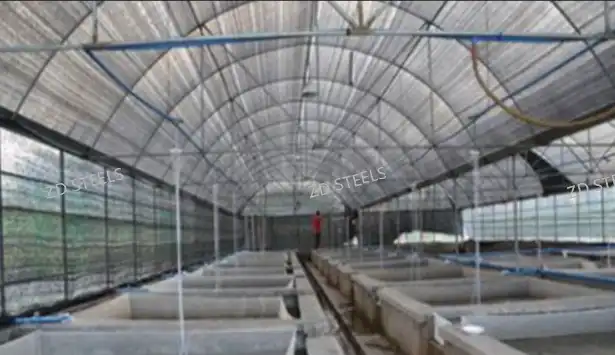
Comparing Breeding Sheds to Other Livestock Housing Options
When air is important, not all farm buildings work the same.
Prefabricated Steel Sheds vs. Traditional Timber Barns
Traditional wooden barns have real problems: wood soaks up water and warps over time, and they can't support the mechanical systems needed for temperature control without expensive repairs. A premade steel Breeding Shed facility, on the other hand, comes with connection points for fans, sensors, and automatic ridge vent actuators that have already been planned out. It usually takes 4–6 weeks to install a modular 1,000 m² steel structure, while it takes months to build a wood structure on-site.
Custom-Built vs. Standard Prefabricated Options
When steel buildings are made to order, procurement managers can define accurate span sizes, pitch angles, and places where ventilation systems can be connected. Lead times are longer than for catalog prefab choices, but the structure works better in the long run because it can be exactly matched to site factors, such as the direction of the wind and local building codes. Zhongda provides both OEM and ODM services, and they work directly from what the customer wants.
Cost-Performance Over the Full Asset Life
Steel beams cost more to make than wooden ones at first. But over a 20-year working life, the difference in upkeep costs is big. Galvanized steel doesn't need to be treated like wood every year, doesn't get damaged by pests, and doesn't need to be replaced after water damage. When buying, managers figure out the total cost of ownership; steel always gives them a better return.
Ventilation Maintenance and Temperature Control Best Practices
Regular upkeep is needed for even the best-designed structures to work as planned.
Scheduled Fan and Filter Inspection
Every three months, exhaust fans should be checked. Dust and pet hair build up on fan blades and outlet screens, which can cut airflow by up to 30% in just one production cycle if nothing is done. When inlets are blocked, negative pressure imbalances happen, which pull air unevenly across the animal housing area.
Automated Climate Monitoring
Environmental sensors connected to variable-speed fans and automatic vent actuators keep the temperature and ammonia levels in the right ranges 24 hours a day. It is important to calibrate these sensors every three months; a sensor that has drifted can let conditions get worse for weeks before a person notices. Fan systems' emergency backup power should be tested every six months.
Manure Management as an Air Quality Intervention
When the bacterial load they have to handle at the source is low, ventilation systems work best. Regularly cleaning up manure and using acid-resistant flooring in areas with a lot of ammonia lowers the rate at which ammonia is produced. This makes the time between repair rounds for the ventilation system longer.
Procurement Considerations: Selecting Breeding Sheds to Maximize Ventilation Benefits
Choosing the right supplier is as important as choosing the right structural specification.
Here are the core factors procurement managers should evaluate:
- Ventilation integration capability: Confirm that the supplier's structural design accommodates automated fan arrays, ridge vent actuators, and sensor cabling conduits as standard features, not aftermarket additions.
- Material certification: Request documentation for steel grade (Q235 or Q345), zinc coating weight (g/m² per ASTM A123), and weld integrity reports from non-destructive testing (NDT).
- Insulation performance: Verify the R-value of roof and wall panels. PIR sandwich panels in the 80–100mm thickness range provide sufficient thermal resistance for most U.S. climate zones.
- Compliance documentation: Ensure the supplier can provide structures compliant with local building codes, including wind load resistance up to 0.6 kN/m² and snow load ratings appropriate for the project location.
These criteria separate suppliers who understand livestock facility engineering from those who simply fabricate generic steel buildings. A supplier with ISO 9001:2015 certification and a documented quality control process from raw steel procurement through final delivery provides procurement teams with traceable assurance at each stage.
Conclusion
A well-thought-out structure for raising livestock is one of the best ways for a business to improve air quality and animal welfare. When building something, the choices you make about the truss span, roof pitch, material grade, and panel insulation will all affect how well the ventilation systems work over time. Steel construction, especially premade Q235 or Q345 beams with galvanized corrosion protection, is strong and gives animals the space they need to breathe. If procurement managers look at providers based on their structural engineering skills, the certification of their materials, and their ability to help with ventilation integration, they will always get better practical results than those who only look at the initial price of a breeding shed.
FAQ
1. How does a breeding shed control ammonia levels more effectively than a standard barn?
Ammonia levels are kept below 20 parts per million by automated ridge vents and sensor-linked exhaust fans that constantly check the air quality and change the volume of airflow in real time. Standard barns have openings that stay in place and can't be changed when the weather changes.
2. What steel grade is recommended for livestock breeding facilities?
Because it is more resistant to corrosion and has a higher tensile strength than Q235 steel, Q345 is better for places with a lot of humidity or ammonia. Depending on the load and the weather in the area, both grades can be used.
3. Can an existing livestock barn be retrofitted with a steel truss ventilation system?
It is possible to do some retrofitting, but the way older barns are built often limits where ridge vents can go and how big sidewall inlets can be. Long-term airflow performance is usually better after a full structure replacement with premade steel parts.
4. What is the typical service life of a galvanized steel breeding structure?
Steel buildings galvanized correctly and made for farming settings can last more than 20 years if they are kept according to the manufacturer's instructions.
5. How long does installation take for a prefabricated steel breeding facility?
Putting together a modular 1,000 m² building on-site usually takes 4–6 weeks, but this depends on how ready the foundations are and how complicated the mechanical systems are that are built in.
Get Your Breeding Shed Ventilation Solution from Zhongda
Zhongda offers certified Breeding Shed steel buildings that are made to work in areas with a lot of livestock. We are a reliable Breeding Shed supplier with over 18 years of engineering experience and ISO 9001:2015 certification. We offer Q235/Q345 steel trusses, corrosion-resistant panel systems, and full OEM/ODM customization. Get in touch with our team right away to talk about the details of your project. You can get professional advice and a quote by emailing us at Ava@zd-steels.com.
References
1. National Institute for Occupational Safety and Health (NIOSH). Criteria for a Recommended Standard: Occupational Exposure to Ammonia. NIOSH, 1974.
2. St-Pierre, N. R., Cobanov, B., & Schnitkey, G. "Economic Losses from Heat Stress by U.S. Livestock Industries." Journal of Dairy Science, 2003.
3. Tao, S., & Dahl, G. E. "Invited Review: Heat Stress Effects During Late Gestation on Dry Cows and Their Calves." Journal of Dairy Science, 2013.
4. Hoff, S. J., Janni, K. A., & Jacobson, L. D. "Three-Dimensional Buoyant Turbulent Flows in a Cold, Ventilated, Swine-Confinement Building." Transactions of the ASAE, 1992.
5. Groot Koerkamp, P. W. G., Metz, J. H. M., Uenk, G. H., et al. "Concentrations and Emissions of Ammonia in Livestock Buildings in Northern Europe." Journal of Agricultural Engineering Research, 1998.
6. American Society of Agricultural and Biological Engineers (ASABE). Design of Ventilation Systems for Poultry and Livestock Shelters. ASABE Standards, 2012.
YOU MAY LIKE
