



Custom Breeding Sheds Support Efficient Poultry and Livestock Operations
2026-10-15 13:00:00






A well-designed breeding shed does more than shelter animals — it directly shapes reproductive outcomes, disease control, and daily operational costs. Whether you manage poultry flocks, swine herds, or small ruminants, the right livestock enclosure determines how efficiently your facility runs. At Zhongda, we engineer steel-framed breeding structures built to perform under real agricultural conditions. This article walks through design principles, material comparisons, procurement guidance, and maintenance practices to help B2B buyers make confident, informed decisions.
Understanding Custom Breeding Sheds and Their Role in Livestock Efficiency
What a Breeding Shed Actually Does
A Breeding Shed is a specially built agricultural enclosure that controls the temperature, humidity, airflow, and biosecurity of animals during mating, pregnancy, and the first few weeks of raising them. These buildings are different from regular farm buildings because they are designed to meet the biological needs of specific species, like broiler chickens, farrowing sows, or breeding rabbits.
How Controlled Environments Improve Productivity
A study published in 2019 in the journal "Poultry Science" confirms that changes in temperature inside layer flocks that are higher than 4°C make fertilization rates much lower. A chicken coop with good insulation and automatic ventilation keeps the temperature inside stable, which lowers the death rate of newborns and raises feed conversion rates.
The Business Case for Custom Design
Most off-the-shelf buildings don't meet the mechanical, biosecurity, or space needs of large-scale activities. Purchasing managers can choose the span width, insulation grade, flooring type, and equipment fixing points for custom cattle housing from the very beginning. This cuts down on later costs and downtime.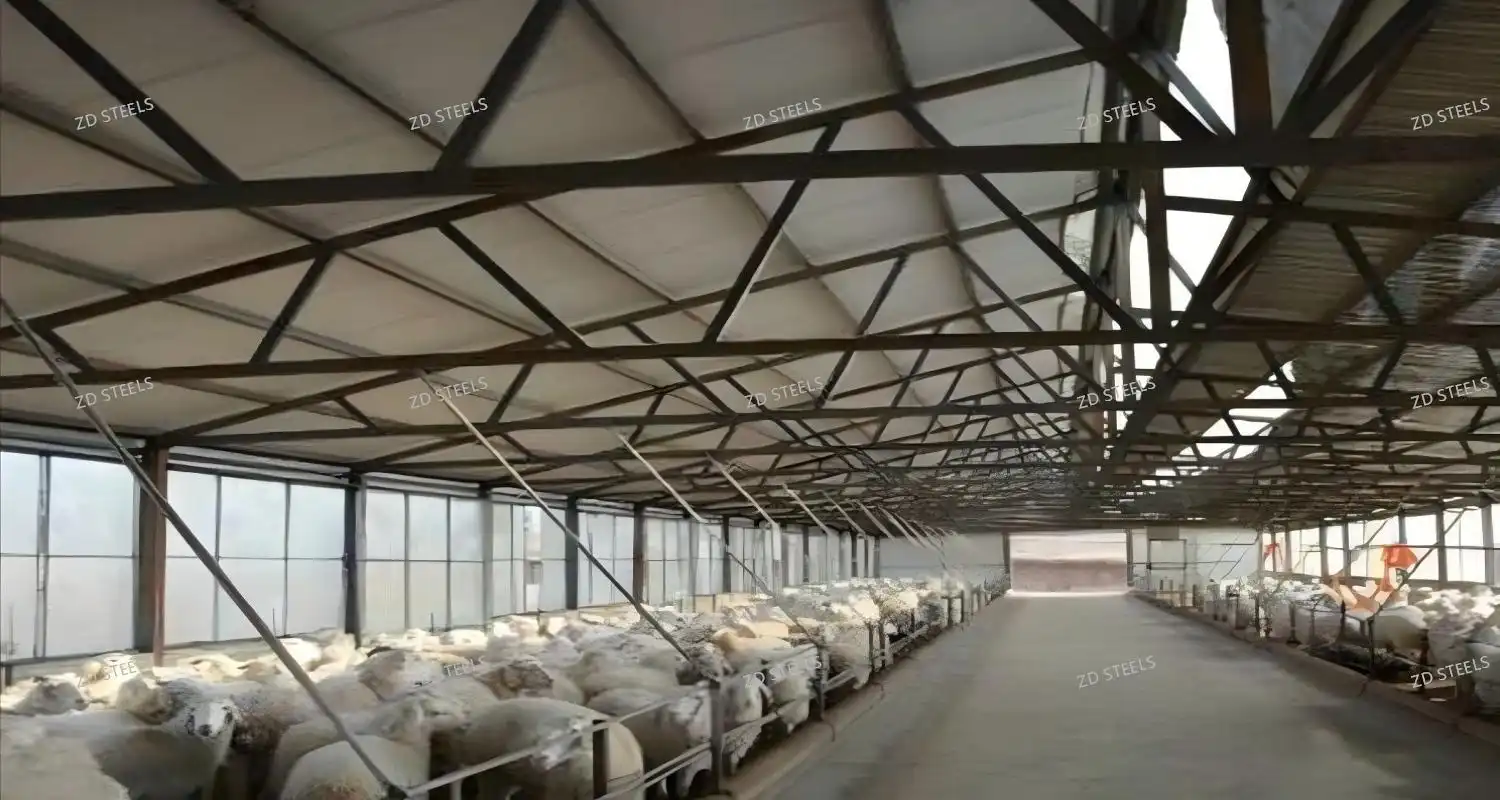
Essential Design Principles and Construction Best Practices
Space Layout and Animal Welfare Standards
Designing a good livestock facility starts with figuring out how much floor room each species needs. The USDA says that industrial companies should have at least 1.5 square feet of space for each broiler bird. To keep animals from losing their babies because of stress, the plan should group them by reproductive stage and have different areas for mating, pregnancy, and feeding.
Material Selection: Steel Frames and Insulated Panels
In places with a lot of ammonia and humidity, hot-dip galvanized steel frames, which are usually made from Q235 or Q355 structural steel, work better than wood. When paired with PIR or rock wool sandwich panels rated at R-20 or higher, they keep the inside stable without using too much HVAC energy. Steel also doesn't let bugs and mildew in, which directly lowers the cost of long-term upkeep.
Ventilation and Lighting as Operational Tools
Negative-pressure ventilation systems keep ammonia levels below 20 ppm, which is the level that OSHA says is safe for animals to be exposed to for a long time. Animal Reproduction Science (2021) found that natural photoperiods-like LED lights could help ewes get into estrus up to 18% more quickly. These systems shouldn't be added as an addition; they should be built into the structure from the start.
The Role of Shed Roof Steel Trusses in Agricultural Buildings
The roof system is the most important part of any good breeding shed cage. For agricultural and industrial uses where load reliability and durability are essential, Zhongda's shed roof steel trusses are designed to meet those needs.
What makes Zhongda's truss system unique and what its main technical features are
- Span range of 10 to 40 feet: This covers everything from compact poultry breeding units to wide-span swine gestation facilities, eliminating the need for interior columns that disrupt animal movement and equipment access.
- Standard 2/12 pitch with customizable angles: The low-slope design channels water efficiently while keeping internal ceiling heights consistent — an important factor for ventilation system performance.
- Q235 and Q345 structural steel: Both grades provide the tensile strength and welding compatibility needed for long-term structural integrity in corrosive agricultural environments.
- Bolt-connection and welding options: Bolt connections allow faster on-site assembly and future disassembly for facility expansion. Welded joints offer higher structural rigidity for permanent installations.
These technical requirements directly address the needs for durability and space in modern housing for animals. The open-span design gets rid of the need for support columns inside, so workers can set up feeding equipment, automatic waste systems, and animal stalls without worrying about how the structure will affect their plans.
In addition to meeting structural requirements, Zhongda's beams have a galvanized finish that is resistant to rust and has been tested to meet ASTM A123 standards. As required by ISO 9001:2015, each truss set goes through computer-aided design, precise cutting, approved welding, and a multi-stage quality testing process before it is shipped.
Comparing Breeding Sheds: Materials, Types, and Cost Considerations
Prefabricated vs. Custom-Built Structures
Prefabricated breeding cages can be set up more quickly; a 1,000 m² modular building can usually be put together in four to six weeks. They often have to make trade-offs when it comes to span width, insulation rating, or internal layout, though. Custom-built steel buildings take longer to deliver, but they are perfect for the spot and the way things need to be done without any changes.
Steel vs. Timber vs. Plastic Framing
Wooden frames are cheaper to buy at first, but they break down faster in damp, ammonia-filled places. Plastic framing systems are good for small rabbit or chicken farms, but they can't support the weight of automatic feeding or ventilation systems. The initial cost of galvanized steel frames is higher, but they pay for themselves over 20 years of use and almost no maintenance.
Flooring and Insulation Trade-offs
In areas where pigs are being born, concrete floors with acid-resistant coatings work best. Slatted composite flooring works well in breeding shed chicken coops because it keeps the birds away from the waste. In all cases, covering the floor slab cuts down on condensation, which is a main cause of lung diseases in young animals.
Procuring the Right Custom Breeding Shed: Supplier Selection Criteria
Certifications and Quality Standards to Verify
Business-to-business buyers should make sure that any seller of structural steel is certified by ISO 9001:2015 and follows EN 1090 or a similar national standard. China's Ministry of Housing and Urban-Rural Development gave Zhongda a First-Class Steel Structure Engineering Qualification. He is also certified by ISO 9001, ISO 14001, and OHSAS 45001.
OEM and Custom Design Services
Not all providers can do engineering that is specific to a job. Zhongda's in-house design team can do both OEM and ODM work. They use your site drawings, load requirements, and function specifications to make truss systems and structural parts that fit without having to be changed in the field.
Delivery, Logistics, and After-Sales Support
The consistency of the packaging during ocean or land freight is just as important as the quality of the goods being made. Zhongda's transportation team plans shipments for large orders and makes sure that deliveries happen on time so that they don't interfere with your building schedule. Technical support after delivery is available from project engineers who are dedicated to the job.
Maintenance and Operational Tips to Maximize Shed Performance
Daily and Seasonal Upkeep Routines
Checks should be done every day to make sure the air fan works, the water lines are intact, and the feed system works. At least twice a year, seasonal checks should look at the links between roof trusses, the joints between insulation panels, and the state of the zinc coating on structural steel members.
Environmental System Calibration
Automated devices that measure temperature, humidity, and ammonia need to be calibrated every three months to maintain their accuracy. Backup power systems connected to HVAC and ventilation units need to be tested every six months to make sure they work without stopping when the power goes out.
Extending Structural Service Life
Putting a touch-up C5-M grade anti-corrosion coating on any steel that is exposed after the first year of use stops it from rusting quickly in places with a lot of moisture. For permanent placements, non-destructive tests should be used every five years to check the weld's integrity.
Conclusion
A good breeding shed area is an investment in infrastructure that has a direct effect on the health and safety of animals and the costs of running the facility in the long term. When it comes to commercial livestock operations, steel-framed buildings with properly engineered roof truss systems are better than wooden and plastic alternatives in almost every way that matters. When purchasing managers and construction engineers look at projects for livestock facilities, they should make sure that the structural requirements match the operational needs from the start of the design phase. This way, they can avoid having to make expensive changes later on. Zhongda's tech team and ability to make things work make this process easy for buyers of all sizes.
FAQ
1. What steel grade should I specify for a breeding shed in a high-humidity climate?
In places where humidity and ammonia are present all the time, Q345 steel has a higher yield strength and better resistance to structural fatigue than Q235 steel. For places near the coast, choosing hot-dip galvanized coatings that have been tested to ASTM A123 adds another barrier against rust.
2. How long does a modular steel breeding enclosure take to assemble?
On-site building of a modular structure of about 1,000 m² usually takes four to six weeks, but this depends on how complicated the internal mechanical systems are and how easy it is to get to the site.
3. Are prefabricated steel trusses suitable for large-scale poultry operations?
Yes. Pre-engineered steel roof trusses with spans of 10 to 40 feet get rid of interior columns, which lets large poultry farms have the open floor space they need for automated feeding lines and airflow ducts.
4. What maintenance does the ventilation system require?
Environmental sensors need to be calibrated every three months. Every month, you should check the exhaust fans and ridge vents for any growth of garbage. Tests should be done every six months on emergency backup power systems that are connected to ventilation units.
5. How do I verify a steel structure supplier's qualifications?
Get copies of the ISO 9001 certificates, the national engineering qualifications, and the inspection reports from a third party. To make sure you can count on the delivery, ask for project references from similar industrial or agricultural uses.
Partner With Zhongda for Your Next Breeding Shed Project
Since 2004, Zhongda has sold precision-engineered steel structures to builders, EPC companies, and people who are building farming facilities in more than 30 countries. We are a reliable Breeding Shed maker with ISO 9001/14001/OHSAS 45001 certifications and the ability to produce 60,000 tons of sheds every year. We can make unique truss systems, structural frames, and full enclosure packages that are exactly what you need. Send an email to Ava@zd-steels.com to get a price on your job right away.
References
1. Lay, D.C., et al. "Swine Housing and Welfare." Journal of Animal Science, 2011.
2. Dozier, W.A., et al. "Effects of Environmental Temperature on Broiler Performance." Poultry Science, 2019.
3. Chemineau, P., et al. "Photoperiodic and Melatonin Treatments to Control Seasonal Reproduction in Sheep." Animal Reproduction Science, 2021.
4. National Institute of Building Sciences. Whole Building Design Guide: Agricultural Facilities. 2018.
5. USDA Agricultural Research Service. Poultry Housing and Ventilation Standards for Commercial Operations. 2020.
6. American Institute of Steel Construction (AISC). Steel Construction Manual, 16th Edition. 2023.
YOU MAY LIKE
