



Custom Steel Box Girders Meet Complex Highway and Rail Requirements
2026-10-15 13:00:00






When engineers face the challenge of designing long-span bridges or elevated rail corridors, the steel box girder stands out as one of the most dependable structural solutions available. Its hollow, closed-loop cross-section delivers exceptional torsional rigidity and load distribution that traditional open-section beams simply cannot match. At Shenyang Zhongda, we fabricate custom steel box girders built to precise engineering specifications — from Q345D and Q420D high-strength steel to variable cross-sections reaching spans of up to 420 meters — giving procurement teams and EPC contractors the confidence they need from day one.
Understanding Custom Steel Box Girders for Complex Infrastructure
Structures that come off the shelf don't always work well for bridge or overpass projects because they aren't all the same. Because each girder is made to order, it can be designed to meet the exact needs of a project, whether that's a tight horizontal curve in an urban interchange or high wind loads on a coastal crossing.
Structural Design Principles That Perform
The fully welded box section of a Steel Box Girder spreads bending force much more evenly than an I-beam shape. The closed shape prevents lateral and torsional buckling, which is very important for long spans that are not supported. The structure stays stable under both static and dynamic loads thanks to longitudinal and transverse stiffeners that stop local plate bending.
Single-Cell vs. Multi-Cell Configurations
When the spans are narrow and the traffic loads are light, single-cell box sections work well. When the spans are wider and the axle loads are heavier, multi-cell configurations are chosen. For instance, viaducts that carry heavy freight rail often need multi-cell designs with extra interior diaphragms to handle load transfer across the full deck width without adding extra dead weight.
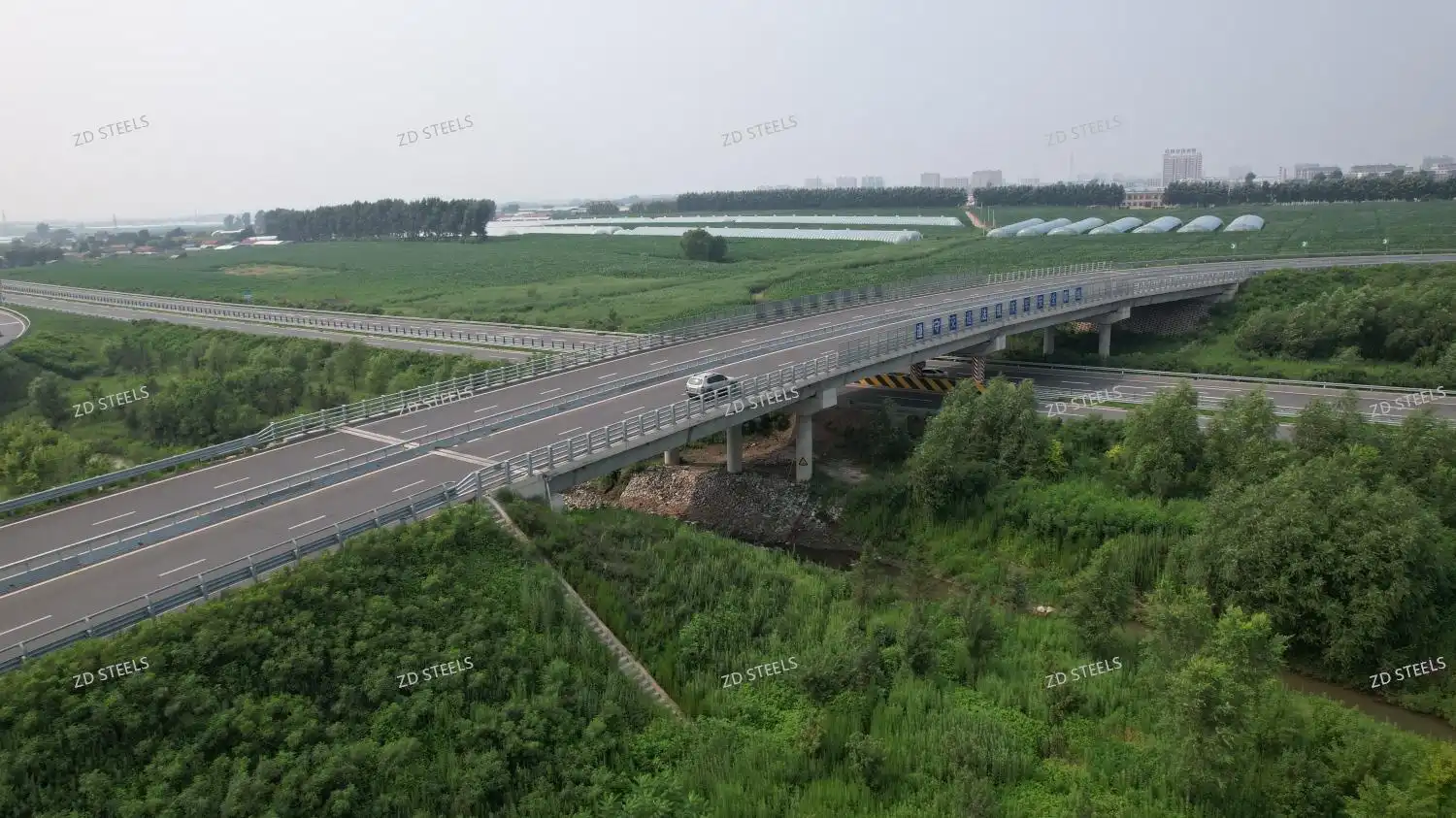
Material Specifications and Grade Selection
Zhongda's main building material is Q345D steel, which has a minimum yield strength of 345 MPa. Q420D steel is used in high-stress areas and critical connection zones. On request, grades that are the same but different, like ASTM A709 Grade 50W or EN S355, can be sent for international projects. When you choose these materials, they directly support fatigue resistance over at least 30 years of design service life.
Challenges in Highway and Rail Construction and How Custom Box Girders Solve Them
Tight deadlines, hard-to-reach job sites, and the need to cause as little disruption to current traffic as possible are all things that regularly put pressure on the construction business. Normal concrete girders are big, take a long time to make, and are hard to change once they are made. Standard I-beams can't bend in the way that bent lines need them to. These issues are all directly addressed by Custom Steel Box Girders.
Overcoming Span Limitations
Because they are heavy, concrete box girders can't be used beyond about 200 meters. Because it is strong for their weight, a Steel Box Girder can hold spans of up to 420 meters without the need for extra props in the middle. Fewer piers mean less damage to the environment and lower foundation costs, which is a big plus for crossing rivers and building in areas that are sensitive to the environment.
Accelerated Construction Through Prefabrication
At our 120,000 m² factory in Shenyang, Zhongda makes girder modules that are typical lengths of 12 to 30 meters. Compared to cast-in-place concrete methods, these factory-built pieces arrive at the job site ready to be put together. This cuts the time needed for building by up to 50%. This method worked well on the Shenyang Dongta Cross-Hunhe River Bridge, where 18,000 tons of steel that had been cut to shape had to be shipped and put together on very tight deadlines.
Corrosion Protection in Harsh Environments
Zhongda uses a two-layer anti-corrosion method that includes hot-dip galvanizing or thermal spray zinc and a finish made of high-build epoxy and polyurethane. This C5-M class protection system can work in a wide range of settings, from marine exposure near the coast to chemical atmospheres in factories. With regular upkeep, it can last for more than 30 years. As our work with clients in Russia shows, our own -60°C Weathering Steel Anti-corrosion Technology can also handle the needs of Arctic bridge projects.
Procurement Insights: Choosing the Right Steel Box Girder Supplier
One of the most important choices a procurement manager on a big building project has to make is which seller to use. Making the wrong choice can cause delays in production, problems with quality, and compliance risk. Here are the main things that experienced buyers look at when deciding what to buy:
- Certification scope: Confirm that the supplier holds ISO 9001 for quality management, EN 1090 for structural steel execution in international markets, and AWS D1.5 compliance for bridge welding. Zhongda holds ISO 9001/14001/45001, EN 1090, AWS, and JIS certifications, along with China's Class I Steel Structure Professional Contracting Qualification.
- Production capacity and lead time: A supplier with 60,000 tons of annual production capacity can absorb large orders without compromising delivery schedules. Zhongda's vertically integrated operations — from CNC ultra-thick plate cutting (±0.2mm tolerance) to automated welding lines — reduce project lead times by 20 to 30%.
- BIM integration and engineering support: Modern infrastructure projects run on Building Information Modeling. Zhongda's engineering team works directly within client BIM environments, coordinating geometry, connection details, and erection sequencing before a single plate is cut.
- Track record on comparable projects: Verified project references matter. Zhongda's portfolio includes the Jingha Expressway expansion, multiple long-span railway bridges, and international EPC collaborations across Asia and beyond.
Track record on similar projects: References from real projects are important. Zhongda is working on the Jingha Expressway expansion, a number of long-span railroad bridges, and foreign EPC projects in Asia and other places.
Comparative Evaluation: Steel Box Girders vs. Alternative Girder Types
It is common for procurement teams to compare box girders to I-beams, prestressed concrete, and truss girders. Each is useful in some situations, but the speed gap gets much bigger as span length and load complexity go up.
Steel Box Girder vs. Concrete Box Girder
When the distance is short and the cost of work is low, concrete is a better choice. But a Steel Box Girder section weighs about 40 to 60% less than a similar concrete section. This means that less base work is needed and the structure can be put up faster. Lifecycle upkeep costs are also better for steel when it is combined with current finishes that protect it.
Steel Box Girder vs. I-Beam and Truss Girder
Because I-beams have an open cross-section, they don't offer much torsional resistance. This means they can't be used for curved highway ramps or rail lines that are loaded from the side. Truss girders are good for long spans because they save space in the middle, but they need to be put together on-site, which takes more time and requires more inspections of the connections. There is a closed-box profile that is both bending- and torsion-efficient in a single unit.
Versatility Across Project Types
Steel Box Girders are used for more than just bridges. They are also used for elevated transit guideways, industrial conveyor support structures in mining operations, and the runway beams of port gantry cranes. The box girder is the best choice for projects that need both power and speed because it can be used in a lot of different sectors.
Maintenance and Long-Term Performance Optimization
A Steel Box Girder that was built well doesn't take care of itself. A planned program for inspections and repairs keeps the infrastructure investment safe and makes sure that buildings follow safety rules for as long as they are supposed to.
Routine Inspection Protocols
A basic maintenance plan for any steel bridge includes visual checks, ultrasonic weld tests, and measurements of the thickness of the coating. Pay more attention to features that are easily worn out, especially at diaphragm connections and bearing zones, on structures that carry heavy dynamic loads, like freight train.
Digital Monitoring Technologies
Fiber-optic strain monitors and accelerometers built into big bridge projects now make it possible to check on the health of the structure in real time. Digital twin models use data to keep track of past loads, spot strange behavior, and help support teams plan actions to take before problems get worse. This method cuts down on unplanned closures and increases the time between inspections for structures that are working well.
Corrosion Management Over Time
Even if you use a C5-M coating method at first, you will need to recoat it every 15 to 20 years, based on the environment. Zhongda provides fabrication and maintenance services on-site, which means that the technical team that built your structure can also take care of it in the future.
Conclusion
Custom Steel Box Girders give modern highway and rail projects the structural performance, span capability, and cost-effective building effectiveness they need. Every part of the product is designed to lower risk and improve project results. For example, the high-strength Q345D/Q420D materials are chosen, and prefabricated sections cut on-site time in half. Because Zhongda can do approved production, has worked on projects around the world, and offers full lifecycle support, procurement teams can depend on us throughout the whole project.
FAQ
1. What drives the cost of a custom steel box girder?
Steel grade, section geometry complexity, span length, fabrication volume, and the anti-corrosion system chosen are the main things that affect the cost. Variable cross-section designs and flexible web optimization can cut the weight of materials by up to 20%, which makes up for the higher costs of making bigger orders.
2. How does a steel box girder compare to a concrete girder in terms of service life?
If you use a dual-layer corrosion protection system the right way, a Steel Box Girder can last more than 30 years, and with regular maintenance, it can often last 75 to 100 years. In coastal or de-icing salt environments, chloride-induced rebar corrosion can happen to concrete girders, which can make them last a lot less time.
3. What certifications should I verify before placing a fabrication order?
Check that at least ISO 9001 is followed for quality management, EN 1090 is followed for structural steel execution class (EXC3 or EXC4 for bridges), and AWS D1.5 is followed for bridge welding. For U.S. federal transportation projects, you must also follow the AASHTO LRFD design guidelines. All of these things are true about Zhongda.
4. Can Zhongda supply girders for both highway and rail applications?
No, Zhongda's engineering team has not only built road bridges but also elevated rail guideways and hybrid transportation corridors using Steel Box Girders. The section's beam height can be anywhere from 1.25 meters to 8 meters, and it can reach 420 meters for a single span.
Partner With Zhongda — Your Trusted Steel Box Girder Manufacturer
Every project that Zhongda works on is backed by more than 20 years of certified fabrication experience. Our engineering team is ready to look over your structural plans, give you advice on how to get the most out of your materials and sections, and get your project site on time with Steel Box Girder solutions that are carefully made. We help procurement teams all over the world and in the U.S. with our ISO/EN/AWS-certified quality and 60,000-ton yearly capability. To get detailed advice right away, email Ava@zd-steels.com with the details of your project.
References
1. American Association of State Highway and Transportation Officials (AASHTO). LRFD Bridge Design Specifications, 9th Edition. 2020.
2. American Welding Society. AWS D1.5: Bridge Welding Code. 2020.
3. Xanthakos, P. P. Theory and Design of Bridges. John Wiley & Sons. 1994.
4. Galambos, T. V., & Surovek, A. E. Structural Stability of Steel: Concepts and Applications for Structural Engineers. John Wiley & Sons. 2008.
5. Federal Highway Administration (FHWA). Steel Bridge Design Handbook: Box Girder Bridges. U.S. Department of Transportation. 2015.
6. Dunker, K. F., & Rabbat, B. G. "Why America's Bridges Are Crumbling." Scientific American. 1993.
YOU MAY LIKE
