
What Are the Advantages of Steel Cable-stayed Bridge Design?
2026-09-22 13:00:00






Steel cable-stayed bridges represent one of the most significant advancements in modern structural engineering. By anchoring high-tension steel cables directly to vertical pylons, this bridge system transfers deck loads efficiently while minimizing material use. Compared to suspension or concrete alternatives, a steel cable-stayed bridge delivers a superior strength-to-weight ratio, longer achievable spans, accelerated construction timelines, and a design life that can exceed a century with proper maintenance. For EPC contractors, infrastructure developers, and procurement teams, these structural and economic advantages make cable-stayed steel bridges the preferred choice for demanding, high-stakes projects.
Understanding Steel Cable-Stayed Bridges
A Steel Cable-stayed Bridge has a simple but effective design: steel cables connect one or more pylons to the bridge deck, putting strain on the cables and compression on the deck. This straight load path gets rid of the need for the big base blocks that suspension bridges need. This makes the site much simpler and cuts down on foundation costs by a large amount.
Core Structural Components
The deck, the stay cables, and the pylons are the three main parts that work together as a single unit. The pylons push down on the foundation with compressive forces, and the stay cables pull up on the deck and load it down on the pylon in a tensioned way. The deck, which is usually made of orthotropic steel box girders, doesn't bend horizontally. Cable-stayed structures are very stiff compared to their weight because of this triangulated force balance.
How Steel Differs From Concrete in This Application?
Cable-stayed concrete bridges are heavier, take longer to build, and aren't as flexible in areas prone to earthquakes. Steel pylons and decks can be prefabricated off-site, connected in the field with bolts or welds, and work better in cold weather, which is very important for projects in northern regions or high-altitude routes.
Core Advantages of Steel Cable-Stayed Bridge Design
Professional engineers always choose this type of structure for reasons other than how it looks. Performance history at hundreds of major crossings around the world shows that the benefits can be measured and repeated.
In terms of structure and operation, these are the main things that make this Steel Cable-stayed Bridge system stand out:
- High Strength-to-Weight Efficiency: Q420qE-grade structural steel has a yield strength that lets cable towers with plate widths of 60–120 mm hold up major spans of 200–800 meters. When compared to truss or girder options, less material is needed per unit of width. This directly lowers the weight and base loads.
- Extended Service Life Through Advanced Corrosion Protection: Stay cables with a dual-layer system—an outer sheath made of PE and an inner coating made of graphene—have a UV resistance rating that is higher than 53 years. At the molecular level, graphene's ability to keep air and water out is a big step forward from epoxy or zinc-based coatings.
- Seismic Resilience: LRB800 lead-rubber bearing isolators, built into the connections between the deck and the pylons, soak up seismic energy and lower the structure's response by up to 40%. This performance measure is often required by law, not just a choice, in areas of the western United States that are prone to earthquakes and along coastal routes.
- Aerodynamic Stability: Streamlined steel box girder profiles have much lower drag coefficients than open truss decks. This means that wind-induced vibration and vortex shedding are less likely to happen, which is what has caused fatigue cracking in older bridge types.
All of these benefits add up to a lifetime cost profile that is better than heavier options in almost every way, from the time of manufacture to decades of use.
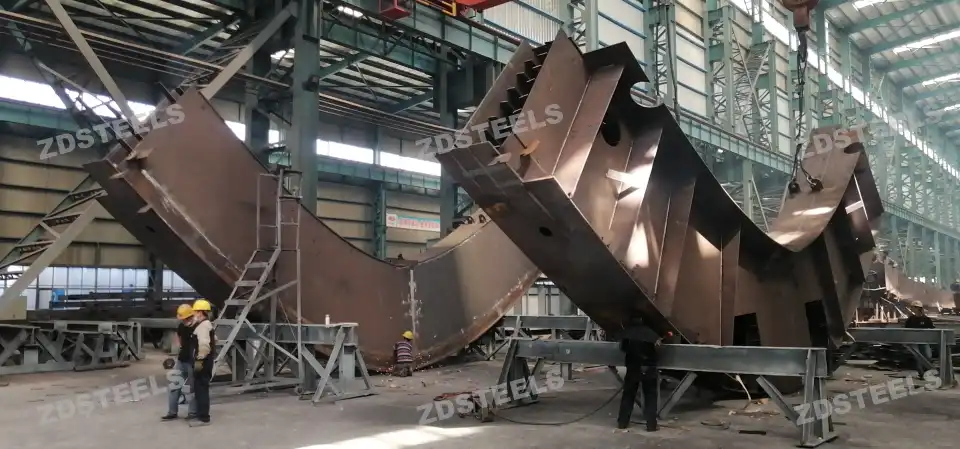
Comparative Analysis: Steel Cable-Stayed vs. Other Bridge Types
When buying, teams look at bridge systems; they can quickly make a decision by comparing them directly across key performance areas.
Because the steel segments are already made and ready to bolt into place, Steel Cable-stayed Bridges can be put up faster than concrete cable-stayed bridges. A balanced cantilever steel deck can move 6–8 meters per cycle without any forms, but cast-in-place concrete needs time to cure at each stage. On projects like highway growth and urban transit that need to be built quickly, this difference can mean a 30–40% drop in the total amount of time spent building on-site.
For spans less than about 1,000 meters, cable-stayed designs are more cost-effective than suspension bridges. Suspension bridges need two huge support systems that take up a lot of space and put a lot of weight on the base. Cable-stayed systems can mostly hold themselves up, which makes them useful for urban areas with limited space or soft ground.
When the span is more than 150 meters, traditional beam and truss bridges can't be built economically. As the span length goes up, their dead weight goes up faster than their load capacity. This creates a structural ceiling that cable-stayed systems can't reach.
Construction and Maintenance Considerations
Quality Standards and Inspection Protocols
Reliable bridge performance starts in the shop where the bridge is made, not on the construction site. At Shenyang Zhongda, a 0.5-inch total station is used to find the 3D coordinates of every part of the cable tower. This makes sure that the vertical accuracy is within a 1/4000 error limit. Stay cables are made with OVM250 anchorage systems and Φ7mm galvanized wire that meets EN 10138 standards for minimum breaking force, relaxing qualities, and surface coating regularity. Before they are shipped, all important welds are tested with ultrasound and X-rays.
Construction Sequence and Efficiency
The steps for erection are arranged in a way that makes sense: building the foundation and pylon base, putting up the pylon shaft in lifts, making sure that the cable conduit is pre-embedded using 3D detection, installing the deck segments using a balanced cantilever, and finally tightening the cables to the theoretical design model. BIM-based digital design is used throughout Zhongda's workflow. It lets engineers virtually model each stage of building, finding problems like clashes and uneven loads before they happen in real life. By using this method, lead times have been cut by 20 to 30 percent compared to normal industry standards.
Long-Term Maintenance Strategy
Checking the tension of the cables on a Steel Cable-stayed Bridge structure on a regular basis using vibratory frequency methods, checking the state of the coatings, and inspecting the bearings are the major parts of preventative maintenance. The graphene-enhanced cable sheathing system greatly lowers the number of times cables need to be replaced, which results in lower lifetime maintenance costs compared to bridges that only use HDPE.
Strategic Procurement and Supplier Selection
Evaluating Suppliers for Cable-Stayed Bridge Projects
To find a good Steel Cable-stayed Bridge manufacturer, you need to look at their certifications, production capacity, accuracy in fabrication, and past projects. Check for important certifications like ISO 9001/14001/45001, EN 1090 compliance, and a Class I Steel Structure Professional Contracting Qualification, which is the top level accepted in China's construction business. Suppliers who have worked on large infrastructure projects for China Railway, CSCEC, and CCCC can show that they have the organizational skills to handle complicated, multi-phase bridge contracts.
Since 2004, Shenyang Zhongda has been based in a 120,000 m² building in Shenyang's Economic-Technological Development Zone. With the ability to produce 60,000 tons per year and a 50-ton crane for moving large parts, the company gives customers all over the world the same level of accuracy as the 18,000-ton steel structure of the Shenyang Dongta Cross-Hunhe River Bridge. A 70% client retention rate among state-owned businesses and international buyers shows that the company consistently delivers, not just once.
Conclusion
The Steel Cable-stayed Bridge design is better than other options in many building situations because it is more structurally efficient, more resistant to earthquakes, less likely to rust, and faster to build. From 200-meter urban viaducts to 800-meter navigable waterway crosses, the engineering reasoning stays the same: direct load lines, lightweight steel, and advanced protective systems all work together to build long-lasting infrastructure. The performance data and real-world project record make it clear to procurement professionals and engineering contractors looking at bridge systems for future projects: this type of structure provides measured value at every stage of a project's lifecycle.
FAQ
Why do steel cables outperform concrete in cable-stayed bridges?
When it comes to tensile strength per unit weight, steel wires are much better than concrete support systems. High-tensile parallel wire strands with an ultimate tensile strength of 1,860 MPa let fewer cables carry greater loads, lowering both the complexity of the structure and the size of the pylons.
How do maintenance costs compare between steel and concrete cable-stayed bridges?
Steel bridges with improved corrosion protection systems, like graphene-enhanced sheaths, need to be fixed less often than concrete bridges, which can rust, carbonate, and have chloride and rebar corrosion. Steel cable systems that are properly protected usually have lower total maintenance costs over a 50-year service life.
What certifications should I verify when selecting a bridge steel supplier?
Check that the contractor has ISO 9001 certification for quality control, EN 1090 certification for completing structural steelwork, and any national certifications needed for the job. Validation points that are just as important are experience on similar bridge projects and written NDT inspection protocols.
Can span lengths be customized for specific project requirements?
Yes, main spans can be designed across a range of 200 to 800 meters thanks to flexible configurations that support both single and double cable planes. This means that a single structural system can be used for river crossings, expressway interchanges, and port access bridges.
Partner With Zhongda for Your Next Cable-Stayed Bridge Project
As a reliable Steel Cable-stayed Bridge supplier, Zhongda offers engineered steel solutions. Their production is ISO-certified; they can handle 60,000 tons of steel every year, and they have a track record of project success ranging from Arctic bridges to major expressway expansions. It is possible to fully customize our Q420qE Steel Cable-stayed Bridge systems for OEM/ODM orders. Get in touch with our engineering team right away at Ava@zd-steels.com or visit zd-steels.com to talk about the details of your project and get a custom technical quote.
References
1. Gimsing, N. J., & Georgakis, C. T. Cable Supported Bridges: Concept and Design (3rd ed.). Wiley. 2012.
2. Podolny, W., & Scalzi, J. B. Construction and Design of Cable-Stayed Bridges (2nd ed.). Wiley-Interscience. 1986.
3. Simiu, E., & Scanlan, R. H. Wind Effects on Structures: Fundamentals and Applications to Design (3rd ed.). Wiley. 1996.
4. Troitsky, M. S. Cable-Stayed Bridges: Theory and Design (2nd ed.). BSP Professional Books. 1988.
5. American Institute of Steel Construction (AISC). Steel Construction Manual (16th ed.). AISC. 2023.
6. European Committee for Standardization. EN 1090-2: Execution of Steel Structures and Aluminium Structures — Technical Requirements for Steel Structures. CEN. 2018.
YOU MAY LIKE