
How Does a Steel Truss Girder Improve Bridge Load Capacity?
2026-09-22 13:00:00






A steel truss girder improves bridge load capacity by converting applied forces into axial tension and compression across a network of triangulated members, rather than relying on a single solid web to resist bending. This geometric efficiency distributes stress over a wider structural envelope, allowing the system to carry substantially heavier live and dead loads across longer spans. Compared to conventional concrete or solid-web steel beams, a truss girder achieves a superior strength-to-weight ratio — a critical advantage in highway, railway, and industrial bridge applications where every kilogram of structural self-weight consumes usable load capacity.
Understanding Steel Truss Girders and Their Role in Bridges
What Defines a Truss Girder Structurally?
A Steel Truss Girder is a type of structural frame made up of triangle-shaped parts that are linked to each other. The triangle is the most basic shape in structural engineering because it is the only one that can't change shape under load without changing the length of the section. The Pratt truss, which has diagonals in tension and vertical members in compression, the Warren truss, which has alternate diagonals but no verticals, and the Howe truss, which has diagonals in tension, are the three most common configurations. Each shape works best for a range of span lengths, types of loads, and building limitations.
In bridge engineering, these arrangements directly lead to performance results that can be measured. The open-web design also lets utility, mechanical, and electrical conduits go through the structure, which lowers the total depth of the bridge, which is useful for both industrial crossings and overpasses in cities.
Why Steel Outperforms Alternative Materials?
The modulus of elasticity of steel is about 200 GPa, which makes the deflection of truss bridges predictable and easy to calculate when they are under dynamic loading. In contrast, concrete has a modulus that is about 10 times lower. This means that spans made of concrete are much heavier and don't respond as well to changes in load. Timber isn't strong enough to be used as the chord members of heavy-load beams because it can't hold its shape. High-tensile structural steel types like ASTM A572 Grade 50 or Q355B have yield strengths above 345 MPa. This lets thin member profiles handle huge axial forces effectively.
Core Factors That Enhance Bridge Load Capacity Using Steel Truss Girders
Triangulation and Load Path Engineering
How live loads, like cars, trains, and wind, move from the deck to the supports is controlled by the way the triangular panels are arranged inside a Steel Truss Girder frame. Each force that is applied turns into pure tension or compression along the line of the member. This gets rid of the twisting moment that limits the performance of solid beams. This clear view of the load path lets structural engineers use analytical or finite element methods to precisely determine the sizes of members. This cuts down on wasteful material use and increases the rated capacity.
Several engineered factors work together to make the bridge's load capacity as high as possible:
- Geometric configuration: Warren trusses with verticals are preferred for railway bridges carrying axle loads exceeding 25 tonnes, because the vertical members handle concentrated point loads directly above panel points.
- Material grade selection: Using Q420 or ASTM A913 high-performance steel in tension chord members reduces cross-sectional area by up to 20% versus standard grades while maintaining equivalent capacity.
- Connection integrity: Welded shop connections combined with high-strength friction-grip bolting at field splices (following AISC 360 and AASHTO LRFD provisions) preserve the full theoretical node capacity under cyclic fatigue loading.
- Compliance with international standards: Adherence to Eurocode 3 EN 1993 or AASHTO LRFD Bridge Design Specifications ensures that safety factors, dynamic amplification, and serviceability limits are rigorously validated before construction begins.
All of these things work together to make a bridge structure whose rated load capacity is based on how it works in real life, not how it should work in theory. When buying truss girder bridges, procurement teams should make sure that any seller they are considering has proof that they meet all four of the above criteria.
Construction and Maintenance Processes Supporting Load Capacity Improvement
Prefabrication as a Quality Lever
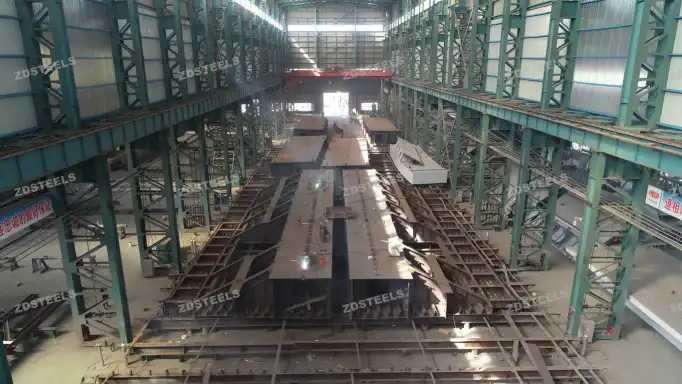
One of the best ways to protect design load capacity from construction variability is to make Steel Truss Girder panels in a controlled shop instead of putting together raw steel on a real construction site. Before a part leaves the shop, it can be tested for ultrasonic (UT) and magnetic particle inspection (MPI) of important node welds. Tight tolerances can be set for camber and node spacing, which makes sure that the geometry that the structural model predicted is produced by field assembly.
Zhongda Steel uses BIM-driven prefabrication, which combines 3D models with CNC cutting and assembly tools to keep the dimensions of ultra-thick plate parts within ±0.2 mm of accuracy. This level of accuracy shows in how well the finished building holds its weight.
Corrosion Management and Long-Term Structural Integrity
One of the main ways that a bridge truss girder loses its load capacity over time is through corrosion. When a tension chord member loses section, its axial capacity goes down by the same amount. A two-part anti-corrosion system that includes hot-dip galvanizing according to ISO 1461 and a high-build epoxy or polyurethane topcoat approved for C5-M marine environments can make maintenance intervals last up to 25–30 years in harsh industrial or coastal settings.
Maintenance teams can step in before section loss lowers the structure's rating by using dry film thickness (DFT) measurement and regular stress-strain tracking during scheduled checks. Zhongda's own -60°C Weathering Steel Anti-corrosion Technology is designed to work in Arctic and subarctic bridge settings, where changing temperatures speed up the breakdown of coatings.
Comparative Evaluation: Steel Truss Girder Solutions in the Market
Truss Girders vs. Plate Girders and Box Girders
For bridges with a span of 30 to 100 meters, solid-web plate girders, box girders, and Steel Truss Girder configurations are all options. Plate girders are easier to build, but they can't hold as much weight after 60–70 m lengths. Box girders are very stiff when it comes to torsion, but they make it harder to inspect and route MEP systems. Truss girders are the most common type of bridge for spans over 80 meters, especially when reducing dead loads directly raises allowable live-load ratings, which is a key factor in buying heavy freight railroad and highway bridges.
When purchasing goods, people in charge should look for certified mill test certificates (MTC) with heat number tracking, EN 1090 execution class compliance, proven NDT inspection procedures, and the ability to provide on-site setup support.
How to Choose Steel Truss Girders for Your Bridge Project
Clearly stating the needs of the project is the first step to a good purchase. Which truss geometry and steel grade will give the best performance depends on the span length, the design live load (distributed and concentrated), the dynamic amplification factors, the environmental exposure class, and the seismic zone.
When looking at suppliers, make sure that the manufacturing facilities have ISO 9001 quality control certification and that the welding methods meet the requirements of AWS D1.5 (bridge welding) or something similar. Ask for load test reports from the prototype stages and look at camber control records from similar projects that have already been done. Logistics factors like wait time, the size of modular panels for shipping, and the order in which they are put together on-site affect the total cost of the project just as much as the prices of the individual materials.
Conclusion
A Steel Truss Girder raises the weight that a bridge can hold by using smart geometry, high-performance materials, precise construction, and regular upkeep. Triangulated frameworks turn complicated applied forces into manageable axial loads. This lets them have longer spans and higher live-load ratings than solid-web alternatives. For people who buy things from other businesses in the infrastructure, energy, logistics, and industrial building industries, knowing about these processes is the first step in choosing bridge structures that will work safely and for a long time.
FAQ
How does a steel truss girder handle thermal expansion?
At support points, engineers use expansion joints and rocker or moving bearings to let the structure move longitudinally when the temperature changes. This keeps the parts from building up secondary stress.
Which connection type — bolted or welded — is better for truss girders?
Welded links are more rigid and work well in manufacturing shops. For field splices, high-strength friction-grip fitting works best because it is quick and the quality stays the same even when site conditions change.
How do you prevent fatigue failure in a bridge truss girder?
We control fatigue by making sure that stress concentrations are kept to a minimum in the node detail design and by following the AWS D1.5 bridge welding code rules for structures that are loaded and unloaded by traffic or wind on a regular basis.
Can a truss girder be structurally reinforced after installation?
Yes, it is possible to strengthen a member using welded cover plates or external post-tensioning, as long as the node's capacity is checked again with a new structural analysis before any work on strengthening starts.
Partner with Zhongda for Your Next Steel Truss Girder Project
Zhongda Steel has been providing approved Steel Truss Girder solutions for bridges, mines, and industrial hubs in the Arctic since 2004. We design buildings that meet AISC, AASHTO, and Eurocode standards. Our work is certified by EN 1090, and we use BIM to drive manufacturing. Each year, we can handle 60,000 tons. Visit zd-steels.com or email Ava@zd-steels.com to get in touch with our engineering team and ask for a technical consultation and quote from a reputable Steel Truss Girder manufacturer.
References
1. American Association of State Highway and Transportation Officials (AASHTO). AASHTO LRFD Bridge Design Specifications, 9th Edition. AASHTO, 2020.
2. European Committee for Standardization. Eurocode 3: Design of Steel Structures — EN 1993-1-1. CEN, 2005.
3. American Institute of Steel Construction (AISC). Specification for Structural Steel Buildings — AISC 360-22. AISC, 2022.
4. American Welding Society. AWS D1.5: Bridge Welding Code. AWS, 2020.
5. Barker, R. M., & Puckett, J. A. Design of Highway Bridges: An LRFD Approach, 3rd Edition. Wiley, 2013.
6. International Organization for Standardization. ISO 1461: Hot-Dip Galvanized Coatings on Fabricated Iron and Steel Articles. ISO, 2022.
YOU MAY LIKE