
Steel Arch Bridge Designs Combine Strength and Architectural Beauty
2026-09-22 13:00:00






When an infrastructure project demands both structural integrity and visual impact, a steel arch bridge stands apart from conventional alternatives. Rooted in compression mechanics, the arch transfers vertical loads into horizontal thrust at the abutments, allowing spans that would challenge beam or truss systems. Modern high-strength steel grades—such as Q420qE—push this principle further, enabling longer reaches, slimmer profiles, and resistance to seismic activity, heavy dynamic loads, and aggressive environments. For EPC contractors, government engineers, and industrial developers, this structural form delivers measurable advantages across the entire project lifecycle.
Engineering Principles Behind Steel Arch Bridge Design
How the Arch Transfers Load?
Any curved steel bridge is held together by the arch rib. When there is weight on the deck, the compression forces move along the rib toward the supports instead of bending the deck as a beam would. This compression-dominant behavior lets steel—which has a great strength-to-weight ratio and a value of elasticity close to 200 GPa—span lengths that concrete would need a lot more material mass to match. The arch shape drastically lowers the mid-span bending moments, which directly leads to better use of materials and lower base needs.
Arch Typologies and Their Applications
There are three main designs that work for different types of sites. A through arch has the deck below the crown, which gives ships more room to move. This makes it perfect for crossing waterways and rail travel routes. A linked arch holds horizontal thrust inside a tension tie, which makes it good for places with soft soils that can't handle outward forces. A deck arch puts the road above the crown and is best for crossing ravines where steep approaches are okay. Before sending out an RFQ, procurement engineers should make sure that the type matches the geotechnical studies, the span requirements, and the environmental limits.
Steel Arch Bridge structures need shorter cable systems and easier anchor arrangements than suspension bridges. Steel arches made in a controlled factory have better fatigue resistance under cyclic traffic loads, tighter tolerances, and faster assembly than reinforced concrete arches. This is an important factor to consider for high-speed train and highway projects.
Advantages of Steel Arch Bridges in Modern Infrastructure
There are strong structural reasons for a curved steel bridge, and there are also strong business reasons for it. For B2B decision-makers, these are the main benefits that make this solution stand out:
- High dynamic load capacity: High-strength steel grades withstand repeated axial and lateral loading without progressive fatigue degradation. Zhongda's Q420qE arch ribs—pentagonal box sections measuring 3.2 m × 4.5 m—resist wind pressure of 1.5 kN/㎡, conforming to code requirements for exposed river crossings and open-terrain expressways.
- Corrosion durability: A 150 μm aluminum thermal-spray layer combined with a fluorocarbon topcoat rated to GB/T 30790 C5M extends service intervals substantially in marine, industrial, and humid continental climates. This anti-corrosion system outperforms standard epoxy coatings in both adhesion strength and barrier performance.
- Sustainability credentials: Steel is one of the most recycled industrial materials globally, with recycling rates exceeding 85% in North America according to the Steel Recycling Institute. Modular prefabrication reduces on-site waste, and precise CNC fabrication minimizes offcut material.
These benefits lead to a lower total cost of ownership over a 100-year design life, which is a factor that is being used more and more in public infrastructure procurement processes and private ESG reviews.
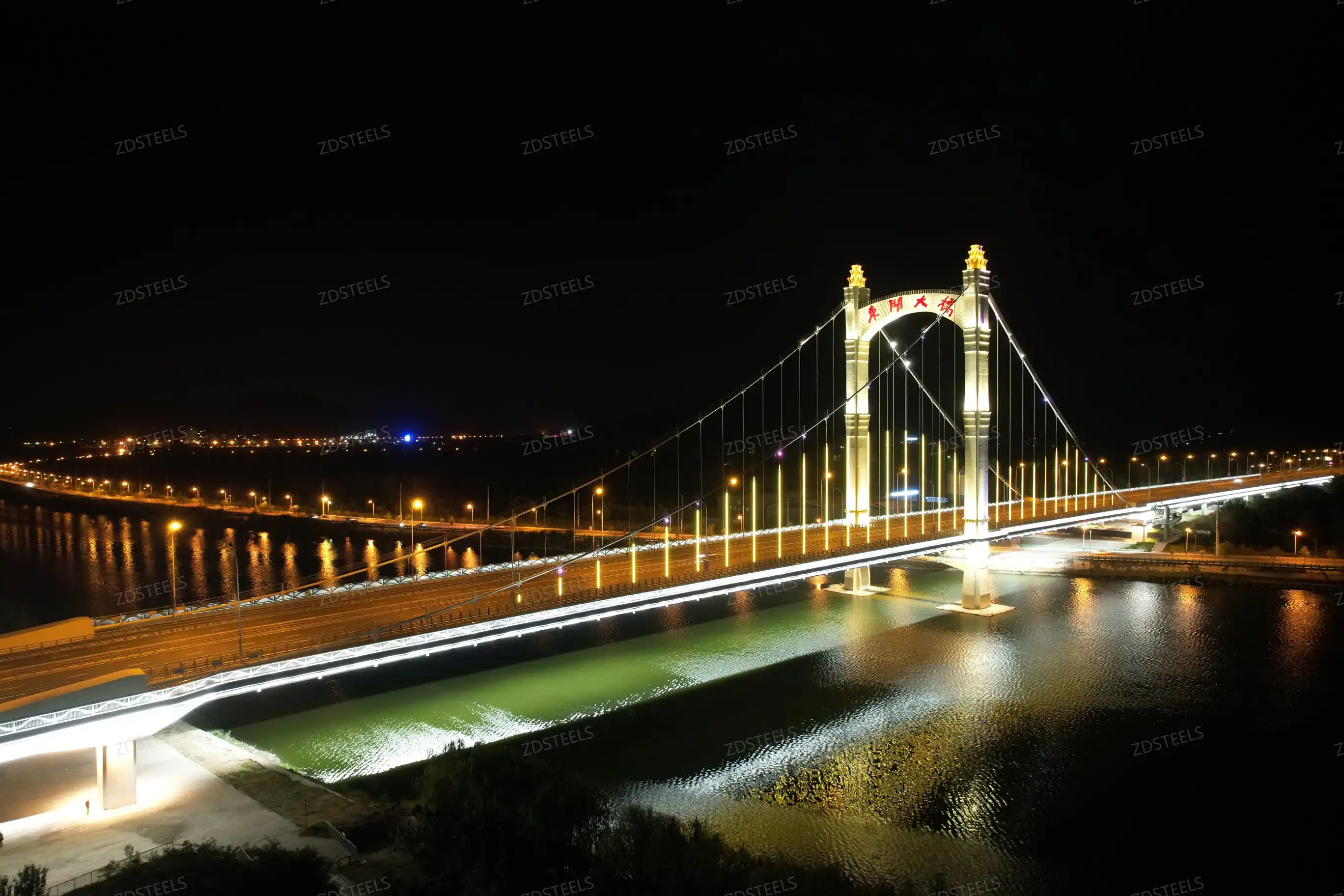
How Steel Arch Bridges Are Fabricated and Erected?
Not on the job site, but in the fabrication hall, Steel Arch Bridge precision starts. The production process at Zhongda starts with BIM-driven design, then moves on to CNC plasma cutting, and finally to automatic submerged-arc welding. Every weld on Q420qE material goes through 100% CTOD (Crack Tip Opening Displacement) testing, which checks how strong the joint is at low temperatures and is very important for bridges in areas that are prone to earthquakes or cold climates.
Stentless Rotation: A Game-Changing Erection Method
One of the most difficult parts of building an arch bridge is turning a finished rib into its final position without putting up temporary walls that block traffic or valley floors. The Shenyang Dongta Cross-Hunhe River Bridge, which weighs 18,000 tons, had an 8,000-ton rotation made possible by Zhongda's stentless rotation technology. This method gets rid of all river-bed falsework, lowers the risk to the construction schedule, and keeps waterways open while the structure is being built. This feature is very useful for government workers and highway builders who have to follow rules about environmental permits.
Prefabrication and Delivery Logistics
Arch rib segments are usually shipped in lengths of 20 meters. Zhongda keeps up a monthly output of 1,203 tons, thanks to its 120,000 m² of production floor space in Shenyang that can handle 60,000 tons of cargo every year. Containerized shipping, break-bulk goods, and just-in-time ordering that is tailored to site sequence are all delivery choices. Because the output is always the same, project managers can confidently plan building efforts instead of worrying about the supply.
Selecting the Right Curved Steel Bridge Solution
Matching Specifications to Site Conditions
When choosing a Steel Arch Bridge, the decision framework should include geotechnical data, navigational clearance requirements, the classification of the seismic zone, the category of environmental exposure, and the budget. The grade of the material is important. Q420qE has a higher yield strength than regular Q345 or ASTM A709 Grade 50. This means that it can be used in thinner sections with less dead load, which directly saves money on foundation design. Contractors who work in C5M exposure categories (like offshore or industrial coastal areas) should ask for the aluminum-spray anti-corrosion system as standard, not as an upgrade.
Evaluating Suppliers
It is important for a maker to have ISO 9001:2015, EN 1090 Execution Class 4 (the best level of execution class for structural steel), and a Class I Steel Structure Professional Contracting Qualification. Zhongda has all three, as well as ISO 14001 for environmental management and OHSAS 45001 for workplace health. Procurement managers should ask for more than just mill certificates when they look at bids. They should also ask for weld process qualifications, CTOD test records, and full surface treatment inspection reports.
When working on projects with non-standard geometry, OEM and ODM capacity is important. The engineering team at Zhongda changes the cross-sections of arch ribs, wind resistance parameters, rotation construction sequences, anti-corrosion specifications, and built-in health monitoring systems to match client drawings and national code needs.
Maintenance, Safety, and Long-Term Performance
A full-bridge structural health tracking system with more than 200 sensors keeps real-time track of temperature changes, strain, deflection, and sound frequency. With this many sensors, maintenance teams can find signs of fatigue and limited corrosion before they get worse and require expensive fixes to the structure.
Steel arch structures usually get inspected every two years, according to guidelines set by AASHTO and FHWA. These guidelines include both underwater and above-deck inspections, as well as continuous electronic monitoring where it is used. Zhongda's bridges with sensors send real-time data to asset management platforms. This cuts down on the cost and danger of inspecting high-clearance buildings by rope access, which is done by hand.
When welding procedures meet CTOD requirements and corrosion protection is kept up, fatigue life under standard highway loading (HS-25 or equivalent) is more than 100 years. For mining conveyor trestles and industrial platforms that carry cyclic mechanical loads, Zhongda's engineers make sure that the weld details are at least category D according to the AISC fatigue classification. This gives facilities that run all the time the extra room they need.
Conclusion
Steel Arch Bridge building has come a long way since its early days in the 1800s. With high-strength grades, precise manufacturing, stentless rotation erection, and real-time structural tracking, this type of structure has become a smart, reliable, and aesthetically pleasing choice for modern infrastructure. The arch configuration is hard to beat when it comes to the performance of the materials and the beauty of the geometry. This is true whether the project is a long-span river bridge, a high-speed rail route, or a famous urban gateway. With its strict quality systems and track record of completed projects, Zhongda's Q420qE product line provides a reliable and technically sound supply path for picky customers.
FAQ
How long does a steel arch bridge typically last?
A well-built steel arch structure can last more than 100 years if it is protected from corrosion and inspected every two years. Zhongda's Q420qE bridges use a 150 μm aluminum thermal-spray system that meets GB/T 30790 C5M standards. This makes coating service times much longer in harsh settings.
What drives the cost of a steel arch bridge project?
Cost is mostly affected by the type of material, the length of the span, the shape of the arch ribs, how they are put together, and the anti-corrosion requirements. Stainless steel rotation erection costs more up front, but it gets rid of expensive falsework and lowers schedule risk, which often saves money on complicated waterway crossings.
How does steel arch maintenance compare to concrete arch?
When aluminum thermal-spray systems are used, steel arches need to be repainted, and their coatings checked more often. Concrete arches need to be checked for cracks and carbonation. For spans longer than 200 meters, current sensor technology makes steel arches easier to check, and modular part replacement is easier to do.
Can the arch rib geometry be customized?
Yes, Zhongda can fully customize rib cross-sections, wind resistance ratings, anti-corrosion systems, and health monitoring configurations to meet the needs of each project and the conditions on the site.
Partner with Zhongda for Your Next Steel Arch Bridge Project
Zhongda offers certified, high-performance Steel Arch Bridge solutions, such as Q420qE fabrication and stentless rotation construction. These solutions are backed by ISO 9001, EN 1090 EXC4, and more than 200 sensor-tracking systems. We help EPC contractors, government engineers, and industrial developers all over the world because we are a trusted Steel Arch Bridge manufacturer and supplier. You can email our engineering team at Ava@zd-steels.com or go to zd-steels.com to get a price, look at case studies of past projects, or talk about your unique needs.
References
1. Xanthakos, P. P. Theory and Design of Bridges. Wiley-Interscience, 1994.
2. Troitsky, M. S. Prestressed Steel Bridges: Theory and Design. Van Nostrand Reinhold, 1990.
3. American Association of State Highway and Transportation Officials. AASHTO LRFD Bridge Design Specifications, 9th Edition. AASHTO, 2020.
4. British Standards Institution. BS EN 1993-2: Eurocode 3 – Design of Steel Structures: Steel Bridges. BSI, 2006.
5. Ryall, M. J., Parke, G. A. R., and Harding, J. E. Manual of Bridge Engineering. Thomas Telford Publishing, 2000.
6. International Organization for Standardization. ISO 12944-5: Paints and Varnishes – Corrosion Protection of Steel Structures by Protective Paint Systems. ISO, 2019.
YOU MAY LIKE