
Why Select Steel Cable-stayed Bridge for Major Infrastructure?
2026-09-17 13:00:01






When planners evaluate structural options for major crossings, the steel cable-stayed bridge consistently earns its place at the top. Its direct load transfer through tensioned stays, lightweight steel superstructure, and adaptable pylon geometry make it the preferred solution for spans ranging from 200 to 800 meters. Compared to conventional girder or arch systems, cable-stayed bridges reduce substructure demand, compress construction schedules through prefabrication, and deliver a design life exceeding a century — making them a strategically sound investment for government contractors, EPC firms, port developers, and energy infrastructure builders alike.
Understanding Steel Cable-stayed Bridges
How the Structural System Works?
A cable-stayed bridge moves the weight of the deck up by using a system of slanted high-tension stays that are directly joined to a pillar. In a suspension bridge, the deck hangs from vertical hangers that are connected to a catenary cable. In a cable-stayed system, however, each stay acts as a separate strut in tension, which squeezes the pylon and squeezes the deck in one direction. This gets rid of the need for big anchor blocks and makes the structure's logic easier to understand overall.
Harp vs. Fan Cable Arrangements
The harp pattern and the fan pattern are the two most common types of wire geometry. In a harp setup, the stays are lined up next to each other. This makes it easy to see and makes sure that there are equal number of anchorage points along the pillar. All the cables in a fan arrangement come together near the top of the pylon. This concentrates the force in one area while allowing longer clear spans. The procurement experts choose between these designs based on the site's limitations, the length of the span, and the height of the pylons.
Advantages of Steel Cable-stayed Bridges for Major Infrastructure
The main benefit of a Steel Cable-stayed Bridge is that the structure is more efficient, but the full value offer goes far beyond span potential. Here are the main reasons why this type of bridge is a good choice for large-scale purchases:
- High strength-to-weight ratio: Q420qE structural steel delivers a yield strength of 420 MPa while keeping dead load low, which directly reduces foundation size and cost on soft or seismically active soils.
- Seismic resilience: LRB800 lead-rubber bearing isolators reduce seismic response by up to 40%, making these structures viable in active fault corridors where concrete bridges face cracking and spalling risk.
- Corrosion durability: A dual-layer protection system combining a graphene inner coating with a PE outer sheath and 53-year UV resistance ensures the cable system performs through decades of marine, industrial, or arctic exposure.
- Modular fabrication: Steel segments are CNC-cut and sub-assembled offsite, then erected using balanced cantilever methods — reducing on-site labor, compressing timelines by 20–30%, and limiting environmental disruption.
- Span flexibility: Double or single-cable plane configurations support main spans from 200 to 800 meters, covering the full range from urban viaducts to deep-water navigable crossings.
These structure and practical benefits save money over the course of a product's life. When total cost of ownership is taken into account, procurement teams that have to work with tight deadlines and strict performance requirements always find that cable-stayed steel buildings perform better than other options.
Design Principles and Engineering Considerations
Load Distribution and Pylon Configuration
The whole force path of a Steel Cable-stayed Bridge is controlled by how well the pylons are designed. In Zhongda's Q420qE cable-stayed system, the cable tower has plate widths ranging from 60 to 120 mm and a vertical erection error of less than 1/4000. This tolerance keeps the stay cable forces from changing during service when there is cumulative geometric variation. OVM250 anchorages hold Φ7mm zinc wire strands that are in line with EN 10138. This makes sure that the anchorages won't break after millions of loads.
Material Selection and Anti-Corrosion Strategy
Q420qE steel is chosen because it is tough at low temperatures and doesn't tear easily in thick-plate welded joints. These are important qualities for bridges that are built in places that get frost or high humidity. The anti-corrosion approach combines a UV-stable polyethylene outer sheath with graphene-enhanced protection against electrochemical breakdown on the inside. This gives the wire system a confirmed 53-year service life. A 0.5-inch total station is used for 3D coordinate detection during inspection, which makes sure that the space is correct before the cable conduit is embedded.
Sustainability and Green Procurement
When steel is no longer needed, it can be recycled in its entirety, and fabrication off-site cuts down on trash and the damage done to the environment. For projects in environmentally sensitive areas like marshes, rivers that can be navigated, or protected uplands, the fact that long-span cable-stayed geometry has fewer piers means less damage to the ecosystem. This is in line with LEED and government green infrastructure requirements that are being put into U.S. public infrastructure bids more and more.
Comparison with Other Bridge Types: Making an Informed Choice
Professionals in procurement often compare cable-stayed steel bridges to other options like concrete girder, suspension, arch, and truss bridges. For middle to long spans, the comparison always favors cable-stayed solutions:
- vs. Concrete girder bridges: Steel cable-stayed structures weigh significantly less, exert lower bearing pressure, and tolerate seismic events more gracefully. Concrete girder systems struggle beyond 150m spans and require massive falsework.
- vs. Suspension bridges: Suspension bridges remain superior for ultra-long spans above 1,000m, but for the 200–800m range, cable-stayed systems offer simpler anchorage, faster erection, and lower overall cost.
- vs. Arch bridges: Arch structures demand firm abutment foundations to absorb horizontal thrust. On soft riverbed soils or in mountainous terrain with unstable geology, cable-stayed systems impose lower horizontal loads and adapt more readily to irregular topography.
- vs. Box girder and truss bridges: Truss and box girder bridges offer robust solutions for short-to-medium spans, but as span length grows, the dead-load penalty of these systems escalates quickly. Cable-stayed designs maintain structural efficiency across the full span range.
The practical result for project planners is that a Steel Cable-stayed Bridge is the best choice for spans over 200 meters when there are complicated site conditions, seismic zones, or needs for navigability. It has the best mix of structural performance, constructability, and lifecycle economy.
Procurement, Suppliers, and Project Execution
To find a good Steel Cable-stayed Bridge maker, you need to look closely at their qualifications, ability to make bridges, and past projects. Shenyang Zhongda Steel Structure Engineering Co., Ltd. was established in 2004 and has its main office in Shenyang's Economic-Technological Development Zone. The company is certified by ISO 9001/14001/45001 and meets the requirements of EN 1090, AWS, and JIS. It also has a Class I Steel Structure Professional Contracting Qualification. Zhongda can produce 60,000 tons of steel a year and has Northeast China's largest steel workshop with a 50T crane. This means they can take on very complicated projects.
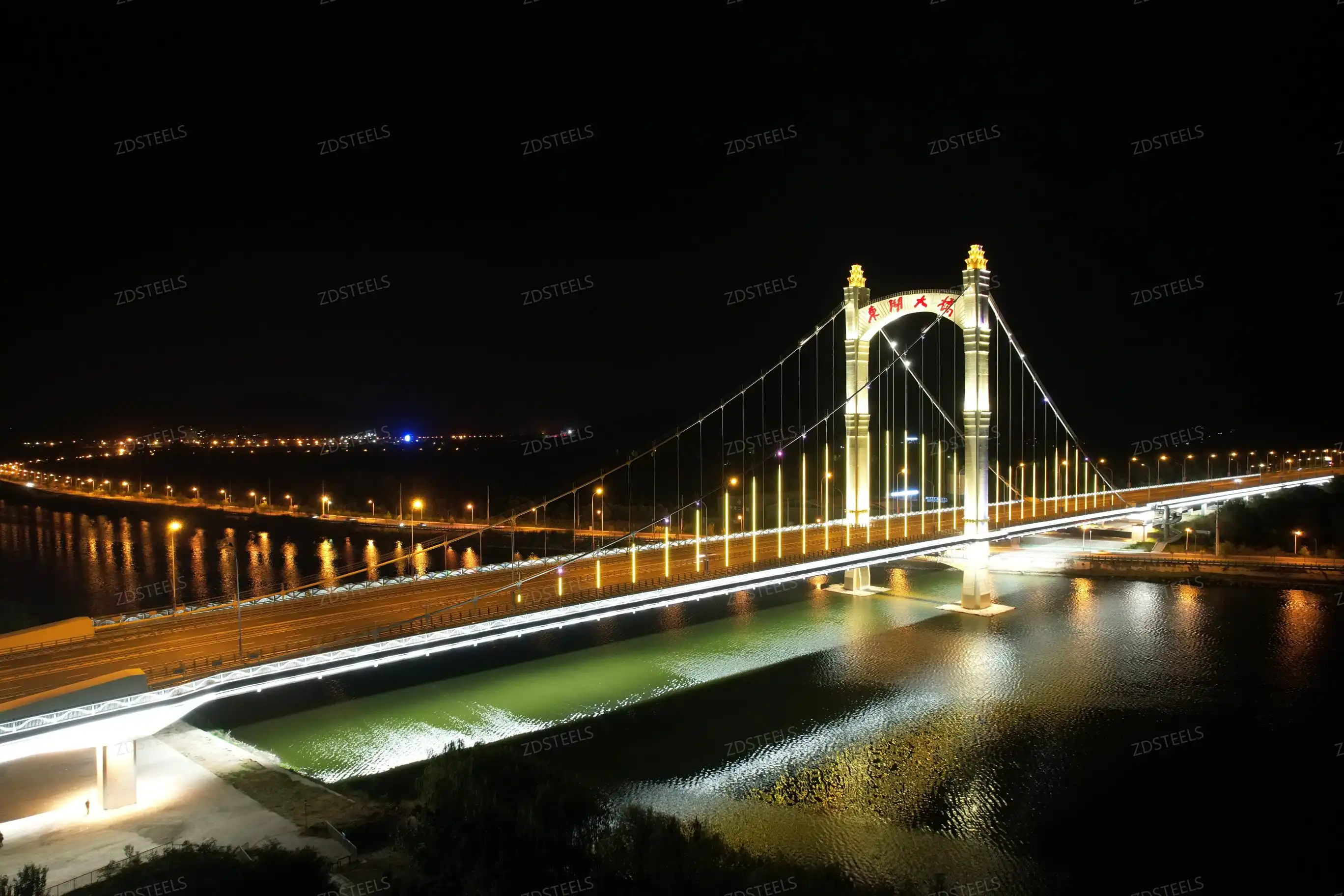
Their production process includes BIM-based design, CNC cutting, robotic welding, full NDT inspection, and precise surface treatment. This gives them a 20–30% lead time advantage over the norm in the industry. A 70% client renewal rate among big SOEs, such as China Railroad, CSCEC, and CCCC, shows that they consistently do a good job. The 18,000-ton Shenyang Dongta Cross-Hunhe River Bridge is an example of a reference project. So are several cable-stayed bridges built as part of national expressway growth plans.
Zhongda can customize the shape of cable towers, seismic isolation specifications, span configuration, and corrosion protection packages for EPC contractors, government infrastructure agencies, port developers, and energy sector builders in the U.S. All of these can be made to meet the requirements of AASHTO LRFD or Eurocode 3.
Conclusion
A Steel Cable-stayed Bridge is a good choice for major infrastructure because it has better span efficiency, seismic resilience, corrosion durability, and lifecycle economy. The Zhongda Q420qE system combines all of these features into a carefully designed and checked package, including 60–120mm wire tower plates and stays covered with graphene that are resistant to UV light for 53 years. This structural system gives you measurable performance benefits at every stage of an asset's lifecycle, whether your project is a deep-water port crossing, an urban expressway viaduct, or an industrial corridor in an earthquake zone.
FAQ
What is the expected service life of a cable-stayed steel bridge?
A well-built cable-stayed bridge is meant to last 100 years, as long as it is protected from corrosion and inspected every so often. The dual-layer graphene and PE cable sheathing from Zhongda is rated for 53 years of UV protection, and the structural steel standard takes into account fatigue, dynamic loads, and weather exposure from the start.
How are stay cables protected against corrosion?
Stay cables have three layers of protection: 7 mm galvanized wire strands that meet EN 10138 standards, a graphene coating on the inside, and a UV-resistant PE covering on the outside.
Can cable-stayed bridges be built in seismic zones?
Yes, the LRB800 lead-rubber bearing isolators do lower the response to earthquakes by as much as 40%. Because steel is lighter than concrete, it reduces inertial loads during ground motion. This makes steel cable-stayed buildings the best choice in areas with a lot of earthquakes.
How long does fabrication and delivery typically take?
Zhongda's integrated BIM-driven production process cuts lead times by 20–30% compared to what the industry usually does. There are global logistics options, and deliveries will be made on time as agreed upon in the contract.
What spans are achievable?
The Q420qE system can handle main spans from 200 to 800 meters in both single and double cable plane setups. This means it can be used for most highway, rail, and port crossing needs.
Partner with Zhongda for Your Next Cable-Stayed Bridge Project
Zhongda has been building major bridges for 20 years, has quality systems that are ISO-certified, and has a history of working with China's biggest infrastructure clients. As a reliable Steel Cable-stayed Bridge manufacturer and supplier, we can come up with solutions that meet your needs for span, seismic, and corrosion. You can email our engineering team at Ava@zd-steels.com or go to zd-steels.com to get expert advice and prices that are specific to your project.
References
1. Gimsing, N. J., & Georgakis, C. T. Cable Supported Bridges: Concept and Design. Wiley, 2012.
2. Walther, R., et al. Cable Stayed Bridges. Thomas Telford Publishing, 1999.
3. American Association of State Highway and Transportation Officials. AASHTO LRFD Bridge Design Specifications, 9th ed. AASHTO, 2020.
4. Virlogeux, M. "Recent Evolution of Cable-Stayed Bridges." Engineering Structures, Elsevier, 1999.
5. Podolny, W., & Scalzi, J. B. Construction and Design of Cable-Stayed Bridges. Wiley-Interscience, 1986.
6. Collings, D. Steel-Concrete Composite Bridges. Thomas Telford Publishing, 2010.
YOU MAY LIKE