
Why Are Steel Arch Bridges Used for Long-Span Applications?
2026-09-17 13:00:01






When engineers and procurement managers evaluate crossing solutions for wide rivers, deep valleys, or busy urban corridors, the curved steel arch consistently rises to the top of the shortlist. A steel arch bridge converts vertical gravity loads into horizontal thrust at the abutments, allowing the structure to span remarkable distances without intermediate pier support. This compression-dominant behavior unlocks spans that would be structurally or economically impractical with conventional girder systems—making the arch configuration a foundational choice in modern long-span infrastructure worldwide.
Understanding Steel Arch Bridges and Their Role in Long-Span Applications
The design of an arch is what makes it beautiful. The arch doesn't bend when it's loaded as a beam does. Instead, the force moves along its curved shape and toward the foundations, keeping the steel in good compression. With today's advanced fabrication technology, this old idea has been turned into a precise engineering field.
The Three Principal Arch Configurations
At the moment, engineers work with three main designs, each of which fits a different site:
- Through-arch: The deck is suspended below the arch ribs via hangers, preserving navigation clearance overhead—ideal for waterway crossings requiring substantial vertical clearance.
- Deck-arch: The roadway sits on top of the arch, transferring load downward through spandrel columns—commonly selected for valley crossings where foundations are positioned at elevation.
- Tied-arch (bowstring): Internal tie girders absorb horizontal thrust internally rather than transmitting it to the abutments—the preferred choice for soft-soil urban sites where massive abutments are cost-prohibitive.
Figuring out which setup works best for your site is the first choice that affects the size of the project, how it will be put together, and the overall cost.
Why Steel Arch Bridges Are Preferred for Long Spans – Core Advantages?
When looking at long-span choices, procurement workers will come across concrete, cable-stayed, and suspension options. A Steel Arch Bridge performs better than other types of arches in a number of ways. Here are the main benefits that make this type of structure stand out:
- Superior strength-to-weight ratio: High-strength steel grades such as Q420 deliver tensile strength exceeding 520 MPa, enabling slender arch ribs that carry enormous loads while minimizing self-weight—directly reducing foundation demands and material volume.
- Excellent fatigue resistance: Unlike reinforced concrete, structural steel tolerates repeated dynamic loading from heavy freight traffic or high-speed rail without microcrack propagation, supporting a design service life that routinely exceeds 100 years under AASHTO LRFD or Eurocode 3 criteria.
- Recyclability and sustainability: Steel is among the most recycled industrial materials globally, with recovery rates above 90% at end of service, giving project owners a credible environmental narrative alongside engineering performance.
- Accelerated modular construction: Prefabricated arch rib segments can be manufactured off-site under controlled workshop conditions and delivered to the field in a predictable sequence, compressing on-site program duration significantly.
These benefits directly lead to lower lifecycle costs, less damage to the environment during construction, and more stable project schedules. These are results that are very important to both EPC contractors and government infrastructure agencies.
Engineering Principles Behind Long-Span Steel Arch Bridges
From an idea for a structure to a finished crossing, you need to be good at a lot of different engineering fields working together. Material choice, connection design, dynamic performance, and the way the structure is put together all affect each other.
Material Performance: Q420qD and Q420qE Steel
The Q420qE Steel Arch Bridge from Zhongda is made of high-strength Q420qD steel, and every joint has been tested for 100% CTOD (Crack Tip Opening Displacement). CTOD qualification proves that the material is not easily broken in very cold conditions and under changing loads—this is a must for bridges in areas that are prone to earthquakes or have harsh weather. The arch ribs are shaped like a pentagonal box with a cross-section of 3.2 m × 4.5 m. They are designed to withstand wind loads of 1.5 kN/Ⅵ without affecting the structure's thinness.
Stentless Rotation Construction Technology
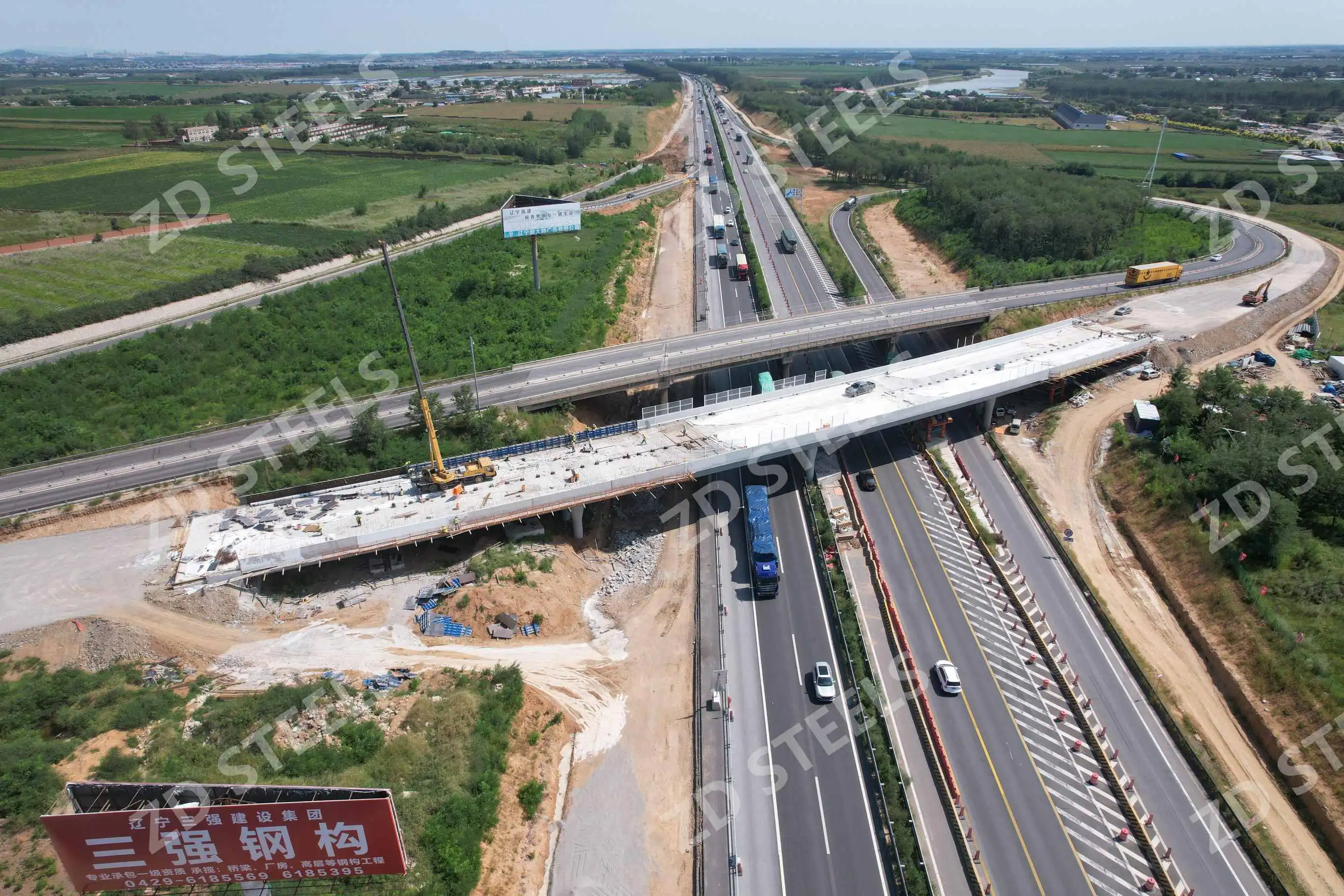
It is a huge technical and safety accomplishment that an 8,000-ton arch structure was built over a busy waterway without a temporary falsework platform being built in the water canal. Zhongda uses a stentless rotation method, putting together each half-arch on the bank of the river and then rotating the finished pieces into place across the span. Compared to traditional scaffolding-based construction, this method gets rid of hydrological interference, lowers the effect on the environment, and speeds up the critical path program.
Long-Term Structural Monitoring
Once the bridge is open for business, its health is monitored by a full-bridge sensor network with more than 200 devices that record real-time data on temperature, strain, displacement, and vibration. This level of tracking for structural health is in line with AASHTO standards for bridge inspections and gives asset owners the data-driven information they need to plan repairs ahead of time instead of after the fact.
Procurement Considerations for Steel Arch Bridges in Long-Span Projects
There's more to choosing a good Steel Arch Bridge supplier than just looking at unit prices. The buying teams should look at the ability to make things, the range of certifications they offer, the level of tailoring, and the ability to handle transportation all at the same time.
Zhongda's factory covers 120,000 m² and is in Shenyang's Economic-Technological Development Zone. It can make 60,000 tons of goods every year. Some important qualifications are ISO 9001:2015, EN 1090 Execution Class 4, and a Class I Steel Structure Professional Contracting Qualification. These meet the standards for prequalification in North America, Europe, and Asia.
Before a part leaves the workshop, it goes through a series of steps that include BIM-driven digital modeling, CNC plasma cutting with ±0.2 mm accuracy in the dimensions, automatic submerged-arc welding, and multiple stages of non-destructive testing. Arch rib pieces are shipped in 20-meter lengths, and a steady delivery rate of 1,203 tons per month keeps up with tight project plans without putting the client at risk of extra inventory.
The anti-corrosion treatment is based on GB/T 30790 C5M marine-environment classification. It uses a 150 μm aluminum spray base coat and a fluorocarbon topcoat to protect against harsh coastal and industrial environments. This makes the coating last 15–25 years longer between maintenance visits.
Case Studies: Successful Long-Span Steel Arch Bridge Projects
The 18,000-ton Shenyang Dongta Cross-Hunhe River Bridge is one of Zhongda's projects. The stentless rotation construction method was used on a large scale to build one of northeastern China's most famous river crossings. The project proved that the engineering team could manage precise assembly, modular manufacturing, and real-time structural tracking all within a single integrated delivery framework. A 1,200-meter stretch of arch bridges was built as part of the Jingha Expressway expansion. This showed that the supply chain could last and that engineers could keep their work consistent over long project periods. Zhongda has shipped structures to Russia, Australia, and Vietnam, in addition to projects in China. These structures have been checked to make sure they meet ASTM, EN, and local national standards in a variety of regulatory settings.
Conclusion
Long-span crosses need structural systems that balance how well they handle loads, how long they last, how easy they are to build, and how much they cost over their whole time. All four conditions are met at the same time by the bent arch made of high-strength steel. Today's Steel Arch Bridges combine traditional engineering ideas with modern production techniques. They are made with high-tech materials, are precisely crafted, have corrosion protection systems that can handle the harshest conditions, and use sensors to keep an eye on the structure. The case for a properly engineered steel arch solution is strong from both a technical and a business point of view for procurement managers, EPC contractors, and government infrastructure agencies planning their next major crossing.
FAQ
How do I know whether a steel arch bridge is right for my span?
Arch systems become structurally efficient at spans generally exceeding 100 meters, where eliminating intermediate piers offers clear navigational, hydrological, or ecological benefits. Site geotechnics, available construction corridor width, and environmental sensitivity all influence the final selection. A detailed feasibility study comparing arch, cable-stayed, and girder options against project-specific criteria is the recommended starting point.
How does the lifecycle cost of a steel arch bridge compare with concrete alternatives?
While fabricated steel structures carry higher initial material costs than reinforced concrete, steel's superior strength-to-weight ratio reduces foundation loads and total material volume. Combined with predictable maintenance intervals—Zhongda's C5M coating system extends protection cycles to 15–25 years—and eventual full recyclability, the total lifecycle cost frequently converges with or undercuts concrete over a 75–100-year service horizon.
What maintenance practices are essential for long-term performance?
Routine visual inspection complemented by periodic non-destructive testing of welds and connections, ongoing monitoring of the structural health sensor network, and scheduled recoating of anti-corrosion systems at manufacturer-specified intervals constitute the core maintenance regimen. Early anomaly detection through real-time sensor data minimizes reactive repair expenditure and prevents service disruption.
Partner with Zhongda for Your Next Steel Arch Bridge Project
Zhongda delivers certified, precision-fabricated steel arch bridge solutions—from Q420qE arch ribs to complete structural packages—backed by ISO 9001, EN 1090 EXC4, and two decades of landmark project experience. As a trusted steel arch bridge manufacturer serving global infrastructure clients, we offer full OEM/ODM customization, BIM integration, and dedicated project support from design through delivery. Reach our engineering team at Ava@zd-steels.com or visit zd-steels.com to request a tailored consultation.
References
1. American Association of State Highway and Transportation Officials (AASHTO). AASHTO LRFD Bridge Design Specifications, 9th Edition. AASHTO, 2020.
2. Chen, Wai-Fah, and Lian Duan. Bridge Engineering Handbook: Superstructure Design, 2nd Edition. CRC Press, 2014.
3. European Committee for Standardization. Eurocode 3: Design of Steel Structures – Part 2: Steel Bridges (EN 1993-2). CEN, 2006.
4. Gimsing, Niels J., and Christos T. Georgakis. Cable Supported Bridges: Concept and Design, 3rd Edition. Wiley, 2012.
5. Reis, António J., and José Oliveira Pedro. "Steel and Composite Arch Bridges: Design and Construction." Journal of Constructional Steel Research, Vol. 65, 2009.
6. Xanthakos, Petros P. Theory and Design of Bridges. Wiley-Interscience, 1994.
YOU MAY LIKE