
A 1.25-Ton Steel Stair: HM294 Stringers and 6 mm Treads
2026-11-06 19:02:26






A 1.25-Ton Steel Stair: HM294 Stringers and 6 mm Treads
English Version
Title: Steel Stair, 1,251 kg Total: HM294×200 Stringers, 6 mm Treads, Bolted M22 Joints
Overview
An industrial steel stair is a small structure with a big job: it carries people up 5 m, several times a day, for twenty years, with handrails that have to stop a fall. This project's stair is a straight flight with a top platform, built from hot-rolled H-section stringers, 6 mm tread plate, and bolted connections — the standard workshop access stair.
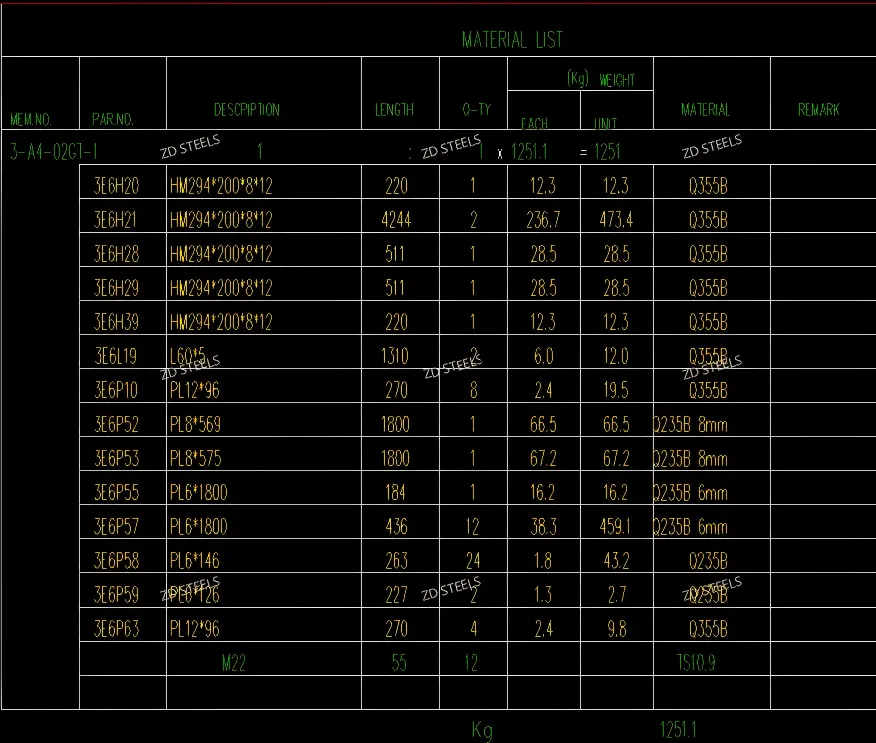
The material list gives the whole picture: 1,251.1 kg of steel, one flight, one drawing number.
Material Data (from Drawing Material List)
| Mark | Section / Description | Length (mm) | Qty | Weight (kg) | Material |
|---|---|---|---|---|---|
| 3EGH20 | HM294×200×8×12 | 220 | 1 | 12.3 | Q355B |
| 3EGH21 | HM294×200×8×12 | 4,244 | 2 | 473.4 | Q355B |
| 3EGH28 | HM294×200×8×12 | 511 | 1 | 28.5 | Q355B |
| 3EGH29 | HM294×200×8×12 | 511 | 1 | 28.5 | Q355B |
| 3EGH30 | HM294×200×8×12 | 220 | 1 | 12.3 | Q355B |
| 3EGL19 | L60×5 angle | 1,310 | 2 | 12.0 | Q355B |
| 3EGP10 | PL12×96 | 270 | 8 | 19.5 | Q355B |
| 3EGP52 | PL8×569 (platform) | 1,800 | 1 | 66.5 | Q235B 8 mm |
| 3EGP53 | PL8×575 (platform) | 1,800 | 1 | 67.2 | Q235B 8 mm |
| 3EGP55 | PL6×1800 | 184 | 1 | 16.2 | Q235B 6 mm |
| 3EGP57 | PL6×1800 (treads) | 436 | 12 | 459.1 | Q235B 6 mm |
| 3EGP58 | PL6×146 | 263 | 24 | 43.2 | Q235B |
| 3EGP59 | PL6×126 | 227 | 2 | 2.7 | Q235B |
| 3EGP63 | PL12×96 | 270 | 4 | 9.8 | Q355B |
| — | M22 bolts, grade 10.9 | 55 | 12 | — | 10.9 |
| Total | 1,251.1 |
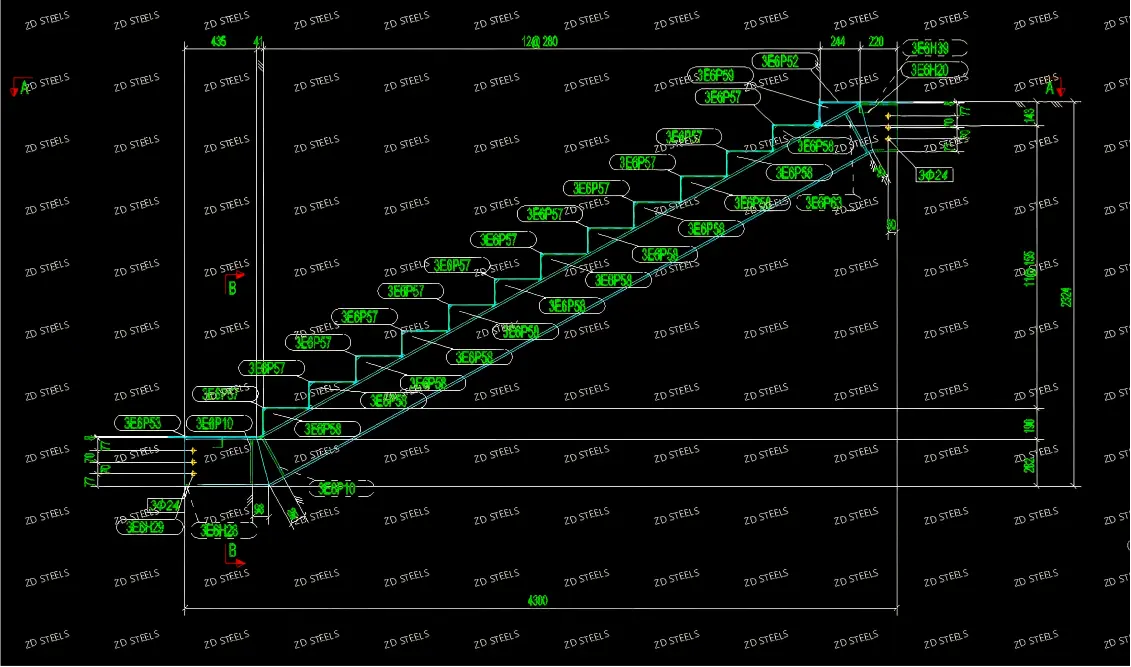
Drawing no. 3-A4-02GT-1. Stair rises from elevation -0.10 m to about +4.90 m, with a top platform.
What Each Part Does
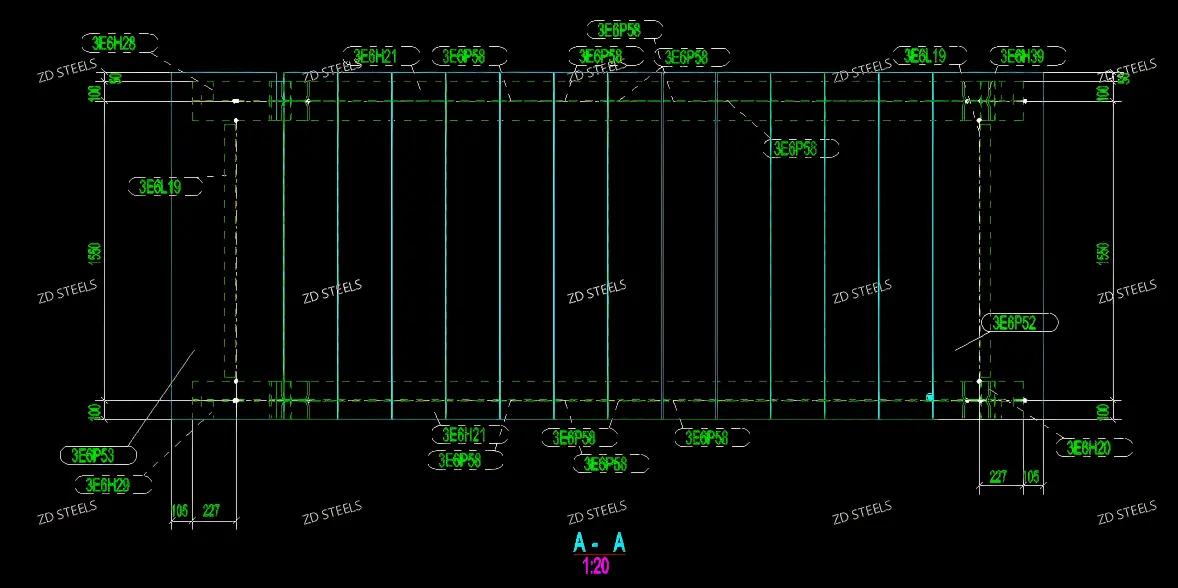
HM294×200×8×12 stringers (2 @ 4,244 mm): the two main inclined beams that carry the whole stair. 294 mm depth gives stiffness under footfall and a safe deflection limit.
PL6×1800 treads (12 pcs @ 436 mm): 6 mm plate treads, welded or bolted between stringers; 436 mm going sits in the comfortable step range.
PL8×569/575 platform plates: the landing at the top, 8 mm plate for heavier foot traffic.
PL12×96 members (12 pcs): handrail posts and stiffeners — 12 mm plate, the part that takes a body falling against the rail.
L60×5 angles: handrail and toe-board framing.
M22 grade 10.9 bolts (12 sets): the stringer-to-support connection; bolted so the stair can be installed after the frame is up.
Advantages
Fast to fabricate and install — a 1.25 t stair is shop-welded and site-bolted in a day; the frame can be finished before the stair arrives.
Hot-rolled stringers are straight and strong — HM294×200×8×12 needs no welded build-up; the mill section carries the stair load with margin.
Light for its height — 1.25 t for a 5 m stair means a small crane or a forklift can set it.
Standard sections, easy to repair — damaged treads or posts are swapped with plate pieces, no custom castings.
Bolted connection allows adjustment — M22 10.9 bolts let the stair be aligned and re-tightened on site.
Disadvantages / Limitations
6 mm treads wear — plate treads in a busy plant show edge wear and can become slippery; checkered plate or nosings are often added.
No closed stringer — an open H-section stringer leaves the tread ends visible; dust and water collect on the flanges.
Handrail loads govern the posts — PL12×96 posts are sized by the code handrail load, not by the stair weight; a lighter post is a safety issue, not a saving.
Bolted joints need inspection — M22 10.9 bolts must be torque-checked; a loose stringer connection lets the stair move under footfall.
Not for extreme heights — above about 6–8 m, a straight flight becomes too long; a switchback or a lift is the better answer.
Typical Use Cases
Workshop access stairs — operator access to mezzanines, crane cabs, and equipment platforms (this drawing, 5 m rise).
Plant room stairs — access to rooftop plant, boiler rooms, and pump rooms.
Maintenance stairs in warehouses — short flights to racking mezzanines and conveyor levels.
Temporary erection stairs — bolted stairs installed after the frame is up and removed after commissioning.
Outdoor access stairs — weather-protected stairs to loading docks and service yards.
Fabrication and Installation Notes
Stringers: HM294×200×8×12, Q355B — check the mill certificate; keep the two stringers parallel within tolerance before welding treads.
Treads: PL6×1800 cut to 436 mm going; weld or bolt per drawing; add anti-slip nosing on heavily used stairs.
Platform: PL8×569 / PL8×575 plates at the top landing; check level before fixing.
Handrail: PL12×96 posts and L60×5 rails; post spacing and height per the safety code (typically 1,050–1,100 mm).
Bolts: M22 grade 10.9, 12 sets; torque per the bolt standard and re-check after the first week of use.
Erection: set the stair after the frame and platform are complete; check the top landing level against the drawing elevation (+4.90 m).
Bottom Line
A 1,251 kg steel stair is the cheapest safe way up 5 m: two HM294×200×8×12 stringers, twelve 6 mm treads, an 8 mm landing, and M22 10.9 bolts. It is fast to build, easy to repair, and light enough for a small crane. The parts that matter are the ones people touch — treads and handrail. Get those right, and the stair lasts as long as the building.
**WhatsApp**: +86‑13889862778, +86‑18242444407
**Email**: eddie@zdsteels.com, wells@zdsteels.com
YOU MAY LIKE