



Can Steel Workshop Designs Support Cranes, Storage and Heavy Equipment?
2026-10-12 13:00:01






Yes — a properly engineered steel workshop absolutely supports cranes, heavy storage systems, and industrial equipment. The key lies in deliberate structural design. A steel workshop built with Q345 or Q355B-grade steel, a portal frame configuration, and crane runway beams integrated into the primary frame can carry overhead cranes exceeding 50 tons while maintaining floor-level stability for production machinery. At Zhongda, we have delivered such facilities across manufacturing, logistics, mining, and energy sectors. The answer is not just "yes" — it is "yes, when engineered correctly from day one."
Understanding Structural Requirements for Steel Workshops Supporting Heavy Loads
Before making a decision about a building plan, procurement engineers and project managers need to fully understand the forces that affect the structure. If a frame works well with static loads, it might not work so well when cranes speed up, slow down, or move goods side to side.
Crane Types and Their Load Demands
Overhead bridge cranes move the weight of the wheels straight to the crane girders and then to the column posts. Gantry cranes put floor-level point loads on structures, so they need reinforced concrete pads under them. Single supports are affected by eccentric cantilever forces when jib cranes are used. Each type of crane needs a different reaction from the structure, and using different kinds of cranes in the same building needs careful load combination analysis in line with AISC 360 and ASCE 7 standards.
Static vs. Dynamic Force Considerations
It's easy to figure out static loads, which include the dead weight of tools, kept items, and the building itself. More work needs to be done on dynamic loads that are caused by crane movement, hoisting acceleration, and stopping. The AISC Design Guide 7 says that for overhead cranes, impact factors of 25% more than the rated hoist load are normal. In industrial building design, one of the most common mistakes is not taking dynamic amplification into account.
Steel Grade and Fabrication Standards
Q345B or Q355B structural steel, which has a yield strength of 345–355 MPa, is often used in workshops that move big cranes and other machines. Zhongda's production process is based on ISO 9001:2015 and EN 1090 standards. We use precision H-beam construction and high-strength bolt links to keep the dimensions within ±0.2mm. When crane runways have to stay level over 36-meter spans, these tolerances are important.
Optimizing Steel Workshop Layout to Integrate Cranes, Storage and Heavy Equipment
Getting the plan of the building right is only half the job. The internal plan of a building determines whether it works well or causes daily problems.
Strategic Crane Positioning
Crane runway beams should be lined up parallel to the main flow of work so that loads move with the work instead of across it. Overhead cranes should be placed so that they don't interfere with racking systems or equipment. This height is usually between 8 and 12 meters. Clear internal heights at Zhongda workshops range from 6 to 12 meters, and special portal frames can be 12 to 36 meters long. This gives layout planners a lot of options.
Balancing Automated and Manual Systems
While automated overhead crane systems save money on labor costs and speed up production, they also require a bigger initial investment. For lower-frequency lifts, manual bridge cranes are still useful. The best option depends on how often you need to lift, how much you can carry, and your budget cycle. We've seen that a mix of automated runway systems and manual jib cranes at workstations gives a good productivity-to-cost ratio when working with EPC contractors and manufacturing plant integrators.
Storage Integration Without Compromising Access
In wide-span buildings, vertical pallet racking makes the most of the space available for storage. One of the best things about pre-engineered steel workshop buildings is that their innards don't have columns, which means that racking rows can run without stopping. To meet OSHA 1910.178 aisle width standards, there must be safety traffic lanes that are at least 3.5 meters wide between the working zones of the crane and the aisles for racks.
When these layout rules are followed consistently, they cut down on the time it takes to move things around and the chance that someone will get hurt or equipment will collide during daily operations.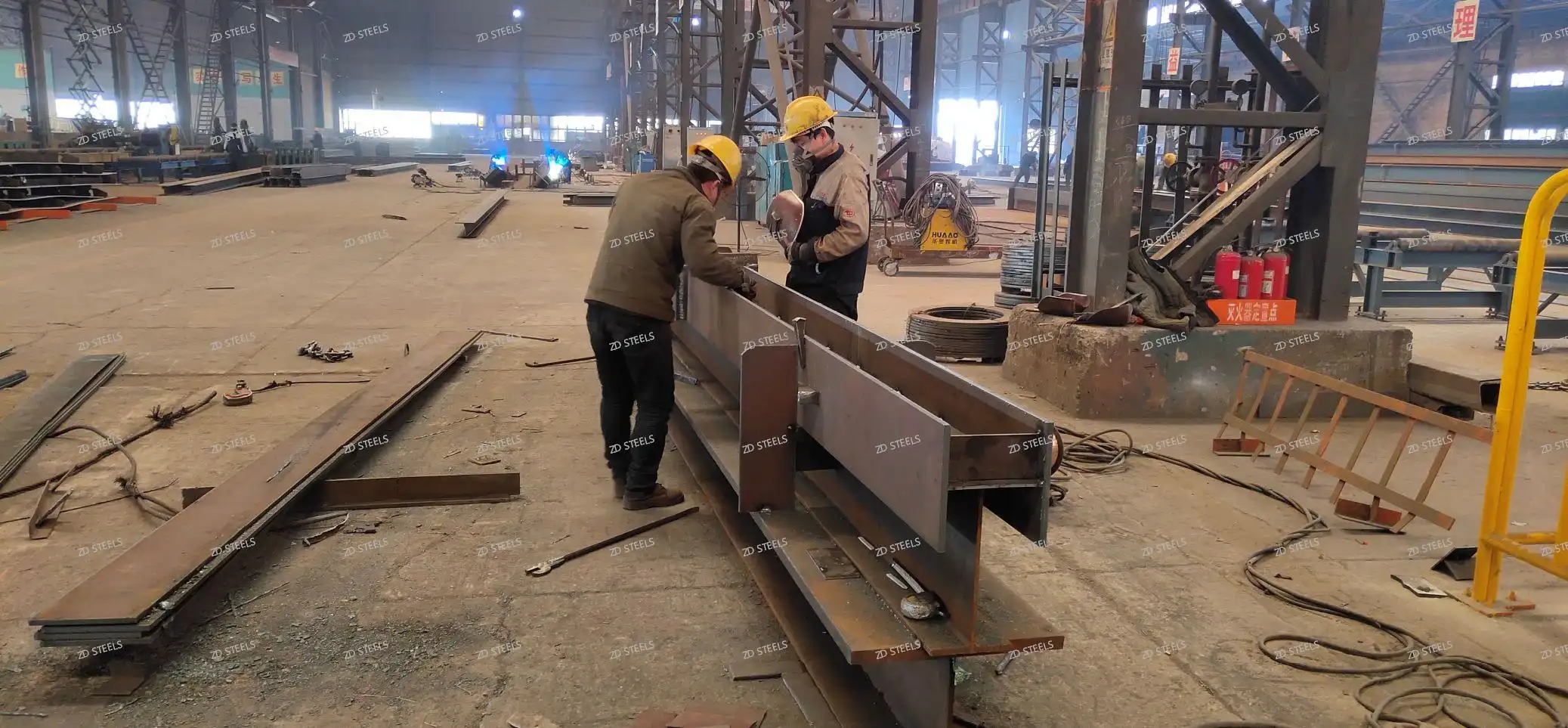
Safety Measures and Maintenance in Heavy-Duty Steel Workshops
If safety rules and maintenance schedules aren't followed, a well-designed structure quickly loses value. Even though structural steel lasts a long time, crane runways, connections, and cladding all need to be checked every so often.
Operator Training and Hazard Protocols
According to OSHA 1910.179, all users of overhead and tower cranes must get written training and be re-evaluated on a regular basis. When cranes are being used, there should be a risk assessment tour before every shift. Clear floor marks, barrier systems, and loud crane alarms all make it much less likely that two vehicles will collide.
Scheduled Structural Inspections
At the very least, crane runway girders, column bracket welds, and runway rail clips should be checked once a year. Every 18 months, bolt torque checks on moment connections should be done. Zhongda offers help after the sale, such as planned follow-up visits and repair services, to make sure that buildings stay compliant and structurally sound for the duration of their full service life.
Anti-Corrosion and Fire Protection
Multi-layer epoxy systems should be used to recoat the outside of steel members every 10 to 15 years in humid or coastal areas. For fire safety, intumescent coatings put on main structural parts usually get a fire rating of one to three hours, based on what the local code says. Zhongda's own -60°C Weathering Steel Anti-corrosion Technology makes surfaces last longer in difficult environments, like arctic and seaside industrial zones.
Choosing the Right Equipment and Suppliers for Steel Workshops Supporting Heavy Loads
Long-term facility performance is directly related to the quality of your supplier. Here are the things that matter most when making B2B purchasing choices.
When looking for a Steel Workshop supplier, these are the main things that make them reliable:
- Engineering capability: A supplier must provide full structural calculations, BIM models, and load case documentation — not just fabricated components. Zhongda's 100+ in-house engineers deliver complete technical packages.
- Material traceability: Every steel member should carry mill certificates verifiable against Q345/Q355 or equivalent grades. This protects buyers during audits and insurance assessments.
- Production capacity: Zhongda operates a 120,000 m² facility with 60,000-ton annual output, supporting large project volumes without delays.
- Certifications: ISO 9001:2015, ISO 14001:2015, and EN 1090 certifications are non-negotiable for projects serving regulated markets in North America and Europe.
- After-sales service: OEM and ODM service capability, on-time delivery coordination, and post-installation technical support define long-term supplier value.
All of these things affect not only the initial cost but also the total cost of ownership over the life of the building. Cutting corners with fabrication tolerances or material certification by a supplier creates risk that is much greater than any short-term savings.
Case Studies — Successful Steel Workshop Designs Supporting Cranes and Heavy Equipment
Real project outcomes illustrate what thoughtful design delivers in practice.
Heavy Manufacturing Facility, Southeast Asia
A factory builder integrating 32-ton overhead cranes across a 28-meter span required reinforced column brackets and precisely leveled runway girders. Zhongda's BIM-driven prefabrication process delivered all structural members to ±0.2mm tolerance, reducing on-site installation time by 40% compared to the client's previous concrete-frame project. Production startup came three weeks ahead of schedule.
Cold-Chain Logistics Hub, Northern Climate
A distribution center operator needed 60-meter clear-span steel structures with integrated insulated sandwich panel cladding to maintain consistent internal temperatures. Zhongda applied PIR sandwich panel systems alongside the primary steel frame, meeting both thermal performance specs and the structural demands of automated storage and retrieval equipment.
Mining Processing Structure, Resource-Intensive Environment
A mining company required conveyor support structures and processing building frames in a high-humidity environment with corrosive atmospheric conditions. Zhongda's C5-level anti-corrosion coating system and marine-grade fasteners extended projected service life beyond 50 years, meeting the client's long-term maintenance cost targets.
Conclusion
Cranes, heavy storage systems, and industrial machinery can all be supported by a Steel Workshop as long as the structural design, steel grade choice, and layout planning are done correctly. Building 12- to 36-meter-long portal frame systems out of Q345/Q355 steel that meet AISC and ISO standards give building owners the load capacity, clear internal room, and long service life their operations need. These buildings are reliable assets in the mining, energy, manufacturing, and logistics sectors because they are carefully designed and regularly maintained.
FAQ
1. What crane capacity can a steel workshop typically support?
Depending on the form of the column brackets, the size of the runway girders, and the base load capacity, a well-built portal frame workshop can hold overhead cranes weighing anywhere from 5 tons to over 50 tons. Engineers at Zhongda specify crane loads during the design phase to avoid having to make expensive changes later on.
2. How often should crane runways and structural connections be inspected?
The standard in the business is to check the crane runway girders and bracket welds once a year. Every 18 months, you should check the bolt pressure on moment connections. Checks every six months are helpful for places where cranes do a lot of work every day.
3. Can an existing workshop layout be modified to add crane support?
Yes, most of the time. If the columns were built with the right section modulus, column braces and runway beams can be added to steel frames that are already there. Before any changes are made, the structure must be inspected. Zhongda can evaluate facilities that are already in place.
4. What steel grade is recommended for workshops with 20-ton overhead cranes?
For crane-loaded workshops, steel grade Q345B or Q355B is the norm. These grades have a yield strength of 345–355 MPa, which is strong enough to handle both the weight of the crane and the impact loads that are called for in AISC Design Guide 7.
Request a Custom Steel Workshop Quote from Zhongda
Since 2004, Zhongda has built heavy-duty factories in more than 20 countries. As a reputable Steel Workshop maker, we offer planning, fabrication, and assembly services that are customized to your crane's size, span, and the conditions of the job site. You can email our team at Ava@zd-steels.com to ask for a consultation that is tailored to your project. Let's make something that will help your business.
References
1. American Institute of Steel Construction (AISC). Design Guide 7: Industrial Buildings — Roofs to Column Anchorage. AISC, 2004.
2. American Society of Civil Engineers (ASCE). ASCE 7-22: Minimum Design Loads and Associated Criteria for Buildings and Other Structures. ASCE, 2022.
3. Occupational Safety and Health Administration (OSHA). OSHA Standard 1910.179: Overhead and Gantry Cranes. U.S. Department of Labor, 2019.
4. European Committee for Standardization. EN 1090-2: Execution of Steel Structures and Aluminium Structures. CEN, 2018.
5. Fisher, J.M., and West, M.A. Erection Bracing of Low-Rise Structural Steel Frames. Steel Design Guide Series, AISC, 2003.
6. Tamboli, A.R. Handbook of Structural Steel Connection Design and Details. McGraw-Hill, 20106.
YOU MAY LIKE
