



Can Steel Truss Girders Reduce Structural Weight in Long-Span Bridges?
2026-10-12 13:00:01






Yes — steel truss girders significantly reduce structural weight in long-span bridges. By organizing steel members into triangulated frameworks, the system transfers loads through axial forces rather than bending, which means less material is needed to carry the same load. A well-designed steel truss girder can weigh 30–50% less than a comparable solid-web concrete girder over spans exceeding 100 meters. This weight reduction translates directly into lower foundation loads, reduced substructure costs, and faster installation — making truss girders a practical choice for bridges, industrial facilities, and large-span infrastructure worldwide.
Understanding Steel Truss Girders and Their Role in Bridge Engineering
What Makes a Truss Girder Different?
A Steel Truss Girder is a type of structural frame made up of triangle-shaped parts that are linked to each other. In contrast to solid concrete girders or rolled steel beams, its open-web geometry means that material is only present where stress moves. Instead of relying on the whole cross-section to be able to resist bending, this design moves loads through the compression and tension of individual members. This makes the structure lighter and stiffer, and it can reach clear spans that solid-web alternatives can't afford.
Common Truss Configurations and Their Applications
Four types of layouts are most common in bridge and industrial construction. When lateral members switch directions, the Warren truss works well for medium- to long-length spans with even loads. The Pratt truss is perfect for building railroad bridges because it puts vertical members under tension and lateral members under compression. This arrangement is turned around in the Howe truss, which is better for heavier short-span loads. The K-truss separates panel points, which shortens the lengths of unbraced members. This makes it a better choice for heavy-duty highway bridges that are longer than 150 meters.
Load Capacity and Structural Behavior
Steel Truss Girders made from ASTM A572 Grade 50 or Q355B steel can usually hold 50 to 120 kN/m² of live weight, based on their shape and span. Their triangular shape gives them high flexural stiffness and good sound damping, which is very important for railroad bridges that are loaded and unloaded quickly. The open-web design also lets the building's mechanical, electrical, and water systems run through it. This lowers the overall height of the building, which is a useful feature that engineers and facility managers always appreciate.
Key Principles Behind Steel Truss Girder Design for Weight Optimization
Triangulation and Efficient Material Distribution
The first step in reducing weight is to study mathematics. Triangulation makes sure that each member carries either pure tension or pure compression. This cuts down on the wasteful material that is needed for sections that bend a lot. Engineers can reduce the size of members and only use material when the structure needs it by directing forces along the simplest load lines. With this principle, spans of 100 to 300 meters can be reached with a dead-weight fraction that can't be beat by solid-web girders.
High-Strength Steel Grades and Prefabrication
When engineers use high-tensile steels like Q420 or ASTM A913, they can ask for smaller cross-sections without lowering the load capacity. When makers use shop-based prefabrication and modular assembly together, they can get tighter tolerances and more uniform weld quality than is usually possible in the field. Prefabricated truss sections come to the job site ready to connect, which cuts down on the time it takes to build and the amount of heavy equipment that needs to be used on the bridge deck.
Truss Girders vs. Concrete Girders and Steel Beams
Here's how the three main building options stack up on some important performance measures:
- Steel truss girder: Dead weight typically 30–50% lower than concrete for equivalent spans; superior span-to-depth ratio; allows MEP integration through open web; repairable and upgradeable.
- Concrete box girder: High dead weight increases substructure costs; excellent compression performance but limited long-span efficiency without post-tensioning; difficult to modify after casting.
- Solid-web steel beam: Economical for short spans (up to ~40 m); weight penalty grows sharply beyond 60 m; no MEP passage; less adaptable to dynamic loading profiles.
These tests show that the truss design is the best way to make a structure that is both strong and flexible over time, especially for projects that need to control both span length and weight.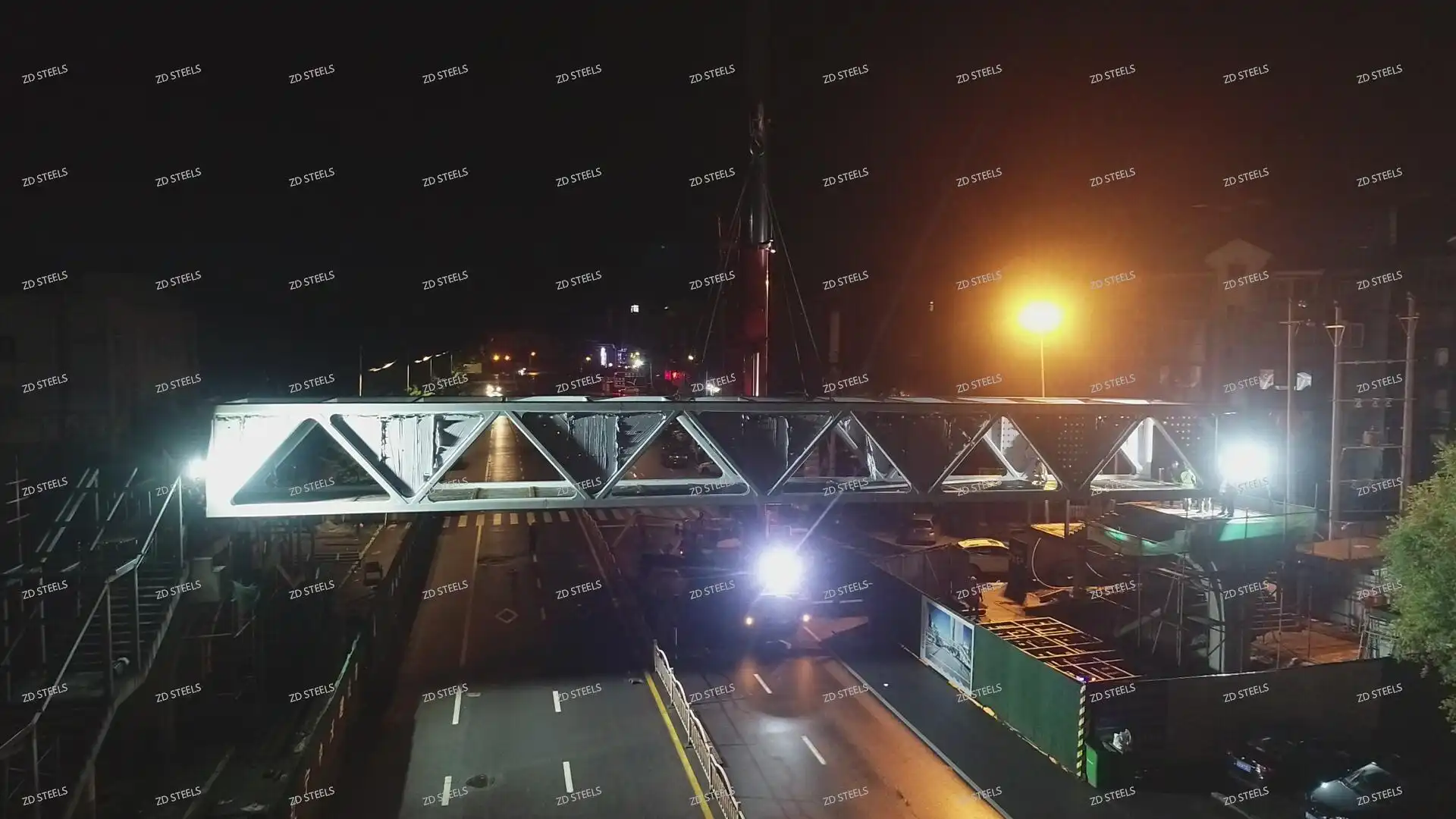
Performance Advantages of Steel Truss Girders in Long-Span Bridges
Documented Weight Savings and Load Capacity Gains
According to a study released in the Journal of Bridge Engineering, steel truss bridges with 120-meter spans can reduce dead loads by up to 45% compared to options made of prestressed concrete. Less dead weight means less bearing reactions and pile loads, which directly cuts down on the cost and material of the base. The extra space can also be used for higher live-load rates, which is very helpful for bridges that are near freight routes or areas that are prone to earthquakes because mass directly affects inertial demand.
Durability, Fatigue Life, and Maintenance
With the right care, steel truss systems made to AISC 360 or EN 1090 standards have been shown to last more than 75 years. To control fatigue life, the geometry of the nodes is improved to spread out stress better, and the AWS D1.5 bridge welding rules for cycle loads are followed. For marine and seaside settings, a duplex corrosion protection system with hot-dip galvanizing and a high-build epoxy or polyurethane finish rated C5-M keeps long-term upkeep costs stable and increases the time between service visits.
Lifecycle Cost Efficiency
The American Institute of Steel Construction (AISC) says that lighter superstructures lower foundation depth and pile count, which in turn lowers civil costs by 15–25% on soft-ground sites. Future reinforcement is also possible with modular steel construction. Members can be made stronger by adding plates or external post-tensioning, as long as the node's capacity is checked again by structural analysis. Because of these factors, the truss girder is a cost-effective choice for an asset life of more than 50 years.
Procurement Considerations for Steel Truss Girders in Global B2B Markets
Evaluating Suppliers: Certifications and Customization
To find a good Steel Truss Girder maker, you need to check their third-party certifications, such as ISO 9001 for quality management, EN 1090 for structural steel execution, and any national manufacturing standards that apply. It doesn't matter how customizable something is; complex bridge geometries need BIM-driven fabrication workflows, accurate camber control, and the ability to work with very thick plates that are within ±0.2 mm of tolerance. Make sure the seller gives you Mill Test Certificates (MTC) for each structural part that has a heat number that can be tracked.
Pricing Factors and Supply Chain Strategy
How much manufactured truss structures cost relies on the type of structural steel used, how complicated the structure is to build, how it is treated on the outside, and how it is delivered. Price changes in the steel market make things more unpredictable. For large infrastructure projects, bulk procurement agreements with fixed-price fabrication windows are a useful way to manage risk. Phased delivery schedules are often used by EPC contractors and government engineering buyers to match fabrication lead times with site readiness. This way, expensive storage at project sites is avoided.
Logistics and International Delivery
Heavy-lift coordination, specialty trailers, and port pre-assembly plans are often needed to move long-span truss modules that are bigger than normal transport envelopes. Working with a fabricator who has shipped large structural parts abroad before and knows how to handle customs paperwork, check coatings at the port of loading, and communicate with site assembly teams greatly lowers the risk to the schedule.
Installation, Engineering Support, and After-Sales Services
Installation Best Practices
To keep quality control even when the weather changes, high-strength friction-grip bolts are used at site connections for truss girder modules that are put together in the field. Before lifting, shop models must be used to check the accuracy of the dimensions, such as the camber levels, node spacing, and general straightness. It depends on how easy it is to get to the spot, how long the span is, and how much weight can be put on makeshift supports before they can be placed.
Engineering Consultancy and Quality Assurance
Reliable providers give engineering advice at all stages of a project, from the initial structural analysis and connection design to the methods for non-destructive testing (NDT). Ultrasonic Testing (UT) and Magnetic Particle Inspection (MPI) are needed on critical node welds to find flaws below the surface before the structure is put to use. The Dry Film Thickness (DFT) test shows that the anti-corrosion layer meets the requirements of ISO 12944.
Inspection, Maintenance, and Long-Term Support
Routine inspection plans, which usually include visual scans every two years and NDT at high-stress nodes on a regular basis, stop damage from happening too soon and keep you from having to make heavy patch fixes. As-built documentation and maintenance manuals from the fabricator are part of the after-sales support that gives operations teams a clear set of steps to follow for the life of the structure.
Conclusion
Steel Truss Girders make long-span bridges measurable 30% to 50% lighter than concrete options, while still having a high load capacity, a long wear life, and flexible maintenance profiles. Because they are triangulated, they are strong over spans of 100 to 300 meters or more. The most important thing for EPC contractors, government infrastructure agencies, and industrial facility developers to do when buying something for a long-span project is to find a qualified truss girder fabricator with certified quality systems, BIM fabrication capabilities, and proven global delivery experience.
FAQ
1. Can a steel truss girder handle thermal expansion?
At support locations, engineers use expansion joints and rocker or moving bearings to let the length of the part move when the temperature changes.
2. Are bolted or welded connections better for truss girders?
For shop construction, welded joints are more rigid and have a cleaner profile. For field assembly, high-strength friction-grip bolting is best because it keeps the clamping force and quality control constant even when site conditions change.
3. How is fatigue failure prevented in bridge trusses?
Following the AWS D1.5 bridge welding rules and making sure that the node shape is optimized to reduce stress concentrations are two ways to control fatigue. As part of any good maintenance plan, NDT inspections should be done regularly at high-cycle nodes.
4. What corrosion protection works best in marine environments?
For marine and ocean bridges, the norm is a duplex system that includes hot-dip galvanizing and a high-build epoxy and polyurethane topcoat that is rated for C5-M conditions.
5. Can a truss girder be reinforced after installation?
Yes, it is scientifically possible to strengthen the member with welded cover plates or external post-tensioning, as long as the node's capacity is checked again with a new structural analysis before work starts.
Partner with Zhongda for Your Next Steel Truss Girder Project
Steel Truss Girder structures made by Zhongda Steel have been sold to customers in Russia, Australia, Vietnam, and other places since 2004. We are certified by ISO 9001, ISO 14001, OHSAS 45001, and EN 1090, and work out of a 120,000 m² building that can hold 60,000 tons per year. We are a reliable Steel Truss Girder source that offers BIM-driven manufacturing, -60°C weathering steel technology, and plate cutting accuracy of ±0.2 mm. You can talk to our team about your project today by emailing Ava@zd-steels.com.
References
1. American Institute of Steel Construction (AISC). Steel Construction Manual, 16th Edition. AISC, 2023.
2. Chen, W.F., & Duan, L. Bridge Engineering Handbook: Superstructure Design, 2nd Edition. CRC Press, 2014.
3. Gaylord, E.H., & Gaylord, C.N. Structural Engineering Handbook, 4th Edition. McGraw-Hill, 1997.
4. Journal of Bridge Engineering, ASCE. "Dead Load Optimization in Long-Span Steel Truss Bridges." Volume 22, Issue 4, 2017.
5. Owens, G.W., & Knowles, P.R. Steel Designers' Manual, 7th Edition. Wiley-Blackwell, 2012.
6. Federal Highway Administration (FHWA). Steel Bridge Design Handbook: Structural Behavior of Steel. U.S. Department of Transportation, 2015.
YOU MAY LIKE
