



Steel Truss Girder Solutions for Long-Span Industrial and Bridge Projects
2026-10-12 13:00:01






When engineers face spans exceeding 100 meters—whether for a railway bridge, an aircraft hangar, or a heavy industrial warehouse—a steel truss girder is often the most technically sound choice available. Unlike solid-web beams that grow exponentially heavier as spans increase, a steel truss girder distributes forces through a triangulated network of members, keeping dead weight low while maintaining exceptional load-bearing capacity. This post walks through design fundamentals, real benefits, procurement strategies, and emerging trends so you can make confident decisions for your next long-span project.
Understanding Steel Truss Girders: Fundamentals and Design Principles
What Makes a Truss Girder Work
When forces are applied to a truss frame, they are changed into axial tension and compression within the parts. Triangles are mathematically rigid, so the system doesn't need the mass of a solid piece to keep it from deforming. People usually ask for steel grades like ASTM A572 Grade 50, Q355B, or high-tensile Q420, which have yield strengths of 345 MPa to 420 MPa and aren't too heavy.
Common Truss Configurations and Their Best Uses
Long-span work is mostly done in three configurations. The Pratt truss uses diagonal members that are pulled together by gravity to save a lot of material over modest lengths of 30 to 80 meters. The Warren truss is made up of equal-sided triangles and works well for railroad bridges and crane girders where the load is often switched. The Howe truss works well for shorter, heavily loaded industrial bays because its diagonals are compressed. Tools like SAP2000 and STAAD.Pro and Tekla Structures can do stress analysis and check the geometry of nodes before they are built.
Standards That Govern Design
AISC 360, Eurocode 3, and China's GB50017 are all internationally recognized codes that spell out the rules for connection geometry, weld integrity, and fatigue detailing. On government bridge contracts and EPC projects, where third-party structure checks are common, these standards must be met without exception.
Advantages and Practical Benefits in Long-Span Projects
Strength-to-Weight Efficiency
According to structural engineering books, a well-designed truss girder usually weighs 30–40% less than a concrete girder with the same span. That decrease directly leads to smaller foundations, lighter lifting equipment on-site, and lower freight tonnage, all of which raise the overall cost of the project.
Here are the main speed benefits of this structure type that make it appealing across all fields:
- Open-web geometry allows mechanical, electrical, and plumbing (MEP) conduits to pass through the truss depth, reducing total building height by up to 15% in multi-story industrial facilities.
- Prefabricated modular assembly shortens on-site erection time significantly. Modules are shop-fabricated to ±0.2 mm tolerances, bolted together in the field using high-strength friction-grip fasteners, and lifted into position with minimal temporary shoring.
- Ductile seismic behavior comes from a steel truss girder's ability to absorb energy through plastic deformation at nodes before failure, a property concrete cannot match without expensive post-tensioning systems.
These benefits help with common problems that come up in big building projects, like time constraints, high foundation costs, and following building codes for earthquakes. In the US, where column-free clear spans of 60–120 meters are becoming more common, these things directly affect the project's viability for people who want to build warehouses and logistics hubs.
Durability Under Harsh Conditions
A structural truss can last more than 50 years if it has the right anti-corrosion system. This includes hot-dip galvanizing according to ISO 1461 and a high-build epoxy-polyurethane finish with a C5-M rating for marine or industrial environments. In rural and semi-industrial areas, weathering steel types don't need a topcoat at all, which lowers the overall cost of maintenance over the life of the structure.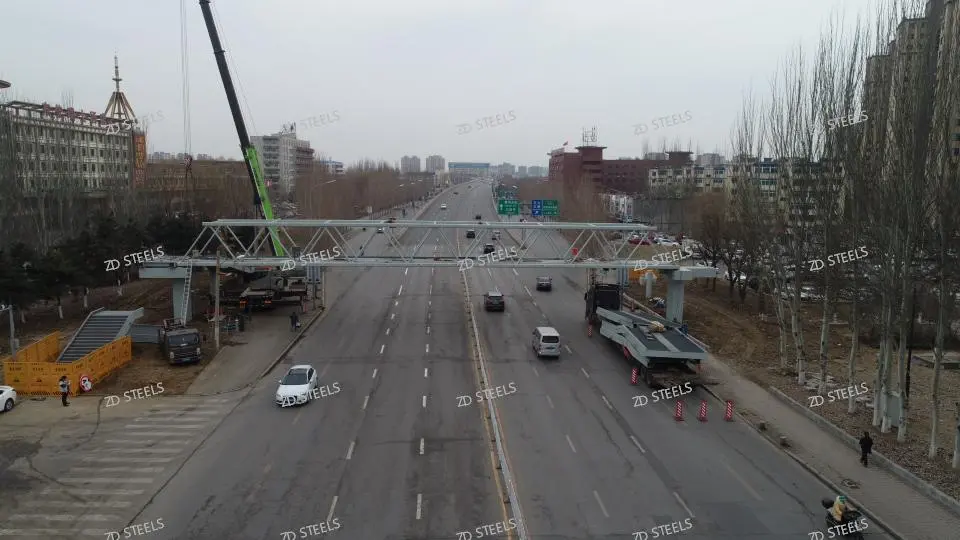
Comparing Steel Truss Girders with Alternative Solutions
Truss Girders vs. Steel Beams
For spans up to about 20–25 meters, a rolled I-beam is a cheap option. When you go over that limit, the needed flange width and web depth make solid beams heavy and pricey. A truss beam can span 60 to 200 meters with a lot less material because the open web only puts steel where the load needs it.
Truss Girders vs. Concrete and Composite Girders
For short to medium spans, concrete girders are a cost-effective way to build, but their high weight means that the substructure needs to be strong. When building a bridge in an area prone to earthquakes or on soft ground, the extra cost of the base often cancels out any savings on materials. Composite steel-concrete decks work pretty well in the middle, but they have fixed formwork and curing time that adds to the risk of delays that modular steel truss girder production doesn't have.
Light vs. Heavy Truss Girders
Light trusses (usually less than 50 tons per module) can be used for bridges, solar array supports, and roofs on warehouses. Heavy trusses are popular in railroad bridges, port gantries, and mine conveyor systems. Each span can weigh more than 500 tons, and they need to have full-penetration welds and CNC-cut nodes that have been checked by ultrasonic testing (UT) and magnetic particle inspection (MPI).
Procurement Insights: How to Source Quality Truss Girders Efficiently
Key Pricing Factors
The main things that affect the cost are the type of material, the total weight, the complexity of the connections, and the surface treatment requirements. When you place a bulk order, suppliers can combine the steps of cutting plates and welding them together, which lowers the cost per unit. Custom camber needs and close limits on dimensions make the manufacturing process take longer, but they are necessary for bridge projects where bearing alignment is very important.
Selecting a Qualified Steel Truss Girder Supplier
Global companies like BlueScope, ArcelorMittal, Tata Steel, and POSCO make certified structural plate. But to get a fabricated girder system, you need to find a maker that does its own design, precision cutting, and certified welding. Some important things that must be checked are ISO 9001 certification for quality management, EN 1090 compliance for execution standards, traceable Mill Test Certificates (MTCs), and written NDT records for every important weld.
Zhongda Steel was established in 2004 in Shenyang. Its 120,000 m² plant, which makes 60,000 tons of steel every year, is certified by ISO 9001/14001, OHSAS 45001, and EN 1090. It has built Arctic bridges for Russia and mining tools for activities in Australia, both of which required a high level of accuracy in harsh environments.
Logistics for Large-Scale International Orders
Custom truss girder orders usually take 8–16 weeks to arrive, but this depends on how complicated the span is and how the surface is treated. Most over-sized units are shipped by sea in flat-rack or open-top containers. Getting involved with the fabricator's engineering team early on in module division cuts down on both shipping volume and time spent putting the modules together on-site.
Future Trends in Truss Girder Technology
High-Strength Alloys and Hybrid Systems
Long-span bridge standards are including steel types with tensile strengths above 690 MPa. This lets the chord sections be thinner while still holding the same amount of weight. Combining high-strength steel chords with standard-grade web members in hybrid systems makes a single unit that is both cost-effective and good at its job.
BIM Integration in Design and Procurement
Building Information Modeling brings together structural design, material takeoff, and fabrication shop drawings in a single set of data. Zhongda Steel's BIM-driven prefabrication cuts down on communication mistakes between the design team and the cutting floor, shortening the time it takes from planning to delivery.
Sustainability and Recyclability
Steel is one of the most recycled building products in the world. The World Steel Association says that more than 85% of steel used in construction is returned. Choosing girders made from recycled steel and planning for easy removal helps achieve LEED and other green building certification goals that are being pushed for by U.S. government and state infrastructure programs.
Conclusion
Long-span industry and bridge projects need structural systems that balance how well they hold loads, how quickly they can be put together, and how long they will last. All three are taken care of by a Steel Truss Girder, which has a triangulated shape, tested steel grades, and flexible construction. If you are looking for a support structure for a solar farm, a heavy-crane warehouse, or a highway bridge, it is important to understand the design configurations, compare options honestly, and make sure that suppliers meet certified quality standards. This will help you stay on schedule and on budget.
FAQ
1. How long does a steel truss girder last in a bridge application?
A well-built truss bridge can last up to 100 years if it is treated against rust properly and inspected every so often. The actual service life depends on how often it is maintained, how often it is exposed to the environment, and how often it is loaded with traffic. The AWS D1.5 bridge welding code sets the rules for how to classify fatigue details in environments with cyclic loads.
2. How does truss girder maintenance compare to a box girder?
Without entry openings, it's hard to check for corrosion and fix problems inside box girders because the spaces are sealed off. With open-web trusses, you can see and use NDT to get to every member and node directly. This speeds up regular inspections and makes it easier to fix problems, like adding more member plates or external post-tensioning.
3. What is the typical lead time for a custom fabricated truss girder order?
The normal wait time is between 8 and 16 weeks, but it depends on the length of the span, the difficulty of the link, and the coating requirements. This window gets shorter if structural drawings and material grade approvals are turned in early.
4. Can an installed truss girder be structurally reinforced?
Yes. You can strengthen something by welding cover plates to chord sections to make the cross-section bigger, or you can use external post-tensioning wires. Before work starts on any changes, the node's ability must be checked again using a new structural analysis.
Partner with Zhongda for Your Next Long-Span Steel Truss Girder Project
Every time Zhongda Steel gets a request for a Steel Truss Girder supplier, we bring more than 20 years of approved manufacturing experience to the table. We deliver precision-fabricated long-span solutions on time thanks to our EN 1090 compliance, BIM-driven production, and ability to weather steel at -60°C. Email our project team directly at Ava@zd-steels.com to get a price or technical advice right away.
References
1. American Institute of Steel Construction (AISC). Steel Construction Manual, 16th Edition. AISC, 2023.
2. European Committee for Standardization. Eurocode 3: Design of Steel Structures – EN 1993-1-1. CEN, 2022.
3. Chen, W.F., and Duan, L. Bridge Engineering Handbook: Superstructure Design, 2nd Edition. CRC Press, 2014.
4. World Steel Association. Steel's Contribution to a Low Carbon Future and Climate Resilient Societies. World Steel Association, 2023.
5. Galambos, T.V., and Surovek, A.E. Structural Stability of Steel: Concepts and Applications for Structural Engineers. Wiley, 2008.
6. Subramanian, N. Design of Steel Structures: Limit States Method. Oxford University Press, 2016.
YOU MAY LIKE
