



Custom Steel Arch Bridges Support Challenging River and Valley Crossings
2026-10-11 13:00:01






When a project demands crossing a deep river gorge or a wide valley floor with no room for intermediate piers, a steel arch bridge is one of the most dependable structural solutions available. The arch transfers vertical loads into horizontal thrust at the abutments, letting the structure span long distances with high efficiency. At Shenyang Zhongda Steel, we design and fabricate custom arch bridge systems—including our Q420qE Steel Arch Bridge—built to perform in the most demanding geographic and environmental conditions across the United States and globally.
Understanding Steel Arch Bridges: Design Principles and Construction Process
How Arch Action Distributes Load
A steel cross mostly works by being compressed. When weight is put on the deck, the curved arch ribs push that weight outward and downward into the abutments. Engineers can use this mechanical principle to make spans that are longer—sometimes more than 500 meters—while using a lot less material than a similar girder system. The AASHTO LRFD Bridge Design Specifications say that this way of building gives arch bridges a clear edge in high-load, long-span situations.
Material Selection for Harsh Terrain
The high-strength structural steel used in our Q420qE Steel Arch Bridge has a yield strength of at least 420 MPa, even when it is cold outside. A 100% CTOD (Crack Tip Opening Displacement) test is done on every weld joint to make sure it can't break under dynamic and cyclic loads. For projects in areas that are prone to earthquakes or have extreme weather, this material standard is a must. It is the minimum requirement for structural safety.
Fabrication and On-Site Assembly
At our 120,000 m² factory in Shenyang, arch rib sections are already made in 20-meter sections. Each pentagonal box rib is 3.2 m long and 4.5 m wide, and it can withstand 1.5 kN/Ⅵ of wind force. To keep big projects on track, we move up to 1,203 metric tons every month. On-site, we use stentless rotating construction, a method that moves an 8,000-ton arch structure that has already been put together into place without putting up any temporary supports over the waterway. This way, there is no interference with the flow of the river at all.
Advantages and Engineering Challenges of Custom Steel Arch Bridges
Structural Strength and Material Efficiency
A Steel Arch Bridge has a much higher strength-to-weight ratio than a concrete arch or a prestressed beam design. This means profiles that are smaller, base loads that are lower, and less material used overall. This is not just a design choice; it is also a measured practical gain for crossings that are far away or sensitive to the environment, where causing as little damage to the ground as possible is important.
Corrosion Management in Aggressive Environments
One of the biggest long-term risks for any steel bridge is that it will rust. Our anti-corrosion system uses a 150 μm aluminum thermal spray base coat and then a fluorocarbon topcoat that meets GB/T 30790 C5M rating, which is the best level of protection for marine and industrial use. This system is recommended for at least 25 years between repair visits, which means that owners will save a lot of money over its lifetime.
Managing Dynamic Loads and Fatigue
At river bridges, wind, hydraulic pressure, and live traffic loads all happen at the same time. Our full-bridge structural health monitoring system puts more than 200 sensors on every arch rib, hanger, and deck element to keep an eye on fatigue buildup. Engineers can find small changes in stress levels before they become structural problems with real-time data feeds. This built-in monitoring is part of all of our deliveries; it's not an extra.
These benefits lower the total cost of ownership in a direct way. When procurement teams look at long-term infrastructure investments, bridges made of durable materials, engineered anti-corrosion protection, and built-in monitoring are the only ones that can reliably last the 100 years that they were designed to.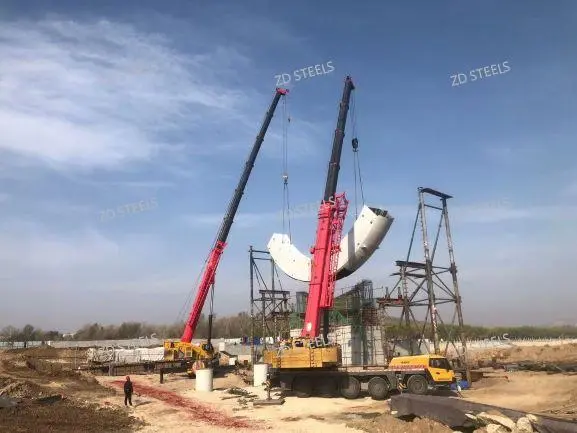
Comparing Steel Arch Bridges with Alternative Bridge Types for Strategic Procurement
Steel Arch vs. Suspension and Cable-Stayed Designs
When the span is very long, usually more than 600 meters, suspension and cable-stayed bridges work well. However, they need big towers and are more likely to twist when the loads aren't even. For spans between 150 and 500 meters, steel arch systems usually offer the same load capacity at lower costs for fabrication and installation, as well as easier long-term maintenance.
Steel Arch vs. Concrete and Truss Bridges
When the ground is stable, concrete arch bridges are a good value, but they need bigger supports because they are so heavy. Truss bridges are stiff, but they need more field links and take longer to set up. A Steel Arch Bridge combines the span efficiency of a concrete arch with the speed of modular steel fabrication. This makes it a good choice for EPC contractors who need to finish projects on time.
Lifecycle Cost Considerations for Procurement Managers
To find the total lifetime cost, you need to add up the costs of the raw materials, the construction, the installation, and the upkeep that will be needed every 25 to 30 years. Corrective maintenance costs are usually lower for steel arch systems that are approved under EN 1090 Execution Class 4 and ISO 9001:2015. This is because quality is built into every part from the start of production. When reviewing bids, purchasing managers should ask for full lifecycle cost models instead of just unit prices.
Sourcing and Procurement of Custom Steel Arch Bridges: Leading Solutions and Suppliers
What to Look for in a Qualified Supplier
A good Steel Arch Bridge supplier should have well-known credentials, like ISO 9001:2015, EN 1090, and any relevant national qualification grades. This company has a Class I Steel Structure Professional Contracting Qualification as well as ISO 9001:2015, ISO 14001, OHSAS 45001, EN 1090 Execution Class 4, and ISO 14001 certifications. These credentials prove that our environmental methods, quality management, and building work all meet international standards.
Customization Capabilities That Match Your Project
These are the main ways that Zhongda can customize arch bridge projects:
- Arch rib geometry: Pentagonal, circular, or project-specific box cross-sections with adjustable span and rise ratios
- Wind resistance ratings: Engineered to site-specific wind load requirements, currently qualified to 1.5 kN/㎡
- Anti-corrosion specifications: System selection from C3 to C5M depending on exposure zone
- Monitoring integration: Sensor count and placement customized to bridge length, traffic class, and owner requirements
With these choices, EPC contractors and government engineering clients can say exactly what the project needs, instead of having to change a standard product to fit it. From the start, our engineering team works directly with your design team to make sure that the fabrication drawings match the structural requirements.
Delivery and Logistics Planning
Twenty-meter prefabricated arch rib pieces are shipped from our plant either in containers or as break-bulk cargo. We can support phased delivery plans that work with on-site construction windows because we produce 1,203 metric tons per month. Just-in-time supply planning cuts down on the amount of laydown space needed on-site, which is helpful for bridge sites that don't have a lot of room near waterways.
Case Studies and Future Outlook of Custom Steel Arch Bridges
Shenyang Dongta Cross-Hunhe River Bridge
Our stentless rotation construction method was used to put up the main arch of this 18,000-ton arch bridge project without stopping river traffic. The project showed that very large arch structures can be rotated into place with millimeter-level accuracy, even over busy commercial waterways, after being assembled and balanced on the bank.
Jingha Expressway Expansion
For this job on the Jingha Expressway with a span of 1,200 meters, Zhongda quickly built and shipped the whole arch structure package. The job showed us how much we can achieve for multi-structure highway projects that need more than one arch span at the same time.
Technology Trends Shaping Future Projects
We now always start new bridge projects with digital twin models and BIM-driven prefabrication. These tools make it easier for designers and builders to work together, cut down on mistakes, and give project owners a digital copy of the structure in real time that they can use to plan future maintenance. More and more, predictive maintenance platforms will be fed by smart sensor networks that are built in during construction. This will change bridge management from reactive to condition-based plans.
Conclusion
For crossing wide rivers and deep slopes where pier placement is not an option, Custom Steel Arch Bridges continue to be one of the most practical options. With their high-strength materials, precise construction, built-in structure tracking, and tried-and-true building methods, these bridges last a long time and don't need a lot of upkeep. Every project Zhongda Steel works on is backed by our more than 20 years of experience and our certified manufacturing platform.
FAQ
1. What factors determine whether a steel arch bridge is the right choice for a crossing?
Span length, foundation conditions, hydrological constraints, and traffic load class are the primary deciding factors. Steel arch systems perform best when spans exceed 150 meters, and intermediate piers are not permissible due to river navigation, ecological sensitivity, or valley depth.
2. How long does fabrication and installation typically take?
Fabrication timelines depend on span length and complexity. For a mid-size arch bridge using our standard 20-meter rib segments and 1,203-ton monthly output, fabrication can run concurrently with site preparation. Stentless rotation installation typically completes in days once the arch is assembled, reducing waterway disruption significantly.
3. What maintenance does a steel arch bridge require over its service life?
With a C5M-rated anti-corrosion system, the first major recoating interval is typically 25 years or longer. Routine inspections every 2–5 years, sensor data review, and hanger tension checks form the core maintenance schedule. Our 200+ sensor monitoring system makes condition assessment faster and more precise than traditional visual inspection alone.
Partner with Zhongda — Your Trusted Steel Arch Bridge Manufacturer
Since 2004, Zhongda Steel has provided certified arch bridge structures for building projects in Asia, Europe, and other places. As a manufacturer and supplier of Steel Arch Bridges with EN 1090 Execution Class 4 certification and a 120,000 m² production facility, we help with projects from the first design consultation to the final delivery. Get in touch with our engineering team right away to talk about your crossing needs, get technical specs, or ask for a construction plan that is tailored to your project. You can email us at Ava@zd-steels.com.
References
1. American Association of State Highway and Transportation Officials (AASHTO). AASHTO LRFD Bridge Design Specifications, 9th Edition. 2020.
2. Chen, W. F., & Duan, L. (Eds.). Bridge Engineering Handbook: Superstructure Design. CRC Press, 2014.
3. European Committee for Standardization. EN 1993-1-1: Eurocode 3 – Design of Steel Structures. 2005.
4. Frangopol, D. M., & Soliman, M. "Life-cycle of structural systems: Recent achievements and future directions." Structure and Infrastructure Engineering, 2016.
5. International Organization for Standardization. ISO 12944: Paints and Varnishes — Corrosion Protection of Steel Structures by Protective Paint Systems. 2018.
6. Ryall, M. J., Parke, G. A. R., & Harding, J. E. (Eds.). Manual of Bridge Engineering. Thomas Telford Publishing, 2000.
YOU MAY LIKE
