



Can Steel Truss Girders Span Large Spaces Without Excessive Supports?
2026-10-11 13:00:01






Yes — a Steel Truss Girder can absolutely span large spaces with minimal intermediate supports. By distributing loads through a triangulated network of steel members, these structures convert bending forces into manageable tension and compression along individual members. This geometry allows clear spans exceeding 100 meters in bridge and industrial applications. Projects ranging from airport terminals to heavy-load warehouses have confirmed this capability. The key factors are proper configuration selection, appropriate steel grade, and verified engineering analysis — all of which determine how far a truss girder can reach before an additional support point becomes necessary.
Understanding Steel Truss Girders and Their Load-Bearing Capabilities
What Makes a Truss Girder Work
A Steel Truss Girder is a type of structural frame whose parts are grouped in triangles that are linked to each other. Each triangle stays the same shape when it's loaded, which means the system doesn't bend as easily as a solid beam of the same weight. The open-web design also lets the building's mechanical, electrical, and water systems run through it. This lowers the height of the building and lowers the cost of making it.
Key Configuration Types
Large-scale projects usually use three configurations. This Warren truss is great for building roofs with even loads because it has lateral members that switch directions. The Pratt truss puts diagonals under tension and vertical members under compression. This is a layout that has been used for many years on both railroad and highway bridges. The K-truss splits panel points to handle stress over longer lengths. It is often used in industrial hall structures. Each design works best for a certain type of load, span length, and site factors.
Factors That Determine Span Capacity
The span capacity is based on the type of material (most often ASTM A572 Grade 50, Q355B, or high-tensile Q420), the shape of the cross-section, the stiffness of the joint, and the ratio of the depth to the span. When it comes to steel weight, a deeper truss can hold more bending moments. As part of the construction process, engineers also take into account wind rise, seismic forces, live loads, and dynamic loads from cranes or traffic.
Can Steel Truss Girders Span Large Spaces Without Excessive Supports?
The Structural Advantage Behind Wide Spans
Steel Truss Girder systems are strong for their weight because the load is spread out over many thin parts instead of being concentrated in one solid piece. This spread makes bending moments a lot smaller. According to AISC Design Guide 21, clear lengths of 60 to 120 meters are common for open-web steel joists and truss girders in industrial and airport buildings. This is far beyond the range where solid steel beams would be too expensive and hard to work with.
Engineering Methods That Validate Large Spans
These days, span validation uses finite element analysis (FEA) and limit state design methods that are spelled out in AISC 360 and Eurocode 3. When real loads are put on these tools, they show how deflection, vibration frequency, and fatigue life change. Engineers use pre-camber, which is a small upward bow built into the truss during construction, to counteract long-term bending caused by steady loads. This keeps the finished building within the allowed range without adding columns.
Real-World Evidence
Long-span rail bridges, aviation maintenance hangars, and the roofs of sports stadiums all show that truss girders can create interior spaces without columns. A well-known example is the use of Warren truss roof girders in large logistics centers across the US. These spans of 80 meters get rid of interior columns, making it possible for forklifts and automated guided vehicles to move freely. Tuned mass dampers or greater truss depth are used instead of extra supports at these spans to control vibration.
Steel Truss Girders Versus Alternative Solutions for Large Spans
Comparing Structural Options Side by Side
When your project demands a large clear span, you have several structural choices. Here is how they compare across the metrics that matter most to procurement and engineering teams:
- Steel truss girders offer the best strength-to-weight ratio for spans above 40 meters. Their open-web geometry reduces dead load, lowers foundation costs, and allows service integration. Fabrication is modular, supporting phased site assembly.
- Solid steel beams work well up to roughly 30–40 meters but become cost-prohibitive beyond that range due to weight and material volume. Deflection control at greater spans requires significantly deeper sections.
- Prestressed concrete girders carry heavy compressive loads and perform well in highway bridge applications, but they are heavier, harder to transport for very long spans, and do not accommodate last-minute design changes. Lifecycle maintenance for concrete in harsh chemical or marine environments adds cost.
- Box girders deliver torsional stiffness for curved alignments in cable-stayed bridges and elevated transit lines. They are heavier and more expensive to fabricate than truss alternatives for standard straight spans.
These differences matter when you are balancing initial fabrication cost against long-term operating requirements. Steel truss systems consistently offer lower lifecycle costs for column-free industrial and infrastructure spans because their open structure simplifies inspection, coating access, and member replacement.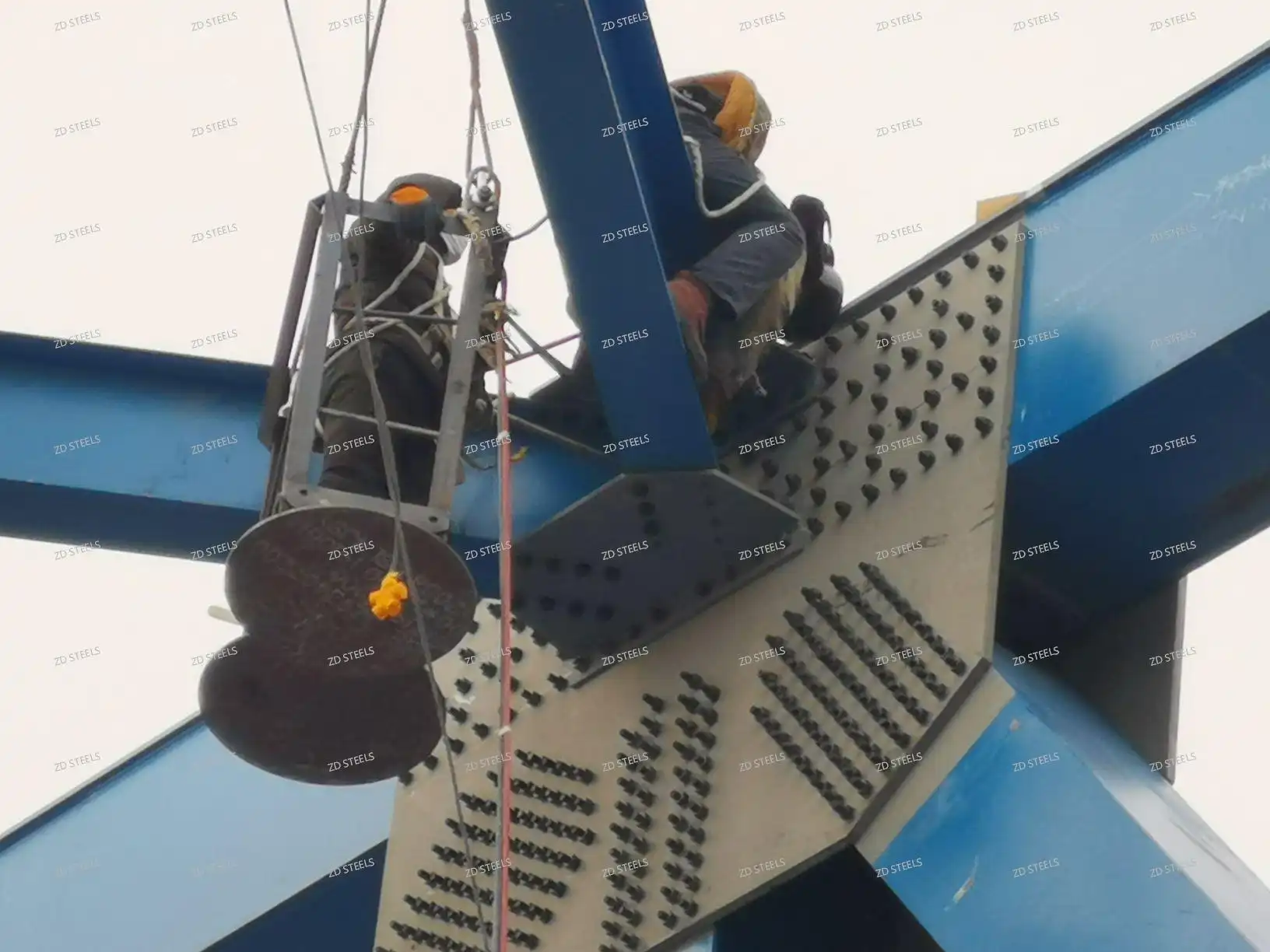
Procurement and Practical Considerations for Large-Span Steel Truss Girders
Custom Fabrication vs. Prefabricated Solutions
Custom manufacturing is best for projects with unusual shapes, specific load needs, or limited space on the job site. It requires more detailed BIM modeling and longer lead times, but it gives you a perfect fit and the best use of materials. Prefabricated modular trusses cut down on lead times and on-site labor, which makes them the best choice for standard-span industrial buildings, solar mounting structures, and repetitive bays in warehouses.
Selecting a Qualified Supplier
Look for manufacturers that are ISO 9001 certified, EN 1090 execution class compliant, and can provide full material traceability through Mill Test Certificates. Before shipping, suppliers should use non-destructive testing methods like ultrasonic testing and magnetic particle inspection on important welds. For field assembly to go forward without having to make expensive fixes, batch consistency and dimensional accuracy (node spacing, camber tolerance) must be met.
Logistics and Installation Planning
Before they can be delivered, oversize truss sections need to be route surveyed, permit applications made, and plans made with local transportation authorities. Large trusses can be shipped in reasonable pieces and put together on-site using high-strength friction-grip bolts, which are best for field joints because they keep quality control even when the weather changes. Anticorrosion coatings should have their dry film thickness checked while they are being made, not after they get to the job site.
Maintenance Tips and Long-Term Performance Optimization
Routine Inspection Priorities
Joints, welds, and surface coats should be looked at visually at least once a year. Pay extra attention to places where water can pool, like lower chord joints and bearing plates, where rust often starts. Ultrasound testing is used for welds in areas that will be used a lot, like the links between crane runway girders.
Corrosion and Fatigue Prevention
A high-build epoxy primer with a polyurethane topcoat is enough to protect against normal industrial environments. A duplex system with hot-dip galvanizing (measured to ISO 1461 thickness standards) and an epoxy topcoat works well in marine or chemical environments rated C5-M under ISO 12944 for a long time. Fix any damage to the coating during the maintenance cycle so that base rust doesn't spread.
Retrofitting and Capacity Upgrades
You can make existing truss girders stronger by attaching strengthening plates to chord members or using external post-tensioning, but only after checking the original node connections again with structural analysis. This method increases load capacity and extends service life without replacing everything. It's a cheap way for facilities to deal with higher operating demands.
Conclusion
Steel Truss Girders have been used for a long time and are a good choice for engineers to span big areas with few supports in between. Modern design techniques and high-quality steel materials, along with their triangular shape, make them useful in buildings, bridges, airports, energy facilities, and big industrial plants. Long-term performance is based on three things: choosing the right configuration, working with a certified supplier, and sticking to a strict inspection schedule. When those conditions are met, a properly built truss girder will last for decades and lengths that solid beams just can't afford to match.
FAQ
1. How does a steel truss girder handle thermal expansion?
At support points, engineers use expansion joints and slide or rocker bearings. These let the girder move along its length when the temperature changes, which keeps the members from getting secondary thermal stress.
2. Which connection type is better — bolted or welded?
Welded links are more rigid and work well in manufacturing shops where quality control is strict. For field assembly, a high-strength friction-grip fitting is best because it can handle changing weather and speeds up the building process without lowering the load transfer performance.
3. How long does a custom truss girder order typically take?
Lead times depend on how complicated the order is and how many of them there are, but fabricators who use BIM to drive their production processes can usually deliver special large-span truss girders 8 to 16 weeks after the final plan is approved, based on how the steel is supplied and how it needs to be treated.
4. Are prefabricated truss girders suitable for all large-span project types?
Standard-span warehouses, logistics centers, and industrial buildings with regular bay plans are good places for prefabricated solutions to work. When there are bent shapes, special load cases, or site-specific restrictions, projects usually need to be custom fabricated to make sure they fit correctly and meet structural requirements.
5. Can a truss girder be reinforced after installation?
Yes, it is possible to strengthen the member by adding more plates or external post-tensioning, as long as the existing node's capacity is checked again and shown to be able to handle the extra loads before any work on the structure starts.
Partner with Zhongda for Your Next Large-Span Project
From our 120,000 m² plant in Shenyang, Zhongda Steel has been making precise structure solutions since 2004. As an ISO 9001, EN 1090, and OHSAS 45001-certified Steel Truss Girder manufacturer, we help EPC contractors, infrastructure developers, and industrial builders with BIM-driven fabrication and full material traceability. To ask for a project review, you can email our engineering team at Ava@zd-steels.com.
References
1. American Institute of Steel Construction (AISC). Steel Construction Manual, 16th Edition. AISC, 2023.
2. American Institute of Steel Construction. AISC Design Guide 21: Welded Connections — A Primer for Engineers. AISC, 2006.
3. European Committee for Standardization. Eurocode 3: Design of Steel Structures — EN 1993-1-1. CEN, 2005.
4. Gaylord, E. H., Gaylord, C. N., & Stallmeyer, J. E. Structural Engineering Handbook, 4th Edition. McGraw-Hill, 1997.
5. American Welding Society. AWS D1.5: Bridge Welding Code. AWS, 2020.
6. International Organization for Standardization. ISO 12944: Paints and Varnishes — Corrosion Protection of Steel Structures by Protective Paint Systems. ISO, 2018.
YOU MAY LIKE
