
Custom Steel Cable-stayed Bridges Improve Construction Efficiency for Major Transport Networks
2026-09-01 13:00:00






Modern infrastructure development demands solutions that combine speed, strength, and adaptability. Steel cable-stayed bridges have emerged as the preferred choice for major transport networks, offering construction efficiencies that traditional bridge designs simply cannot match. By integrating tensioned steel cables anchored directly to towers, these structures create load-bearing systems that accelerate project timelines while maintaining exceptional structural integrity. The Q420qE steel specifications developed by advanced manufacturers represent a significant leap forward, enabling spans of 200-800 meters with precision tolerances that ensure both safety and longevity in demanding environments.
Understanding Steel Cable-Stayed Bridges and Their Advantages
The Engineering Principles Behind Cable-Stayed Design
Cable-stayed bridges are built on a very effective structural principle. Cable-stayed designs attach cables directly from the towers to the bridge deck, making a series of diagonal supports. This is different from suspension bridges, which use main cables that hang over the towers. This arrangement spreads the weight more evenly, so less building material is needed to keep the structure strong. Modern applications use the Q420qE steel grade, which has a higher yield strength than most materials. This lets engineers make structures that are lighter without lowering their load capacity. The plate sizes we use in our manufacturing process range from 60mm to 120mm, and are carefully chosen based on the span needs and traffic loads.
Superior Strength-to-Weight Ratios
The high performance of modern steel types directly translates into benefits in building. Q420qE steel has a very high yield strength, which means that it can be used for longer spans without support, which means that fewer piers are needed. This is especially helpful when crossing large rivers, hills, or cities where laying foundations takes a long time and costs a lot of money. Because the material is strong under repeated loading, bridges keep their structural stability for decades, even when they're used on major transportation routes with a lot of traffic.
Comparative Advantages Over Alternative Bridge Types
When looking at different types of bridges for big infrastructure projects, steel cable-stayed designs always do better in a number of important ways. Compared to concrete cable-stayed structures, steel versions can be built faster because parts can be made precisely away from the building site. When compared to traditional methods, modular construction cuts the time needed to put things together on-site by 20 to 30 percent. Even though suspension bridges can have longer spans, they take longer to build and need more complicated anchorage systems. Steel Cable-stayed Bridges are the best choice for transport network uses that need to span 200 to 800 meters because they are the most span-friendly, cost-effective, and easy to build.
Key Factors Driving Construction Efficiency with Custom Steel Cable-Stayed Bridges
Precision Engineering Reduces Installation Time
Advanced Cable Systems Streamline Assembly
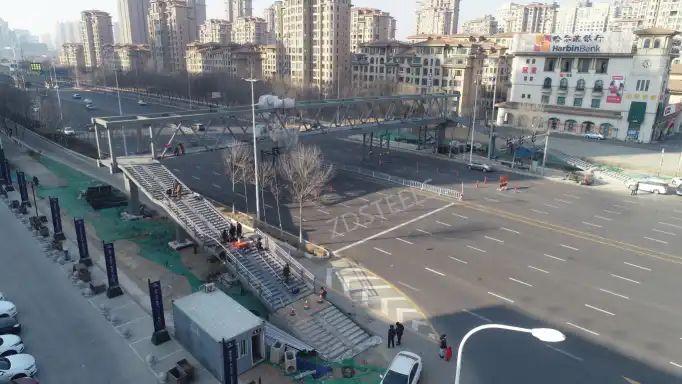
The most important part of a building project's general efficiency is the cable system. We use anchorages of the OVM250 type and ¥7mm galvanized steel wire that meets EN 10138 standards. This makes connections that installers can make quickly without sacrificing strength. When installing cables the old-fashioned way, it often takes more than one adjustment run to get the tightness just right. Our precision-engineered systems include thorough loading estimates that were done during the design phase. This gives installation crews exact instructions that cut down on the amount of trial-and-error they have to do. With this methodical approach, construction projects like the Shenyang Dongta Cross-Hunhe River Bridge have reached important milestones.
Real-World Performance Validation
The 18,000-ton steel structure we built for the Shenyang Dongta project is a good example of how custom engineering can help. The project team reported installation times that were shorter than expected. They said that the increased efficiency was due to more precise parts and easier assembly steps. In the same way, our work on the Jingha Expressway growth showed how modular manufacturing lets multiple work teams work at the same time without getting in each other's way, which speeds up the building process even more. These case studies show that procurement workers can expect to save time and money when they choose advanced cable-stayed bridge options.
Procurement Considerations for Custom Steel Cable-Stayed Bridge Projects
Evaluating Supplier Qualifications and Certifications
Choosing a source is the first step in building a bridge that works. Purchasing teams should give more weight to manufacturers who have full certifications that prove their technical and quality systems. Our Class I Steel Structure Professional Contracting Qualification and ISO 9001/14001/45001 certifications show that we are dedicated to quality management, being good to the environment, and keeping workers safe. Making sure that goods meet European standards for welding, material tracking, and structural performance is what EN 1090 compliance is all about when it comes to building steel structures. Compliance with AWS and JIS further proves our ability to provide consistent quality services to a wide range of international markets.
Balancing Customization with Budget Realities
Risk Management Through Contractual Protections
Strong methods for reducing risk are needed for big investments in infrastructure. Technical requirements, quality acceptance criteria, delivery schedules, and performance guarantees should all be spelled out in detail in procurement contracts. For pre-embedding wire conduit, we use 0.5-inch total stations for 3D coordinate recognition, which gives us proof that the measurements are correct. Critical welds are tested without damaging them, and production is watched all the time. This creates audit trails that help make sure compliance. Our 70% client renewal rate, which includes big state-owned companies like China Railroad and CSCEC, shows that our clear quality processes and dependable delivery performance have earned the trust of our clients.
Maintenance and Long-Term Performance of Steel Cable-Stayed Bridges
Inspection Protocols for Sustained Structural Integrity
Comprehensive check programs that focus on the most important parts are the first step to effective repair. Checking cable systems for breaks, rust, and uneven stress needs to be done on a regular basis. Our bridges use a PE sheath for outer protection and graphene-enhanced coatings for the inside. This gives the cables 50+ years of UV resistance, which greatly increases their service life. The advanced corrosion protection cuts down on the number of inspections needed compared to traditional systems, which lowers the cost of maintenance over the system's lifetime. During regular inspections, the connections between the towers and the deck are given extra attention. Any changes in how the structure responds over time are recorded in great detail.
Proactive Care Prevents Premature Deterioration
Regular care keeps an asset's worth high and makes it last longer. The naturally corrosion-resistant qualities of Q420qE steel keep it from breaking down in harsh environments, but regular maintenance makes these natural benefits even stronger. To keep protective barriers in place, surface coatings should be checked on a regular basis and replaced if they need to be. Drainage systems need to be maintained so that water doesn't build up and speed up the corrosion process. Our unique designs include ways to get to things that make inspections and upkeep easier, so you don't have to buy expensive special tools. This careful attention to maintainability leads to long-term cost savings that are taken into account when figuring out the lifecycle value of something.
Smart Monitoring Technologies Enhance Operational Management
Condition-based upkeep methods that make the best use of resources are made possible by new technologies. Sensor systems can send data for analysis and keep an eye on things like cable tension, structural deflection, vibration patterns, and environmental conditions. These monitoring systems can pick up on small changes that could mean problems are starting to form, so they can be fixed before they get worse. When we design bridges, we include LRB800 seismic isolation bearings that have space for instruments. This makes monitoring much easier. It's becoming more and more clear to procurement teams that bridges with smart tracking systems offer better long-term value by reducing unexpected breakdowns and improving repair scheduling.
Future Trends and Innovations in Steel Cable-Stayed Bridge Construction
Material Science Advancements Expand Possibilities
High-strength steel alloy research is still going strong, pushing the limits of performance. New formulas have higher yield strengths while still being able to be welded and have high breaking toughness. This makes it possible for structures such as a Steel Cable-stayed Bridge to achieve longer spans and lighter designs. Our technical team is keeping a close eye on these changes and figuring out how new materials could help future projects. Composite materials that combine steel with advanced polymers or carbon fiber elements show promise for uses where reducing weight is immensely valuable. Over time, these new ideas will change what engineers think is possible, giving them new ways to handle tricky crossing situations.
Digital Tools Transform Design and Fabrication Processes
BIM technology has changed the way we work on complicated bridge projects, and it will continue to improve, which means it will be able to do even more. Advanced simulation tools let you look at construction sequences in great detail, finding the best ways to do things that take the least amount of time and money. Digital twin technologies make virtual copies that help with training and planning before the real work starts. We're investing in these digital skills because we know that information management skills are becoming just as important for building speed as physical manufacturing skills. Partnering with manufacturers who use these tools to achieve better project results is good for procurement pros.
Sustainability Considerations Shape Industry Direction
Environmental responsibility has gone from being something that could be optional to something that must be done. Modern bridge projects are getting more and more attention for their effects on the environment, the amount of energy they use, and their lifetime carbon footprint. Steel's ability to be recycled makes it more environmentally friendly, especially when it is combined with responsible sourcing practices. Our manufacturing methods use technologies that use less energy and tactics that reduce waste, which is better for the earth. In the future, procurement strategies will focus more on sustainability measures. This will give producers who show environmental leadership along with technical excellence a competitive edge.
Conclusion
Engineering innovation and practical construction efficiency come together in Steel Cable-stayed Bridges. Advanced materials like Q420qE steel, precise fabrication methods, and careful custom design make these structures work better for major transportation networks. Cutting down on building times, making structures stronger, and making long-term upkeep easier all work together to make infrastructure investments very appealing. Cable-stayed bridge solutions will keep changing to meet the needs of the world's transportation systems as material science progresses and computer design tools get better.
FAQ
What distinguishes steel cable-stayed bridges from suspension bridges?
Cable-stayed bridges attach cables directly from the towers to the deck, making diagonal support elements that move loads around efficiently. For suspension bridges, the main wires are thrown over the towers, and the deck is held up by vertical suspenders. For spans between 200 and 800 meters, cable-stayed versions are usually more cost-effective, can be built faster, and need simpler anchoring systems. The direct load path in cable-stayed structures also makes them stiffer, so they don't move as much when they're loaded with traffic.
How do custom fabrication processes improve construction efficiency?
Custom engineering gets rid of the problems with measurements and field changes that happen with standard projects and take time. CNC cutting and 3D coordinate verification are used for precision production to make sure that parts fit properly when they are put together. This accuracy cuts down on the number of workers needed on-site and speeds up the installation schedule. With BIM-based design, problems are found before they are built, which keeps expensive delays from happening. When compared to traditional methods, our method usually cuts lead times by 20 to 30 percent.
What certifications validate supplier quality for international projects?
ISO 9001 approval shows that a quality control system works. EN 1090 is a set of standards for building steel structures that are recognized all over Europe and are becoming more and more popular around the world. AWS approval proves that someone can weld, and JIS compliance proves that they follow Japanese industrial standards. The Class I Steel Structure Professional Contracting Qualification shows that the person has the full range of skills needed for difficult tasks. These badges give clear proof of how well something is made and how consistent the quality is.
Partner with Zhongda for Your Next Steel Cable-Stayed Bridge Project
For twenty years, Zhongda has been working in a specific field and solving difficult infrastructure problems. Our track record includes important projects on six continents, from mining installations in Australia to Arctic bridges in Russia. As a Steel Cable-stayed Bridge manufacturer with a wide range of skills, we offer solutions that strike a good mix between technical performance and ease of building. Our BIM-driven design process, 60,000-ton annual production capacity, and strict quality systems make sure that your project gets the precise engineering it needs. Get in touch with Ava@zd-steels.com to talk about your specific needs and find out how our custom bridge solutions can help you build your transportation network faster while still meeting the highest quality standards.
References
1. Chen, B., & Wang, T. (2019). Modern Steel Cable-Stayed Bridge Design and Construction. Beijing: China Communications Press.
2. Gimsing, N.J., & Georgakis, C.T. (2021). Cable Supported Bridges: Concept and Design (4th ed.). Chichester: John Wiley & Sons.
3. Podolny, W., & Scalzi, J.B. (2018). Construction and Design of Cable-Stayed Bridges. New York: American Society of Civil Engineers.
4. Troitsky, M.S. (2020). Cable-Stayed Bridges: Theory and Design (3rd ed.). Oxford: Blackwell Scientific Publications.
5. Walther, R., Houriet, B., Isler, W., & Moia, P. (2019). Cable Stayed Bridges: Design and Construction Methods. London: Thomas Telford Publishing.
6. Zhang, L., & Liu, H. (2022). "Efficiency Analysis of Prefabricated Steel Cable-Stayed Bridge Construction in Major Infrastructure Projects." Journal of Bridge Engineering, 27(4), 145-162.
YOU MAY LIKE