
Double-Layer Horizontal Bracing: φ180×5 Round Tube, Q355B, X-Cross System with XG-3 / XG-4 Tie Rods for a High-Low Bay Snow-Load Roof
2026-11-29 18:32:13






Double-Layer Horizontal Bracing: φ180×5 Round Tube, Q355B, X-Cross System with XG-3 / XG-4 Tie Rods for a High-Low Bay Snow-Load Roof
English Version
Title: Double-Layer Roof Horizontal Bracing — φ180×5 Circular Hollow Section, Q355B, X-Cross Diagonals, Upper XG-3 and Lower XG-4 Tie Rods, Snow Load per 100-Year Return Period
Drawing note: brace section, steel grade, member marks and load notes are read from the bracing plan, the drawing remarks and the 3D roof layout. Brace length, count, member weight, gusset plates, bolt grade, truss span, column grid, purlin specification and roof pitch are not listed in this batch; they follow the original material schedule and detail drawings.
Overview
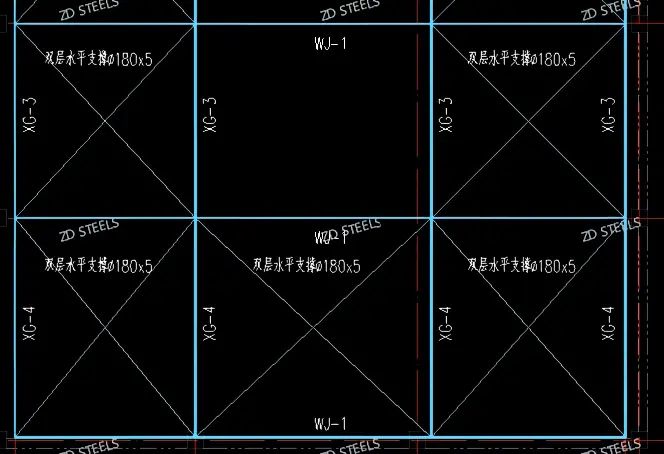
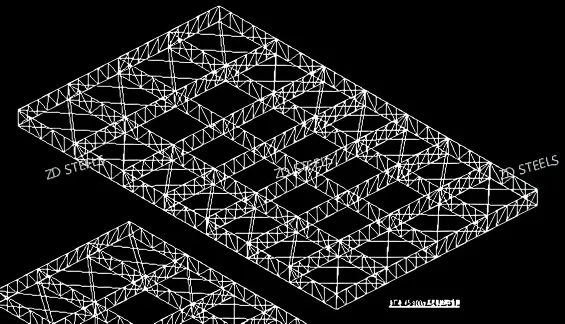
This is a double-layer horizontal bracing system for a steel roof with high and low bays. Each frame bay carries an X-shaped cross brace made of φ180×5 round tube. The upper layer ties into XG-3 tie rods and the lower layer into XG-4 tie rods, forming a horizontal truss that stabilizes the WJ-1 roof trusses. The 3D view shows two roof levels (high bay and low bay) linked by the same brace and tie-rod layout.
Readable Drawing Data
| Item | Value |
|---|---|
| Bracing type | Double-layer horizontal roof bracing |
| Brace section | φ180×5 circular hollow section (OD 180 mm, wall 5 mm) |
| Steel grade | Q355B (all steel members per remark 1) |
| Brace layout | X cross diagonals in each bay; 2 rows × 3 bays visible on plan |
| Tie rods | XG-3 (upper layer), XG-4 (lower layer) |
| Roof member tied to | WJ-1 roof truss |
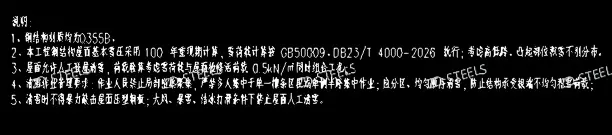
| Snow load basis | 100-year return period; per GB50009 and DB23/T 4000-2026; uneven snow on high/low bay and raised parts considered |
| Maintenance live load | 0.5 kN/m², combined with snow load in the checked case |
| Reference weight | φ180×5 ≈ 21.58 kg/m (calculated at 7,850 kg/m³; derived figure) |
How the Double-Layer Bracing Works
Two horizontal trusses stabilize the frame. Upper and lower brace layers act as two horizontal trusses tied to the truss nodes, distributing wind, crane and roof forces along the frame axes.
X diagonals share tension and compression. Crossing round tubes transfer horizontal shear in both directions; one diagonal takes tension while the other checks compression.
Tie rods close the chord line. XG-3 and XG-4 connect brace nodes along the frame line, keeping the trusses aligned and preventing lateral spread.
Bracing follows the high-low bay geometry. The 3D layout matches roof levels; snow drift on the high/low bay step and raised parts is accounted for in the load combination.
Base reactions flow through the roof truss. Horizontal forces reach the WJ-1 truss nodes and are carried down the supporting columns to the foundation.
Advantages
Two layers give rigid horizontal stiffness — upper and lower bracing together resist sway in both frame directions better than a single flat brace layer.
Round tube diagonal is efficient in both tension and compression — circular section has no weak axis and performs well as a crossing brace.
Q355B grade matches brace force demands — higher strength than plain Q235 for the same tube size, with enough ductility for brace connections.
Open X layout leaves room for services — diagonal members don't block the bay center; roof panels, ducts and snow removal access remain usable.
Repeatable bay-by-bay detail — the same X brace and tie-rod arrangement repeats across bays, simplifying shop fabrication and site fitting.
Disadvantages / Limits
Two layers double the brace work — more diagonals, gussets and rods than a single layer; fabrication and inspection time rise accordingly.
Round tube-to-gusset welding needs proper end treatment — tube cuts, end seals and weld category must follow the detail; sloppy welding leaves stress concentration.
Compression diagonal capacity depends on slenderness — long bays can make the compression branch buckle; tube section and brace length must match the design force.
Open faces accumulate dirt and moisture — brace and tie-rod nodes need paint touch-up and periodic corrosion inspection.
Data gaps on these drawings — brace length, quantity, total weight, gusset thickness, bolt grade, truss span, column grid and purlin size are not legible; capacity and takeoff require the original design.
Typical Use Cases
Industrial workshop roofs with high and low bays where horizontal stability must be maintained across two roof levels.
Heavy snow region roof frames checked under 100-year snow return period with maintenance live load combined.
Large-span portal frames and truss roofs needing two-level wind and longitudinal force bracing.
Warehouse, plant and logistics center roofs with repeated X-bay layouts.
Retrofit or extension roofs added beside an existing high/low bay, where tie rods and braces line up with the old frame.
Fabrication and Erection Notes
Confirm brace length, count, gusset plate and bolt specification from the original schedule before cutting the φ180×5 tubes.
Mark the upper layer (XG-3) and lower layer (XG-4) nodes; fit diagonals so the X intersection matches the bay center.
Check tube wall thickness and weld category; seal tube ends against internal corrosion.
Erect tie rods first, then fit crossing diagonals; keep rods straight along the frame line before final bolting.
Per the drawing remarks, roof access for manual snow removal is allowed, but staff must spread out evenly by zones; no crowding on a single purlin line or one half span, and no striking the roof sheet. Work stops in strong wind, heavy snow or icy conditions.
Coat brace, tie-rod and gusset surfaces after inspection; inspect nodes at regular intervals for corrosion and loose bolts.
Bottom Line
The double-layer horizontal bracing uses φ180×5 Q355B round tubes as X cross diagonals, linked by upper XG-3 and lower XG-4 tie rods to the WJ-1 roof trusses, arranged for a high-low bay roof checked under 100-year snow load plus 0.5 kN/m² maintenance live load. Section, grade and layout come from the drawings; brace quantity, weight, connections and grid dimensions follow the original structural design.
**WhatsApp**: +86‑13889862778, +86‑18242444407
**Email**: eddie@zdsteels.com, wells@zdsteels.com
YOU MAY LIKE