
How Does Power Plant Steel Structure Improve Equipment Support and Operational Safety?
2026-08-30 13:00:00






Power Plant Steel Structure revolutionizes equipment support and operational safety through superior load-bearing capabilities, vibration dampening, and precision-engineered frameworks. These industrial-grade systems distribute massive static and dynamic forces from turbines, boilers, and generators across optimized steel members, preventing localized stress concentrations that compromise equipment alignment. Advanced design methodologies incorporate seismic isolation, thermal expansion allowances, and corrosion-resistant treatments, creating resilient platforms that maintain structural integrity under extreme operational conditions. By employing high-strength steel grades like Q355 and modular prefabrication techniques, these structures reduce installation errors while enhancing accessibility for maintenance operations, directly translating to reduced downtime and elevated safety standards in energy facilities.
Understanding Power Plant Steel Structures: Types and Design Considerations
Modern energy facilities depend on special frameworks for structures that are made to meet the specific needs of power generation environments. There are three main types: turbine hall frames, boiler suspension towers, and cooling tower supports. Each is designed to deal with a different set of mechanical and environmental issues.
Framework Classifications in Energy Infrastructure
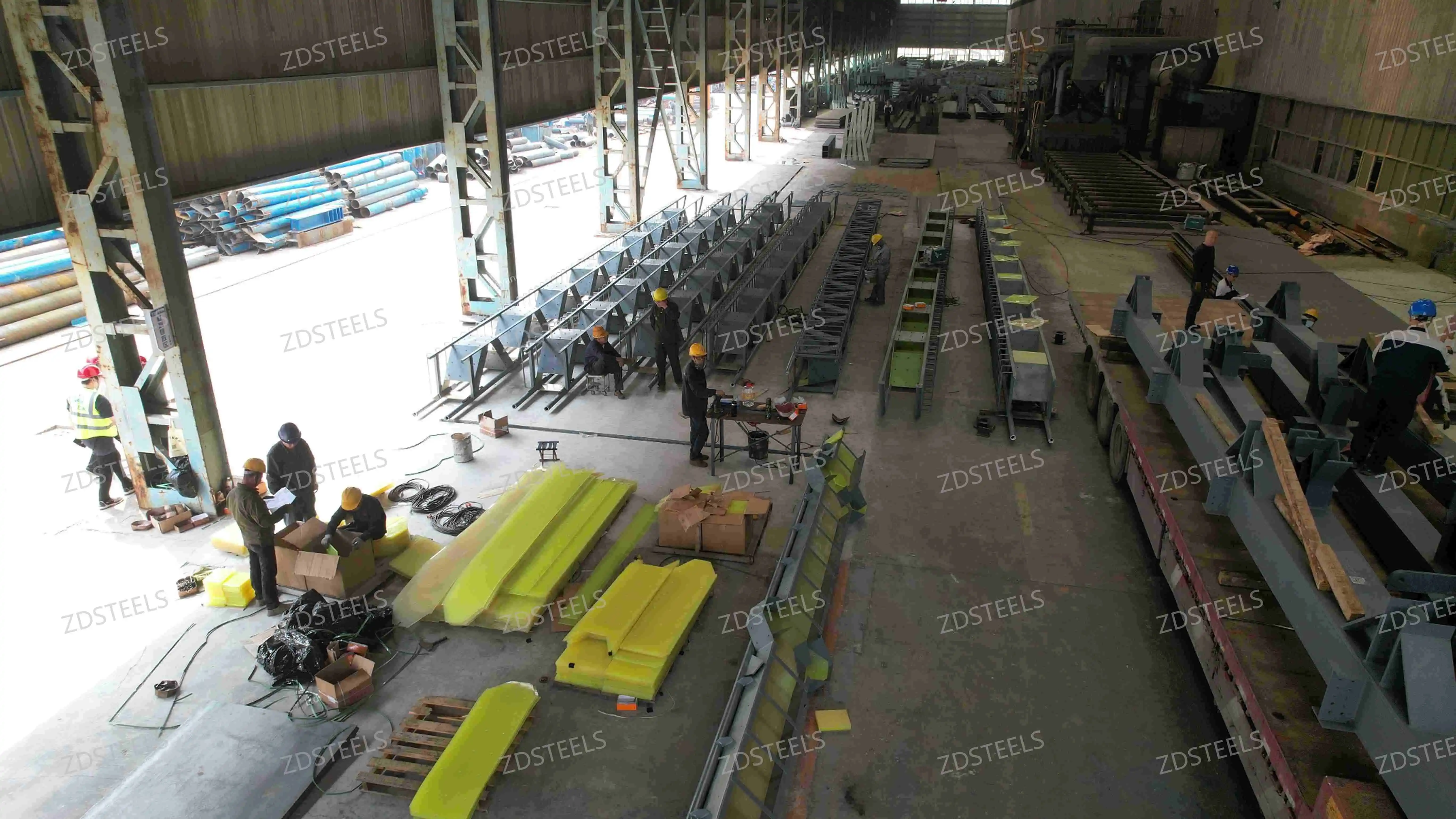
In order to fit huge engines and allow overhead cranes to service equipment, turbine rooms need long, column-free spans. Clear spans of more than 30 meters are possible with these portal frame systems, which use welded H-beams or box columns with moment-resisting joints. Boiler support systems are basically different. They use vertical steel cages to hold up pressure vessels and allow for downward thermal expansion during heat cycles. Air-cooled condenser platforms add another level of complexity—elevated A-frame designs must be able to withstand vibrations caused by wind while supporting large amounts of fan equipment in open outdoor areas.
Critical Design Parameters
The integrity of a structure depends on how well the loads are chosen. Dead loads are the weight of steel members and equipment that stays in place, like cable trays, insulation materials, and pipe systems. Live loads are different for each type of building. For example, maintenance walkways need different load rates than places where equipment is laid down. Environmental factors like wind speeds, snowfall, and ground movements caused by earthquakes must be in line with local building rules and the unique geologic conditions of the site.
The way a structure works under practical stresses is directly affected by how well the materials work. Steel types Q235 and Q355 are most often used to build power plants because they have the best mix of yield strength, weldability, and cost-effectiveness. In cold climate installations, mechanical properties like tensile strength, elongation capacity, and Charpy V-notch impact toughness at low temperatures are very important. The spatial geometry is set by the structural system factors. For example, the column grid spacing, beam depth-to-span ratios, and link details all affect how loads move and how stable the structure is overall. Iterative analysis with finite element modeling and checking for compliance against ASTM, EN, and ISO standards lead to these scientific choices.
How Steel Structures Enhance Equipment Support in Power Plants
Superior Load-Bearing Performance
Because steel is naturally strong for its weight, thin members can support heavy equipment loads that would need thick concrete sections. A steel box column that is 600 mm square can hold more than 5,000 kN in vertical loads and stay stable in windy conditions. This efficiency is very important when adding on to existing buildings where the foundations can't hold any more dead weight. The flexibility of the material takes shock loads from starting up and stopping down equipment, which keeps it from breaking in ways that put people and machines at risk.
By putting together whole structural bays off-site, modular prefabrication changes how efficiently construction is done. When fabrication shops have CNC cutting lines and automatic welding stations, they can get dimensions to within ±0.2mm, which gets rid of the need for delays in the field. Transporting pre-assembled units up to 12 meters long speeds up site construction. For example, a coal-fired plant boiler structure that would take 18 months to build with cast-in-place concrete can be built in 9 months with prefabricated steel. This shortening of the timeline lowers the cost of financing and speeds up the time it takes to start making money from earlier grid connections.
Longevity Through Advanced Protection Systems
Power plants have corrosive atmospheres that need strong anti-corrosion strategies. These atmospheres can be caused by combustion byproducts, cooling tower drift, or salt spray from the coast. Hot-dip galvanizing adds a coat of zinc that is metallurgically bound to the base steel and protects it for many years. When you mix galvanizing with fluoropolymer topcoats, you get ISO 12944 C5-M durability grades that are good for the roughest marine conditions. Weathering steel metals with copper, chromium, and nickel create stable oxide patinas that renew themselves, so they don't need to be painted as often.
Regular access built into the design makes tools last longer. Technicians can get to important connection points, bearing assemblies, and expansion joints without having to set up temporary support thanks to permanent catwalks, ladder cages, and working platforms built into the structure frame. This method is better for upkeep because it lowers the cost of inspections and makes it more likely that damage will be found early, stopping catastrophic breakdowns.
Operational Safety Improvements Driven by Steel Structure Design
How safe energy facilities are depends on how well their structures handle both normal operational stresses and unusual events. Thoughtful engineering uses redundancy, flexibility, and code-compliant detailing to deal with different failure scenarios.
Resilience Under Environmental Extremes
Seismic design rules take into account that power plants are important equipment that needs to work after an earthquake. Because steel is flexible, it can bend and hinge in a controlled way when the ground shakes, releasing energy without breaking. Special moment frames and buckling-restrained braces keep the gravity load capacity while providing horizontal resistance. Another problem is wind loads, which put a lot of pressure on tall boiler buildings and open condenser platforms. Computational fluid dynamics analysis finds the rates at which vortices shed their spin, which lets architects adjust the natural periods of structures so that they don't coincide with conditions that make tremors stronger.
Compliance With Rigorous Safety Regulations
The rules that control the building of power plants put public safety and grid stability first. Fall protection, guardrails, and safe entry paths must be built into structures from the start in order to meet OSHA guidelines. NFPA rules talk about fire resistance ratings for structural parts that support important equipment. These ratings are sometimes needed for spray-on fireproofing or concrete encasing. Third-party inspection agencies check the quality of the weld using X-rays, ultrasound, and magnetic particles to make sure that every connection follows the written Weld Procedure Specifications.
Top engineering companies go above and beyond the bare minimums required by code to improve safety factors for key load paths. Support beams for equipment might be made to hold 1.5 times the calculated load, just in case something goes wrong. When a single member fails, progressive collapse doesn't happen because of redundant load routes. This is a concept that is clear in truss systems where multiple web members share the load transfer duties.
Comparative Insights: Steel vs. Concrete and Other Materials in Power Plant Structures
Procurement managers are still arguing about which materials to use while weighing the initial costs against the long-term value. Quantitative comparison shows situations where steel has unbeatable benefits and situations that need a mix of methods.
Performance Metrics Across Material Categories
Steel has a higher tensile strength—Q355 has a yield strength of 355 MPa, while concrete's typical compressive strength is 30 MPa. This difference directly affects the size of the members: a steel column takes up about a third of the floor space of a concrete column of the same size, making more room for tools and people. Steel is faster to build with because it doesn't need to cure like concrete does. Concrete takes 28 days to reach its design strength, but bolted steel connections reach full capacity as soon as they are installed.
Concrete is great for uses that need to fight fire and store heat. Concrete's ability to take in and release heat without breaking down is good for boiler foundation pedestals. When you combine steel superstructures with reinforced concrete supports, you get the best of both worlds. The concrete provides stable bearing surfaces and seismic mass, while the steel frame allows for flexible gaps above without columns.
Fiber-reinforced plastics and metal alloys are other materials that are used in certain situations, but they aren't as strong, cheap, or well-established as steel. Aluminum's lower density makes it useful for uses that need to be light, but because it has a lower modulus of elasticity, it needs bigger pieces to keep it from deflecting. FRP composites strongly prevent corrosion, which makes them good for supporting buildings for scrubbers. However, they aren't widely used because the materials are expensive and there aren't many ways to connect them.
Supplier Selection Criteria
To find a skilled steel structure seller, you need to look at a number of their capabilities. A fabricator's manufacturing capacity shows if they can meet the tonnage and schedule needs of big power plant projects. Facilities that can handle 5,000 tons per month and have heavy-plate cutting tools that can cut through 150 mm of steel meet the needs of work in the utility industry. Quality management systems that are checked by ISO 9001 certification give you confidence in the consistency of the process, and AWS D1.1 qualifications for welding procedures make sure that the joints are strong.
Procurement Guide: Investing in Power Plant Steel Structures for Enhanced Support and Safety
Strategic procurement changes buying steel structures from a one-time transaction to a partnership that creates value. Buyers can get the best results if they understand the buying process, what affects costs, and what vendors can do.
Navigating the Procurement Lifecycle
Detailed specifications about structural loads, environmental conditions, code requirements, and schedule milestones are used in the inquiry phase to set the project's parameters. By giving all the necessary details at this point, you allow fabricators to give you accurate budgetary prices instead of quotes that depend on a lot of factors. The next step is customization discussions, where engineering teams work together to improve the design. For example, they might use higher-grade materials to cut down on steel tonnage or make connections easier to speed up field erection.
Delivery and fabrication times depend on how much work the shop can do and how long it takes to get materials. Getting structural plates bigger than 80 mm from steel mills could take 16 weeks, which would add time to the whole job. By pre-assembling structural bays with built-in platforms, handrails, and equipment supports, modularization strategies shorten the time it takes to install things on-site. This is especially helpful for projects that need to be finished quickly or for expanding an existing brownfield that is already full. When time pressures get tough, turnkey solutions that include design, manufacturing, transportation, and installation all come from a single source. This makes planning easier and makes it clear who is responsible.
Cost Considerations and Value Engineering
Price changes are caused by more than just base steel product rates. Complexity of the design affects the amount of work needed to build it. For example, a building with repeating details costs less per ton than one that needs unique connections at every joint. Surface preparation and coating specs have a big effect on the total cost. For example, using a normal shop primer doesn't add much to the cost, but using NAPS 3/SSPC-SP10 blast cleaning and 250-micron epoxy systems does, which adds 25–30% to the cost. Logistics costs depend on the size of the modules. Over-dimensional loads need escort vehicles and route surveys, which add to the costs.
Value engineering, which is done together by the buyer and the supplier, often finds ways to cut costs without affecting performance. If you use bolted field splices instead of welded connections, you might be able to cut down on erection time by 20% while making quality control easier. By making column sizes the same across multiple bays, die setting changes are kept to a minimum, which saves the buyer money. These improvements come from the supplier's real-world experience, which shows how important it is to involve the seller early on in the plan development process.
When you work with qualified, experienced makers, you lower the risks that come with putting together complex industrial projects. Fabricators who are AISC certified have been checked to make sure they can control quality, track materials, and make sure their staff is qualified. Testimonials from clients saying that projects were finished on time and on budget are real proof of trust. Credentials in an industry, like membership in professional groups and ongoing training for employees, show a dedication to technical excellence that goes above and beyond the minimum requirements.
Conclusion
FAQ
How does steel framing address vibration from rotating equipment?
To control vibrations, tuned mass dampers and high-strength friction-grip bolts built into the frame of the structure are used. These systems get rid of kinetic energy and stop resonance conditions that make noises caused by machines louder. During construction, detailed finite element analysis finds natural frequencies. This lets engineers change the size of members or add stiffening elements that move the structure's reaction away from the speeds of turbines and generators.
What corrosion protection suits coastal power plants?
Coastal installations need duplex coating systems that use both hot-dip galvanizing and fluoropolymer topcoats and meet the requirements of ISO 12944 C5-M for durability. This multi-layered method gives both protective shielding from the zinc layer and barrier protection from the polymer film. This results in a 25-year service life with no upkeep needed in harsh marine environments with high humidity and salt spray.
Can modular construction reduce project schedules?
Large-scale modularization of structure bays, which includes pre-installed platforms and built-in pipe supports, often cuts site assembly times by 30 to 40 percent compared to stick-built methods. By fabricating things off-site in a controlled shop environment, delays caused by bad weather are avoided, and quality is improved through repeatable processes. This leads to earlier completion dates and a faster return on investment.
Partner With Zhongda for Proven Power Plant Steel Structure Excellence
When the structural performance of your energy project can't be compromised, Zhongda offers engineered solutions backed by 20 years of experience around the world. Our ISO-certified factory in Shenyang makes 60,000 tons of precisely built frames every year using BIM-driven design, advanced weathering steel technology, and cutting ultra-thick plates to within ±0.2mm standards. Our ability to work in harsh settings is shown by projects like building bridges across the Arctic for Russian clients, building mining infrastructure in Australia, and building industrial sites in Vietnam. To find a reliable Power Plant Steel Structure manufacturer, you need to check their technical know-how, quality systems, and track record of completing projects. Zhongda consistently shows that they have these qualities by working with China Railroad, CSCEC, and BMW. You can email our technical team at Ava@zd-steels.com to talk about how our full-service approach can turn your building needs into useful assets, or you can visit zd-steels.com to learn more about our wide range of engineering services.
References
1. American Institute of Steel Construction. (2016). "Specification for Structural Steel Buildings." AISC 360-16, Chicago, Illinois.
2. International Organization for Standardization. (2017). "Paints and Varnishes - Corrosion Protection of Steel Structures by Protective Paint Systems." ISO 12944 Parts 1-8, Geneva, Switzerland.
3. Smith, J.C., & Williams, R.T. (2019). "Design of Steel Structures for Power Generation Facilities: Load Considerations and Safety Factors." Journal of Structural Engineering, Vol. 145, No. 8.
4. European Committee for Standardization. (2015). "Execution of Steel Structures and Aluminum Structures." EN 1090-2:2018, Brussels, Belgium.
5. Chen, W.F., & Lui, E.M. (2018). "Handbook of Structural Engineering, Second Edition." CRC Press, Boca Raton, Chapter 28: Industrial Structures.
6. National Fire Protection Association. (2021). "Building Construction and Safety Code." NFPA 5000, Quincy, Massachusetts, Section 7: Structural Design Requirements.
YOU MAY LIKE