
Slotted Insert Joints for Steel Lattice Columns
2026-11-07 18:58:37






Slotted Insert Joints for Steel Lattice Columns
English Version
Title: Lattice Column Joints: Slot the Tube, Insert the Plate — Φ700×16 Legs at 9 m
Overview
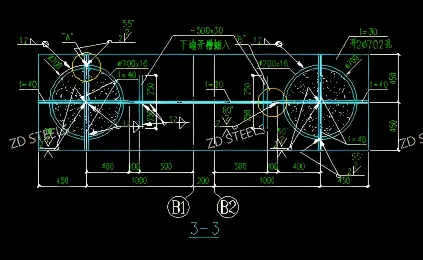
A lattice column is only as good as its joints. The legs are joined by plates and braces, and every one of those connections has to pass the column load without cracking the tube wall. This project uses a slotted insert joint — the tube is drilled, then slotted, and a steel plate is inserted and welded.
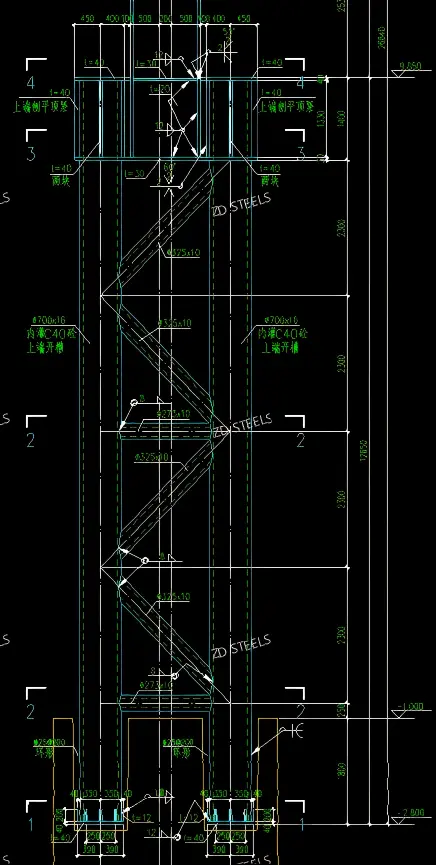
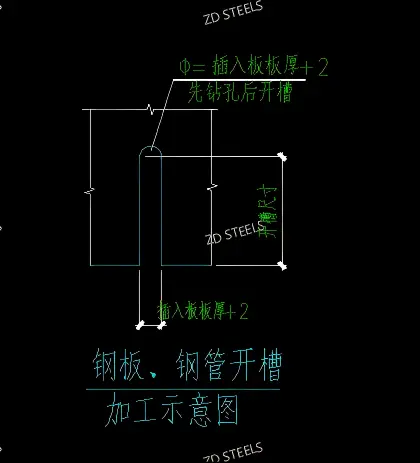
The drawings show the joint detail, the assembly elevation, and the fabrication method for the slot.
Drawing Data
| Item | Value (from drawing) |
|---|---|
| Column type | Twin-leg lattice |
| Leg section | Φ700×16 steel tube |
| Diagonal brace | Φ245×10 tube |
| Connection plate | -500×10 |
| Node plates | t = 30 / t = 40 |
| Slot opening | Φ = insert plate thickness + 2 mm |
| Slot method | Drill first, then slot (先钻孔后开槽) |
| Groove angle | 55° / 60° |
| Column top | +9.050 m |
| Column base | +1.000 m |
| Segment heights | 2,200 / 2,900 / 2,500 mm |
| Hole note | "开 Φ670Φ2 孔" per the 3-3 section |
How the Joint Works
Drill first. A hole is drilled through the tube wall at the joint location — this stops the slot from cracking at its end.
Then slot. The tube is slotted to a width of the insert plate plus 2 mm, so the plate slides in with a controlled fit.
Insert the plate. The -500×10 connection plate or the node plate (t=30/40) enters the slot and is welded on both sides.
Weld with a groove. The 55°/60° groove prepares the tube wall for full-penetration welding at the plate junction.
Braces tie in. Φ245×10 diagonals connect at the node plates, completing the lattice.
Why this detail matters: a plate welded onto the tube surface concentrates force at the weld toe. A plate inserted through the tube spreads the load across the wall thickness and removes the sharp weld toe — better fatigue behavior at the node.
Advantages
Load goes through the wall, not onto it — inserted plates avoid the stress concentration that surface-welded plates create.
Better fatigue life — no sharp weld toe on a loaded tube; important for wind and crane cycles.
Controlled fit — the slot is plate thickness + 2 mm, so the plate cannot distort the tube during fit-up.
Drill-first detail prevents cracking — the round hole at the slot end stops the slot from propagating.
Buildable in a normal shop — drilling and slotting with a plasma cutter; no special machinery beyond a mag drill.
Disadvantages / Limitations
More fabrication steps — drill, slot, fit, weld, inspect; each joint costs more hours than a simple fillet weld.
Slot tolerance is tight — a slot too wide leaves a root gap that is hard to weld; too narrow and the plate will not fit.
Weld access is limited — welding inside a slotted tube is awkward; welder skill matters more than on open joints.
Cutting damages coating — the slot and weld zone need recoating after fabrication; the shop must plan for it.
Not for thin-wall tubes — a 16 mm wall can take the slot; thinner walls lose too much section at the joint.
Typical Use Cases
Lattice column leg-to-brace joints — Φ700×16 legs with Φ245×10 diagonals (this drawing).
Column base and cap connections — -500×10 plates inserted into the tube at the top and base.
Tall industrial columns — 9 m lattice columns in workshops where fatigue from wind and crane loads matters.
Retrofit strengthening — inserting new plates into existing tubes to add braces or connections.
Truss and tower nodes — any tube-to-plate joint that needs the load spread through the wall.
Fabrication and Erection Notes
Legs: Φ700×16 tube — verify wall thickness and ovality; the slot must be cut on the true axis.
Slot: drill the end hole first, then cut the slot to plate thickness + 2 mm; deburr both edges.
Insert plates: -500×10 and node plates t=30/40; check the plate thickness before cutting the slot — a mismatch scraps the tube.
Welding: prepare 55°/60° grooves; weld both sides; check the root with UT or MT on loaded joints.
Assembly: match segments to the drawing (2,200 / 2,900 / 2,500); check the column top at +9.050 before closing the joint.
Coating: recoat the slot and weld zones after fabrication; touch up after site welding.
Bottom Line
A slotted insert joint is the detail that makes a lattice column survive its own load path. Drill first, slot to plate thickness + 2 mm, insert the -500×10 or t=30/40 plate, weld with a 55°/60° groove. It costs more hours than a surface weld, but it moves the force through the tube wall instead of piling it on the weld toe. On a 9 m column with wind and crane cycles, that is the difference between a joint and a crack.
**WhatsApp**: +86‑13889862778, +86‑18242444407
**Email**: eddie@zdsteels.com, wells@zdsteels.com
YOU MAY LIKE