
What Engineering Challenges Can Steel Cable-stayed Bridges Solve in Complex Terrain?
2026-09-01 13:00:00






Steel cable-stayed bridges deliver transformative solutions for infrastructure projects facing mountainous regions, deep gorges, seismic zones, and unstable geological conditions. These advanced structures utilize high-strength cables connected to robust towers, distributing loads efficiently while minimizing foundation demands. Their adaptability to uneven topography, rapid construction timelines, and superior resilience against environmental stressors make them invaluable for government contractors, EPC firms, and infrastructure developers navigating challenging landscapes. When conventional bridge designs falter under geological complexity or environmental extremes, modern steel cable-stayed bridges provide the engineering precision and economic viability essential for successful project execution worldwide.
Understanding Complex Terrain Challenges in Bridge Engineering
Complex terrain environments have a lot of big problems that make it hard to use traditional bridge building methods. From the Alaska Range to the Appalachian valleys, these difficult areas have things in common that make building infrastructure harder.
Geological and Topographical Barriers
For rough mountain ranges, deep canyons, and river valleys, bridge spans need to have as few support systems as possible in the middle. It is very hard to put down a foundation when bedrock is deep below layers of sand or when the soil conditions change a lot from one spot to another. Civil engineering firms have to deal with unstable slopes that are likely to erode, seismic activity zones that need flexible structural reactions, and landscape gradients that make it hard to use standard pier placement methods. Traditional concrete span bridges need a lot of groundwork and more than one foundation point, which makes the project much more expensive and causes environmental damage in these sensitive areas.
Environmental and Climatic Constraints
Bad weather patterns make it harder to deal with the terrain. Coastal bridge projects have to deal with salt spray and hurricane-force winds, while high-altitude crossings have to deal with temperatures that can range from very hot in the summer to very cold in the winter. Heavy precast concrete pieces are very hard to move to remote areas because of the way they are set up. Access problems at the site make it harder to use equipment, take longer to build, and cost more to hire workers. Because of these environmental factors, bridge solutions need to be long-lasting and not need constant maintenance. This is especially important for energy corridor projects and mining operation connectors where downtime directly affects operational revenue.
Limitations of Conventional Bridge Systems
Even though suspension bridges can have long spans, they need big anchorage systems that don't work well in many geological conditions. Formwork and curing time for concrete bridges are very long, so they can't be used on sites with short construction windows or that are hard to get to. Even though truss bridges are cheap, they can't span wide slopes and need a lot of piers that can damage sensitive environments. Because of these problems, procurement managers and project engineers are looking for other options that balance the performance of the structure, the efficiency of construction, and the cost-effectiveness over its entire life in difficult terrain applications.
How Steel Cable-stayed Bridges Address Key Engineering Challenges
These days, cable-stayed designs change how we work on projects in rough terrain by using new ways to manage loads and build. The basic engineering idea behind these designs makes them better in ways that directly address the problems listed above.
Optimized Load Distribution and Structural Efficiency
The cable-stayed design of the Steel Cable-stayed Bridge sends loads from the bridge deck directly to vertical towers through slanted cables. The towers then focus the forces on a few central foundation points. Compared to standard designs, this load line makes the structure very efficient. Our Q420qE steel cable-stayed systems can support main spans from 200 to 800 meters with few intermediate supports. This makes foundations much less necessary in areas with unstable geology. The high-strength Q420qE steel used to build towers (plate thicknesses between 60 and 120 mm, with a vertical accuracy range of 1/4000) has a better yield strength while keeping the weight reasonable. This edge in strength-to-weight means fewer structural parts, less dead load, and smaller supports, all of which are important when working above deep valleys or weak substrates.
The OVM250 type mooring with Υ7mm galvanized wire (which meets EN 10138 standards) used in the stay cable setup makes sure that the load is evenly spread across the whole span. Cable shape can be changed while the bridge is being built and while it is in use. This lets the bridge handle settlement, heat expansion, and changing loads that would damage rigid concrete structures. This adaptability is very useful in areas prone to earthquakes, where structures need to be able to bend without breaking completely.
Accelerated Construction Through Prefabrication
In rural or environmentally sensitive places where time is limited, rapid deployment methods are needed. Through modular prefabrication, Steel Cable-stayed Bridges excel here. Tower sections, deck segments, and cable assemblies are some of the main parts that are made in our 120,000 m² factory in Shenyang and then sent to construction sites to be put together. This method cuts down on the time needed for building on-site by 20–30% compared to traditional methods. It also reduces the damage to the environment and delays caused by bad weather.
BIM-based computer planning makes sure that exact parts are made, and CNC cutting can achieve tolerances of ±0.2mm. Using 0.5-inch total stations, our 3D coordinate detection systems check the positions of cable conduit pre-embedding, so there are no more expensive field adjustments. Precision manufacturing and prefabrication work especially well for building infrastructure in Alaska, the Rocky Mountain corridor, and the mining regions of the Appalachians, where the work seasons are short, and sometimes it's not possible to get to the site.
Enhanced Durability in Harsh Environments
Conditions in the environment are often very bad when the terrain is complicated. Coastal highway bridges have to deal with winds that are full of salt, and mountain passes have to deal with UV exposure and freeze-thaw cycles. Our anti-corrosion system solves these problems with two layers of protection: a PE outer sheath and graphene-enhanced inner coatings that make the system UV-resistant for more than 50 years. This security method, created using our own -60°C Weathering Steel Anti-corrosion Technology, keeps the structure strong in places where painted steel would need to be fixed up often.
For projects in tectonically active zones, seismic resilience is still the most important thing. When we put LRB800 type isolation bearings into our bridge systems, they lower the seismic response forces by up to 40%. This keeps the superstructure and foundations safe during earthquakes. This engineering method meets strict safety standards for government companies building important infrastructure in earthquake-prone areas from California to the Pacific Northwest.
Engineering Case Studies: Successful Steel Cable-stayed Bridge Projects in Complex Terrains
Theoretical benefits are supported by success in the real world. When you look at finished projects, you can see how cable-stayed designs work to get around problems with the ground while also saving money and improving operations.
Mountain Valley Crossing: Shenyang Dongta Cross-Hunhe River Bridge
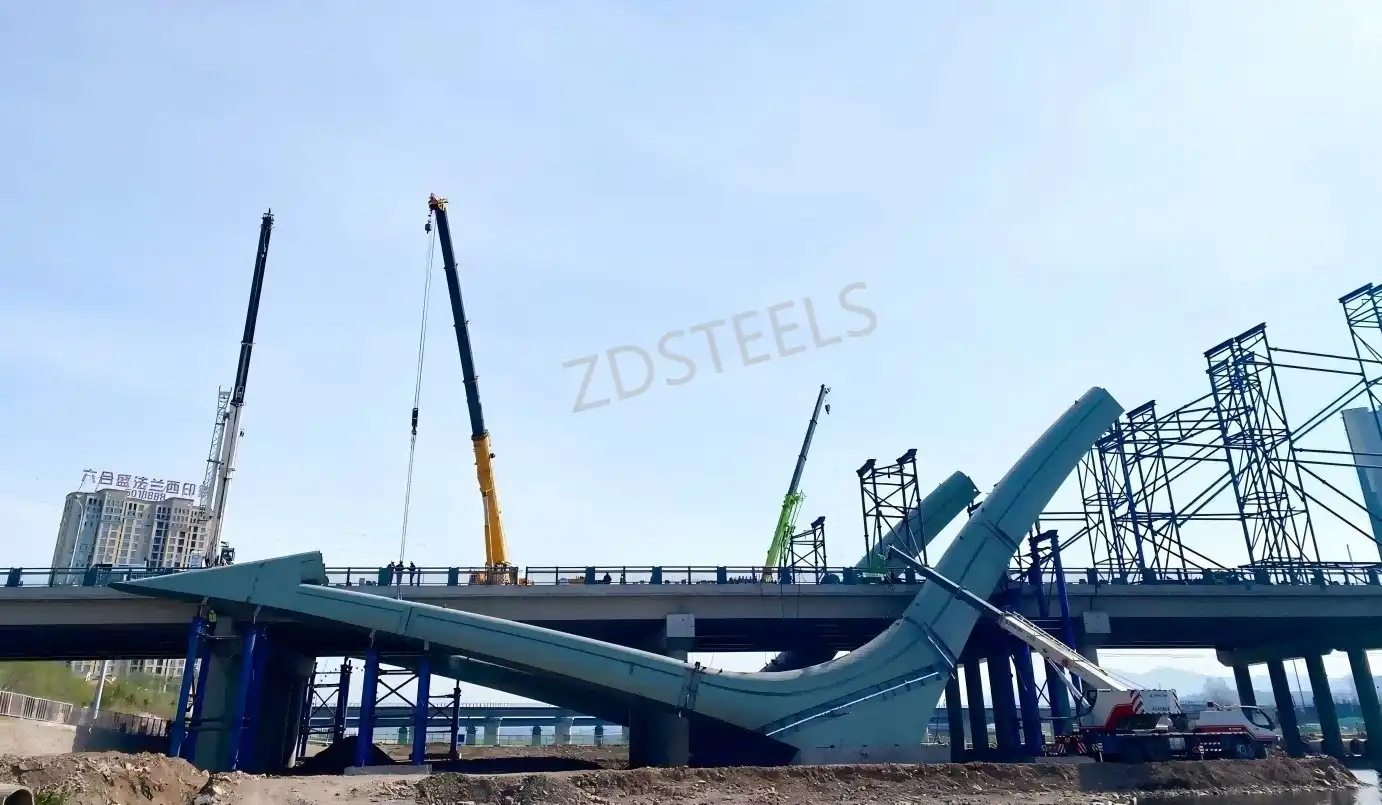
This 18,000-ton steel structure shows how cable-stayed technology can work in urban valleys with limited space. Due to unstable riverbanks and existing infrastructure, the project didn't have many options for where to put the foundations. In the past, using multiple piers would have meant digging up a lot of the riverbank and setting up temporary redirection systems. Instead, the cable-stayed design got the clearances needed with just two main towers, which caused less damage to the environment and cut down on the time it took to build. New anchoring systems were able to work with different types of soil, and prefabricated deck sections made installation go quickly when the water level was low. When it was finished, the bridge met strict requirements for flood transportation and now handles a lot of commercial traffic.
Coastal Wind Zone Application
A recent project on the East Coast needed to cross a tidal estuary in an area where hurricane-force winds are common. The team that designed the Steel Cable-stayed Bridge asked for our Q420qE steel system, which has tuned mass dampers built into the tower structures and better aerodynamic deck profiling. Computational fluid dynamics modeling was used to find the best arrangements for the stay cables so that vortex-induced oscillations would happen as little as possible. The rust protection system with added graphene worked well in harsh salt spray conditions, and it got rid of the problems with upkeep access that older concrete buildings have in similar settings. Compared to traditional box-section designs, streamlined tower profiles cut wind loads by about 25%. This made it possible for supports to be lighter, even though the sands along the coast were not very good.
Remote Industrial Access Bridge
In the western United States, a mining operation needed a bridge to cross a steep canyon and connect processing facilities to roads and other infrastructure. Because of the need for a 500-meter span, concerns about earthquakes, and very limited access for building, standard bridge types were not financially viable. The steel cable-stayed approach used a single-cable plane layout, which cut down on material volume while keeping the right level of torsional stiffness. Prefabricated parts were moved along existing mining roads and put together using special cranes that were set up on the edges of canyons. The whole superstructure was built in seven months, which would not have been possible with cast-in-place concrete. Heavy haul trucks carrying mineral concentrates can now drive over the bridge. This shows how cable-stayed designs can be used to solve problems with span and construction in industrial settings.
Comparing Steel Cable-stayed Bridges to Other Bridge Types in Complex Terrain
To make smart investments in infrastructure, we need to compare different systems in a fair way. Knowing the differences in performance helps procurement managers and tech teams choose the best options for each project.
Design Adaptability and Span Capability
While suspension bridges can span the same amount of space, they need huge anchorage blocks that go deep into the ground, which isn't always possible in places with unstable geology or limited access to property. Cable-stayed towers spread out the loads on the foundation, so they need a lot less digging and geotechnical work. Concrete cable-stayed bridges have similar span lengths, but because they are heavier, they need bigger tower cross-sections and stronger supports, which can't be used when the ground isn't stable. Truss bridges aren't structurally sound after 300 meters of span, and they need more than one pier in wide valleys, which raises the initial cost and the number of inspections that need to be done on a regular basis.
Construction Speed and Logistics
When compared to field-cast concrete, prefabricated steel parts greatly shorten project timelines. Building a concrete bridge in stages with breaks for drying adds months to the time it takes in ideal conditions and years in places with limited access. This difference in time directly leads to lower financing costs, earlier revenue generation for toll facilities, and less risk of delays caused by bad weather. No matter what the temperature is, steel erection keeps going as planned, even during the winter months when concrete work stops. Steel's higher strength-to-weight ratio makes it easier to transport because it requires fewer truckloads, less damage to the road, and less fuel to get to remote sites.
Lifecycle Economics and Maintenance Requirements
Even though the initial costs of materials change with the commodity markets, Steel Cable-stayed Bridges' economic benefits are clear from lifecycle analysis. Inspection access methods that are built in during production make normal checks easier. Long-term settlement can be fixed by making changes to the tension on the cables. No changes need to be made to the structure. Our advanced corrosion protection means that maintenance intervals are longer than 15 years, even in harsh environments. This is very different from concrete bridges, which need to have their decks repaired, expansion joints replaced, and delamination in the concrete fixed all the time. According to AASHTO lifecycle assessment methods, steel cable-stayed designs tend to have lower total ownership costs over 75-year service lives, as long as they are properly designed and kept. This is because they last longer.
Procurement Considerations and Engineering Services for Steel Cable-stayed Bridge Projects
Supplier Qualification and Quality Assurance
Product performance is always the same when it comes from certified manufacturers with documented quality management systems. Our Class I Steel Structure Professional Contracting Qualification and ISO 9001/14001/45001 certifications show that we have a system for quality control during the design, fabrication, and delivery phases. Compliance with EN 1090, AWS, and JIS standards shows that worldwide rules for welding and fabricating structural steel are being followed. For projects that need to follow Buy America rules, providers must be able to show where their materials come from and provide proof of their domestic content.
Ultrasound, magnetic particle inspection, and radiographic testing are all non-destructive methods that check the integrity of welds in key connection areas. Our 3D coordinate detection systems check the tolerances of dimensions before parts leave the factory. This keeps expensive corrections from having to be made in the field. Quality documentation is needed for infrastructure projects with strict acceptance criteria, and continuous monitoring during fabrication is the only way to get it.
Cost Structure and Budget Optimization
Engineering design, raw materials, fabrication labor, protective coatings, transportation, and field assembly are some of the main cost factors. The total cost of the project is affected by the strategic choices made at each stage. Early involvement of suppliers in the basic design phase improves the efficiency of manufacturing by determining the best member sizes and connection details. Value engineering tasks compare the initial costs to the performance over the whole lifecycle. For example, specifying better corrosion protection costs more up front but stops the need for frequent recoating cycles.
Transportation costs go up as a project gets farther away and as parts get bigger. Modular design strategies make shipping as efficient as possible while still following transportation rules. With a yearly production capacity of 60,000 tons, we can offer volume discounts for big projects and keep shipping options open through integrated logistics planning. Our 20–30% shorter lead times compared to industry standards help clients on a budget by lowering borrowing costs and speeding up project returns.
Integrated Engineering and Project Management
For projects with complicated terrain, geotechnical engineering, structural design, fabrication, and construction all need to work together. Integrated project delivery methods lower the risks of interfaces and make the project easier to build. BIM-based digital design processes make it easier for everyone involved to work together, and they allow for virtual building sequencing before the project is moved to the field. This image finds possible conflicts, improves erection methods, and speeds up the quality assurance steps.
When you form strategic partnerships with experienced bridge contractors, you can use their knowledge of foundation systems, tower construction, cable installation, and deck placement. Our work with China Railroad, CSCEC, and CCCC shows that we can handle big infrastructure projects where sticking to schedules and coordinating with other people are very important. For design-build-deliver project structures, having a single point of responsibility lowers the risk for both government contractors and commercial developers.
Conclusion
Infrastructure problems in rough terrain need engineered answers that balance the performance of the structure, the efficiency of construction, and the cost over its entire life. The optimized load distribution, prefabricated construction, and cutting-edge material technologies of Steel Cable-stayed Bridges address these needs. The Q420qE steel systems we make show how modern bridge engineering can get around problems caused by geology, extreme weather, and logistics that make traditional methods impractical. To complete a project successfully, you need to find qualified suppliers that can help with design optimization, precision fabrication, quality assurance, and technical support throughout the lifecycle of the bridge. When making strategic investments in infrastructure in tough places, it helps to work with experienced makers who are dedicated to building excellence and client success.
FAQ
What makes steel cable-stayed bridges superior for difficult terrain compared to other designs?
Cable-stayed bridges focus loads at tower sites, which reduces the need for foundations in areas with unstable ground. Their flexible wire systems are better at dealing with settlement and earthquakes than rigid buildings. When compared to cast-in-place options, prefabrication speeds up deployment in remote areas with short construction seasons. This cuts down on project duration and environmental impact.
How do material properties affect bridge longevity in harsh environments?
The minimum yield strength of Q420qE steel is 420 MPa, which means that structures can hold more weight with smaller cross-sections. This means that foundation demands and dead loads are lower. Advanced rust protection, including PE sheathing with graphene-enhanced inner coats, means that maintenance times can be longer than 50 years, even in seaside or industrial settings. Lifecycle costs and operational dependability are directly related to the right material specifications and protective systems.
What should I prioritize when selecting a construction partner for cable-stayed projects?
Check for certifications that show safety protocols (ISO 45001), quality management systems (ISO 9001), and environmental compliance (ISO 14001). Check the manufacturing skills, such as the ability to cut precisely, obtain welding certifications, and use systems for verifying measurements. Look at past projects that were done in similar areas and across similar ranges. Check out your BIM skills and experience with combined project delivery to lower the risks of teamwork in large, complicated programs.
Partner with Zhongda: Your Trusted Steel Cable-Stayed Bridge Manufacturer
The Shenyang Zhongda Steel Structure Engineering Co., Ltd. has been in business for twenty years and can help you with your difficult terrain infrastructure problems. Our Q420qE Steel Cable-stayed Bridge systems use precise engineering, high-tech materials, and tried-and-true building methods to provide reliable answers for situations where standard designs fail. We can produce up to 60,000 tons per year, use BIM-driven workflows, and have certifications that cover ISO 9001, 14001, 45001, and EN 1090 standards. This means that we can do everything from the initial design to the final delivery. Our technical team can help you with any kind of infrastructure project, whether it's a bridge over a mountain, a tunnel through a valley, or a structure for a seismic zone. We can make solutions that are perfect for your site conditions and performance needs. Get in touch with Ava at Ava@zd-steels.com to talk about how our engineering excellence helps government companies, EPC firms, and infrastructure developers around the world complete successful projects. You can look at all of our bridge solutions at zd-steels.com.
References
1. American Association of State Highway and Transportation Officials (AASHTO). LRFD Bridge Design Specifications. Washington, D.C.: AASHTO, 2020.
2. Gimsing, Niels J., and Christos T. Georgakis. Cable Supported Bridges: Concept and Design. 3rd ed. Chichester: John Wiley & Sons, 2012.
3. Troitsky, M.S. Cable-Stayed Bridges: Theory and Design. 2nd ed. Oxford: BSP Professional Books, 1988.
4. Walther, René, et al. Cable Stayed Bridges. 2nd ed. London: Thomas Telford Publishing, 1999.
5. Podolny, Walter, and John B. Scalzi. Construction and Design of Cable-Stayed Bridges. New York: John Wiley & Sons, 1986.
6. Chen, Wai-Fah, and Lian Duan, eds. Bridge Engineering Handbook: Superstructure Design. 2nd ed. Boca Raton: CRC Press, 2014.
YOU MAY LIKE