What is a Steel Arch Bridge?
2026-05-14 13:53:52






A long-span steel arch bridge is a sophisticated structural system where curved steel elements function primarily through compression to transfer loads from the deck to the abutments or foundation supports. In the context of long-span steel arch bridges—typically spanning 150 meters or more—these structures utilize high-strength steel alloys like Q420qD weathering steel to achieve remarkable stiffness-to-weight ratios. The fundamental mechanism involves converting vertical loads into axial thrust forces along the arch curve, which are then resisted by solid foundations or, in tied-arch configurations, by tensile ties within the deck itself. This engineering approach eliminates the need for intermediate piers, making these bridges ideal for crossing wide rivers, deep gorges, or busy shipping lanes where clearance is paramount.
Fundamentals of Steel Arch Bridges
Core Design Principles and Load Distribution
A beautiful way that steel arch bridges work is that they shift gravitational forces along the bent path of the arch rib, which changes bending moments into compressive stresses. This design makes it possible for the building to carry big loads well. The arch rib, which is usually made up of a pentagonal box section that is 3.2 meters wide and 4.5 meters high, is very strong against both vertical loads and side forces like wind pressure up to 1.5kN/◡.
The shape of these bridges is based on careful mathematical relationships. Engineers usually choose span-to-rise ratios between 1:4 and 1:7, making sure that the needs for horizontal thrust and vertical space are balanced. Flatter arches put more horizontal force on the supports, so the foundations need to be stronger. Steeper shapes make the arch rib longer but lessen the lateral force.
Distinguishing Types of Steel Arch Configurations
Modern building projects usually follow one of three main layouts. Deck-arch bridges put the road or rail deck above the arch rib. This makes them good for hilly areas where the arch rises from the canyon walls. Through-arch designs put the deck between the arch ribs and hang it from vertical hangers. This makes the most of the space below and creates interesting shapes. Half-through arches take the best parts of both methods; the deck crosses the arch at a height in the middle.
Each configuration is made to fit the needs of a particular place and set of functions. When we plan for river bridges with a lot of boat traffic, through-arch or half-through arrangements give us the vertical clearance that marine rules require. Deck-arch designs are great when the valley floor can't be disturbed during building. This lets cable cranes be set up without a lot of extra work.
Material Superiority: Steel Versus Concrete
Modern steel arch bridges use advanced metalworking techniques to perform better than older concrete designs in a number of important ways. When compared to structural concrete, Q420qD weathering steel has higher tensile strength, which means it can support longer spans with less weight. This type of steel is easier to weld and tougher at low temperatures. These properties were proven by strict CTOD tests that had 100% pass rates.
Getting rid of extra weight directly leads to more efficient building. With stentless rotating technology, an 8,000-ton steel arch can be built in just a few weeks, while a similar concrete structure might need months to cure. Because steel construction is made up of separate modules, it can be made with great accuracy in a factory setting, where CNC cutting can achieve limits of ±0.2mm. With cast-in-place concrete, where quality is affected by external factors that can't be predicted, this level of accuracy is not possible.
When current anti-corrosion methods are used to protect steel arch bridge, it is even more durable. Arc-sprayed aluminum coats that are 150μm thick and have fluorocarbon finishes that meet GB/T 30790 C5M standards protect just as well as or better than concrete in marine or industrial settings. These layers protect against chloride getting in better than concrete covering over rebar, especially near the coast or where salt is used to melt ice.
Engineering Challenges and Innovations in Long-Span Steel Arch Bridge Construction
Structural Analysis and Safety Considerations
To design steel arch bridges that span several hundred meters, you need to use complex computer analysis. Engineers use finite element models to see how stress is distributed under different types of loads, such as dead loads, live traffic, wind, seismic activity, and heat expansion. The study needs to take into account second-order effects, which happen when displacement under load causes extra moments that could lead to buckling instability.
When it comes to wind engineering, these buildings face some unique problems. The uncovered arch ribs make large windward areas that can be affected by aerodynamic forces. To deal with these issues, we use computer studies of fluid dynamics and sometimes test scale models in wind tunnels. The box-section shape of arch ribs, along with internal diaphragms and longitudinal stiffeners, gives the bridge rotational stiffness that stops flutter and galloping, which happen in more flexible suspension bridge designs.
When designing for earthquakes, it's important to think about the arch's main shaking types. Arch bridges have complicated mode shapes that include both in-plane and out-of-plane deformations, while simple beam bridges have known response traits. Modern damping systems and base isolation bearings help break up earthquake energy, which protects both the building's shell and its supports during ground motion events.
Innovative Construction Methodologies
The order of the construction is one of the most important parts of building an arch bridge. Our stentless rotating method is an example of how this field has changed in recent years. For this method, the full arch rib is built horizontally next to the final bridge alignment. Then, hydraulic systems are used to turn the entire 8,000-ton unit into a vertical position. This method gets rid of the need for costly temporary supports in the waterway or valley, which is better for the environment and speeds up the project schedule.
Another tried-and-true way for difficult areas is cable crane cantilever construction. The arch is put together piece by piece, with each piece being lifted into place by rope systems that are attached to the canyon walls or portable towers. During building, temporary stay cables hold up the partially completed arch. Each section adds strength until the two cantilevers meet in the middle of the span for the final closure. This method has been used to build bridges in places where traditional falsework would not be possible or would be too expensive.
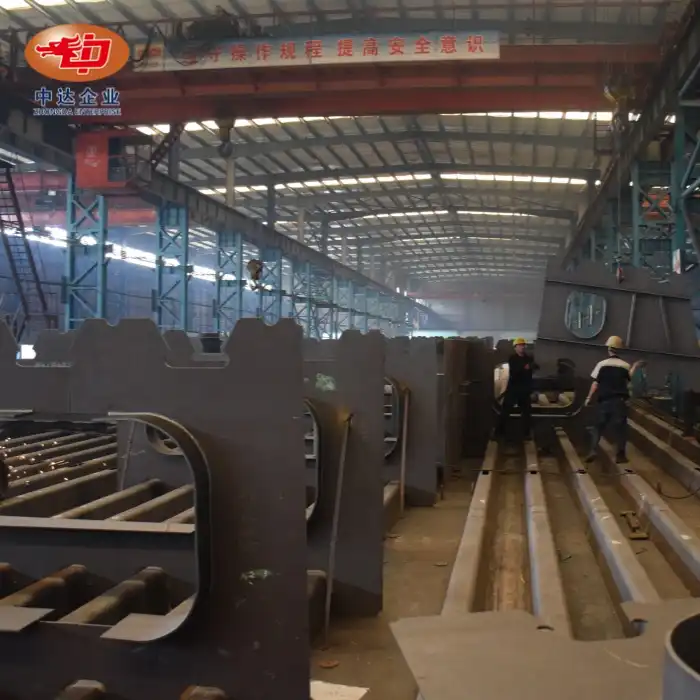
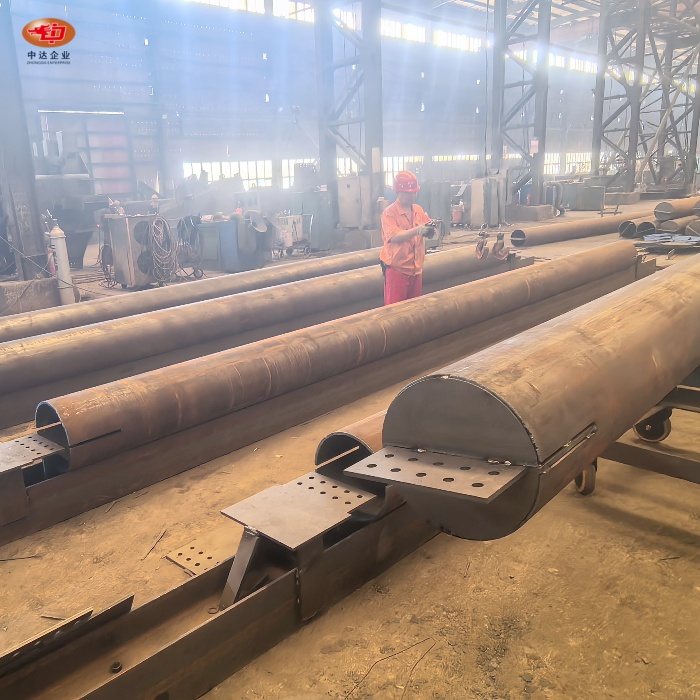
A lot of the work that used to be done on the job site is now done in the workshop thanks to modular prefabrication. We make 20-meter arch rib pieces at Zhongda's 120,000-square-meter factory, which can produce up to 1,200 tons of them every month. Before being shipped, each module goes through full welding, surface treatment, and quality testing. When it gets to the site, it is ready to be put together. This method cuts down on delays caused by bad weather, improves quality stability, and lowers the need for on-site workers.
Collaboration Between Fabricators and Contractors
The smooth running of these complicated projects depends on how well the steel fabricators and building workers can work together. The maker needs to know the order of construction in order to plan the right connection details, temporary lifting points, and field splice sites. On the other hand, workers need to know a lot about the qualities of materials and how they can and can't be handled so they don't damage precision-made parts while transporting and installing them.
Building Information Modeling (BIM) technology for a long-span steel arch bridge makes it easier for everyone to work together by making digital copies of the whole project. We all use the same 3D model to work from, which includes manufacturing tolerances, erection processes, and temporary works. Clash recognition finds possible problems before the building process starts, and 4D scheduling tools show the schedule in 3D, which helps teams plan for things like resource needs and transportation issues.
Benefits and Practical Applications of Long-Span Steel Arch Bridges
Exceptional Durability and Architectural Impact
When properly kept, steel arch bridges can last more than 100 years, which is a great long-term investment for infrastructure owners. Truss-type arch configurations have built-in redundancy that creates multiple load routes. This keeps the structure from falling apart completely if one member gets damaged. Asset managers are sure that the bridge will be able to serve important traffic corridors effectively for many years to come because of how strong its structure is.
Besides being strong structures, these bridges are also well-known symbols that shape city skylines and regional identities. A well-proportioned arch bridge's beautiful curves show that the people who built it are skilled engineers with high social goals. A gem like the 18,000-ton Shenyang Dongta Cross-Hunhe River Bridge shows how infrastructure can be more than just a way to get things done. It can also become a source of community pride and a draw for tourists.
Lifecycle Cost Advantages
When looking at investments in infrastructure, the total cost of ownership is more important than the cost of building it. The lifetime economics of steel arch bridges are good because they don't need much upkeep. The strong main structure doesn't need much maintenance other than regular checks and a new protective covering every 15 to 25 years, based on how exposed it is to the elements.
Maintenance work is mostly done on secondary parts like deck covering, expansion joints, and bearing changes. These are parts that need to be replaced on all types of bridges, no matter what the main structure system is. Steel box girders are easy to check because they have interior access for people and tools, which makes it easier to figure out what's wrong without stopping traffic. Our full-bridge tracking systems, which have more than 200 sensors, give us constant health data. This lets us do preventative maintenance that fixes problems before they get worse.
Environmental Sustainability Considerations
More and more recovered materials are used in modern steel production for steel arch bridge. For example, electric arc furnace methods use up to 90% scrap steel. Because steel buildings can be recycled, they are naturally more environmentally friendly. At the end of a project's life—though well-kept bridges can last a hundred years or more—the steel parts still have a lot of worth as scrap and can be recovered over and over again without losing any quality.
Careful research and high-strength steel types help design optimization cut down on the amount of material used. A bridge made with Q420qD steel needs about 15–20% less mass than one made with lower-grade structural steel. This directly lowers the carbon footprint of making and transporting the materials. Our precise manufacturing methods reduce waste, and our CNC cutting designs are set up to get the most out of each steel plate.
Construction methodologies also influence environmental impact. Prefabricated modular building cuts down on the time that work has to be done on-site, which is better for communities and ecosystems. When crossing gorges with a cable crane, the valley floor is not disturbed. This protects areas along the edges of the gorge that would be destroyed by traditional falsework methods.
Global Applications Across Diverse Sectors
Most steel arch bridges are used for highway structures, where spans of 300 to 600 meters cross major rivers without getting in the way of boats. Because arch structures are stiff up and down, they work well for heavy truck traffic, where controlling deformation is important for the pavement's life and for people's comfort.
For railway uses, even tighter deflection limits are needed to keep the track's geometry accurate at speeds over 250 km/h. Because steel arches are naturally stiff, they meet these strict standards without needing to be too deep like beam bridges would. Throughout Europe, Asia, and more and more North America, rail arch bridges are used for both regular freight lines and high-speed passenger lines.
Pedestrian and bike bridges look nice with arches because they can go over barriers without extra supports in the middle. More and more, urban riverfronts and park systems have thin arch structures that connect things and make the environment look better. In these uses, steel that has been left bare to develop its own rust color is often used. This gives the materials warm tones that look good in natural settings.
Bridge jobs aren't the only ones that can be used in industry. Arch buildings are used in mining to support conveyors across slopes without having to do a lot of digging. Arch-supported roads and train lines are used in ports to make sure that equipment below has plenty of room to move. Our list of foreign projects includes supports for mining equipment in Australia and buildings for industrial complexes in Vietnam. These projects show how steel arch technology can be used in a wide range of industries and places.
Conclusion
In conclusion, long-span steel arch bridge are a tried-and-true way to get over hurdles where long spans, structural economy, and artistic concerns all come together. Their main idea of how they work—guiding loads through compression along beautiful curves—makes buildings that can handle tough moving jobs for a hundred years or more. Arch bridge design has become more flexible thanks to new materials like Q420qD weathering steel, improved manufacturing methods like CNC precision cutting, and new ways of building like stentless rotation.
Successful procurement requires careful supplier evaluation focused on technical capability, quality systems, and applicable experience. Understanding how costs change over time and making sure that contracts are set up correctly can help you control risks and get value. During the operating phase, things need to be inspected regularly, maintained proactively, and monitored with more and more advanced technologies that allow for predictive asset management. These things make sure that steel arch bridges do what they're supposed to do for a long time, which is to provide stable infrastructure that connects towns and helps the economy grow.
FAQ
What distinguishes steel arch bridges from cable-stayed designs for similar spans?
Steel arch bridges mostly move weight to the supports by compressing the arch rib. Cable-stayed bridges, on the other hand, use tensioned wires that run from towers to hold up the deck. Arches usually have higher vertical stiffness, which makes them better for places where bending control is important or where heavy rail loads are present. Because they put less horizontal thrust on the base, cable-stayed versions can be cheaper when the ground isn't very good. The choice between these two structure systems is also affected by personal taste and the need for guidance clearance.
How do I verify a manufacturer's capability to deliver a long-span project?
Ask for proof of similar projects that have already been finished, including the span lengths, mass, and methods used for building. Check to see if they have quality certifications like ISO 9001, EN 1090, and any state standards that apply. Find out what the manufacturing equipment can do, especially how precise the CNC cutting is and what the thickest plate that can be processed is. Find out how they test their products, especially for important welds; 100% CTOD testing shows that they care about quality. You might want to go to their facility to see the output and quality control methods for yourself. Lastly, get in touch with references from past customers to find out how they liked working with the company.
What is the expected service life of a properly maintained steel arch bridge?
Steel arch bridges that have been well-designed and maintained typically last 100 years or more. When the main structure is covered by the right corrosion control methods, it doesn't break down much over decades. Deck covering, expansion joints, and bearings are all secondary parts that need to be replaced every 20 to 30 years. This is normal maintenance that all types of bridges do. Advanced protection coatings, like arc-sprayed metal with fluorocarbon topcoats that meet C5M standards, make it possible for things to last a hundred years or more without needing major repairs.
Partner with Zhongda for Your Steel Arch Bridge Projects
Transform your infrastructure vision into reality with Shenyang Zhongda Steel Structure Engineering Co., Ltd., your trusted long-span steel arch bridge manufacturer. Since 2004, our advanced 120,000-square-meter plant in Shenyang has been providing technical greatness to clients all over the world through ISO 9001/14001/45001 certified operations and EN 1090 compliance. We can build using BIM, make up to 60,000 tons of steel every year, and have a lot of experience with Q420qD weathered steel structures with better anti-corrosion protection systems. Our engineering team is ready to make solutions that fit your needs, whether you need pentagonal box arch ribs that can withstand 1.5kN/◡ of wind, stentless rotation building support, or full health monitoring systems with 200+ sensors. Get in touch with Ava@zd-steels.com right away to talk about how our track record with important projects like the 18,000-ton Shenyang Dongta Bridge can help you speed up your next infrastructure investment with trust and accuracy.
References
Chen, B. and Wang, T. (2018). Modern Steel Bridge Engineering: Design, Fabrication and Construction. China Communications Press, Beijing.
Structural Engineering Institute. (2020). Guidelines for Design of Steel Arch Bridges. American Society of Civil Engineers, Reston, Virginia.
Menn, C. (2016). Prestressed Concrete and Steel Arch Bridges: Design and Construction Methods. Birkhäuser Architecture, Basel.
National Steel Bridge Alliance. (2021). Steel Bridge Design Handbook: Structural Behavior of Steel Arch Bridges. American Iron and Steel Institute, Washington DC.
Zhang, L., Zhou, W., and Liu, D. (2019). "Long-Span Steel Arch Bridge Construction Technology and Quality Control," Journal of Bridge Engineering, Volume 24, Issue 8, pp. 04019067.
Troitsky, M.S. (2017). Planning and Design of Bridges: Steel Arch Systems and Modern Applications. Construction Technology Publishers, Toronto.
YOU MAY LIKE
_副本_1755241212578.png "prefab steel warehouse")
_副本_1754121416739.jpg "Prefabricated Steel Structure Stadium")