Steel Box Girder, the Backbone of Modern Bridge Engineering
2026-05-13 13:56:31






What pulls everything together when you think about the bridges that connect towns, cross wide rivers, or take high-speed trains through mountainous terrain? The answer lies in the steel box girder, a marvel of engineering that has quietly changed the way infrastructure is built all over the world. Because it is very strong, doesn't bend easily, and doesn't react badly to external pressures, this hollow, fully welded structural element is now the best choice for building long-span bridges. Traditional I-beams have trouble with twisting forces in curved lines, but the closed box design evenly spreads loads and keeps the structure strong even in the worst circumstances.
Understanding Steel Box Girders: Design, Types, and Technical Specifications
Basic Structure and Historical Evolution
Hollow box sections were first used by builders in the middle of the 20th century to solve problems with bigger and bigger bridge projects. The design is made up of two vertical web plates that join a top flange to a bottom flange to make a shape that is either rectangular or trapezoidal. This shape makes a structural part that is better than open sections in terms of its qualities. In the 1960s, the first uses were seen in European highway viaducts. As manufacturing methods got better, the technology quickly spread around the world. Moving from riveted joints to modern automatic welding has made quality more consistent and cut production time by a large amount.
Types and Geometric Arrangements
Based on the needs of the project, bridge builders choose from a number of configurations:
Single-Cell Box Girders: The single-cell box girder has a single sealed room and works well for moderate-span bridges where simplicity and ease of construction are important. The uniform load path makes structural analysis easy, and it's still easy to get inside for inspections.
Multi-Cell Box Girders: When spans need to be longer than 100 meters or decks need to be bigger, multiple cells linked by internal webs give the needed strength without adding too much depth. This arrangement is common on big highway bridges with more than one traffic lane.
Variable Cross-Section Designs: Modern production methods, like those used at Zhongda's Shenyang plant, allow beam heights to range from 1.25 meters to 8 meters. This customization makes the best use of material by adding more depth where bending moments are highest, which is usually near supports, and lowering the weight in the middle of the span.


Choosing between straight and bent lines changes how hard it is to make something. When welding curved box girders, it's important to keep the shape under tight control so that leftover stresses don't build up and hurt the structure's performance. Advanced design integration based on BIM makes sure that engineering models are accurately translated to finished parts.
Material Specifications and Standards Compliance
The choice of material has a direct effect on how well and how long a structure works. These days, most things are made with high-strength low-alloy steels, and Q345D is the most common grade for major structural parts. This steel has a minimum yield strength of 345 MPa, which is strong enough, and it is also easy to weld and tough down to -20°C. Critical connecting zones and areas with a lot of stress use Q420D steel, which improves performance where loads are concentrated.
Following foreign guidelines for steel box girder makes sure that projects can be used all over the world. In North America, projects must follow ASTM A709 standards, while in Europe, they must follow EN 10025 standards. Chinese GB/T standards are very similar to foreign standards, which makes it easier to buy things for building projects that involve multiple countries. Material certificates need to include a study of the material's chemical make-up, the results of tensile tests, and Charpy V-notch impact data at certain temperatures.
Structural Analysis and Load Distribution
Torsional constants are hundreds of times higher in closed sections than in open sections of the same weight. This quality is very important for bent bridge lines where traffic loads cause twisting moments. Software for finite element analysis models how stresses are spread out under service loads and checks them against limits on deflection and standards for wear. Live load patterns are based on AASHTO LRFD standards or appropriate area rules. They take into account the presence of multiple trucks and dynamic amplification factors.
Under service loads, deflection standards usually limit vertical displacement to span length divided by 800. This keeps riders comfortable and stops harm that isn't structural. Zhongda's CNC ultra-thick plate cutting technology keeps fabrication tolerances at ±0.2mm for key measurements. This makes it easier to install without any problems with fit-up in the field.
Corrosion Protection Strategies
Exposure to the environment can damage structures over many years of use. Multiple hurdles are used by comprehensive security systems to deal with this problem:
Hot-dip galvanizing and high-performance finishing methods are used together in the base approach. Zinc layers that are at least 85 micrometers thick offer temporary protection, and epoxy primers and polyurethane topcoats keep surfaces dry. This two-layer approach makes the service life longer than 30 years, even in coastal areas with a lot of salt.
For the right conditions, weathering steel choices don't need to be maintained on a regular basis. As long as the structure is regularly wet and dry cycles, ASTM A709 Grade 50W material forms a stable rust coat that stops further rusting. Dehumidification devices are needed in internal box rooms to keep condensation from building up in sealed areas.
Advantages of Steel Box Girders Over Other Bridge Girders
Comparing Performance with Alternative Systems
Procurement workers can make better choices when they know what their competitors are doing. When choosing a bridge girder, there are a number of different structure systems to think about. However, each has its own problems that hollow box sections can solve.
Superior Torsional Performance: Regular steel I-beams and concrete girders don't have the torsional stiffness needed for bent lines and uneven loads. Centrifugal forces cause twisting moments that open parts don't handle well when cars are going along curved highway curves. The closed-loop design naturally fights these forces, so there is no need for complicated cross-bracing that adds weight and costs more to make. Multiple I-beams can be replaced with a single steel box girder with lateral bracing, which makes planning and building easier.
Optimized Weight-to-Strength Ratios: Over long spans, concrete buildings become too heavy to support, needing huge supports and making them more vulnerable to earthquakes. A normal steel box girder that holds the same amount of weight weighs 2.5 times less than a concrete one. This extra weight makes the whole support system cost more, which raises the cost of the foundation. Corrugated web choices created through advanced manufacturing lower the self-weight of steel girders by an extra 20% compared to flat-plate designs while keeping the strength of the structure. With this new technology, cable-stayed uses can now have spans of up to 420 meters.
Construction Speed and Site Disruption for steel box girder: Truss bridges need to be put together in the field using thousands of fixed connections, which slows down construction and causes traffic problems. Cast-in-place concrete needs months of falsework to be put up, drying time, and building in stages. Prefabricated pieces ranging from 12 to 30 meters come ready to be quickly put together using either a crane or a launch method. Before, projects took two building seasons to finish. Now, they only take one. This cuts down on the economic loses caused by traffic jams and business interruptions.
When these benefits come together, they make lifetime value offers that are hard to refuse. Maintenance crews can get into internal rooms to do safe inspections and repairs, which makes the time between big interventions longer. Factory quality control, quick installation, and less frequent upkeep all work together to save money that more than makes up for the higher cost of materials at the start within the first ten years of service.
Performance Under Extreme Conditions
Resilient infrastructure is very important in places where there are earthquakes, high winds, or big changes in temperature. Because structural steel is flexible, it can absorb energy during earthquakes, which keeps it from breaking in terrible ways like unreinforced concrete often does. As required by seismic design guidelines, cross-sections must be small and have enough horizontal bracing to ensure that the structure can't move easily. Protocols for testing make sure that bonded joints stay strong even when they are loaded and unloaded many times, which simulates ground motion histories.
Places with a lot of wind have aerodynamic problems that need forms that are smooth. When compared to truss bridges, box sections have lower drag coefficients because their outside profiles are smooth. Testing in a wind lab proves that cable-supported spans are stable against flutter, which can happen when there are even small aerodynamic problems that can cause destructive movements. Because hollow boxes are heavy and stiff, they naturally reduce vibrations, which increases safety gaps.
Arctic uses check how tough a material is at very high and very low temperatures. Zhongda's -60°C Weathering Steel Anti-corrosion Technology is used for projects in places like Russia's Far East, where regular steels break easily. Special impact testing at lower temperatures shows that the material's fracture strength is still good, so it doesn't break suddenly during cold snaps.
Steel Box Girder Bridge Construction: From Manufacturing to Installation
Fabrication Excellence and Quality Protocols
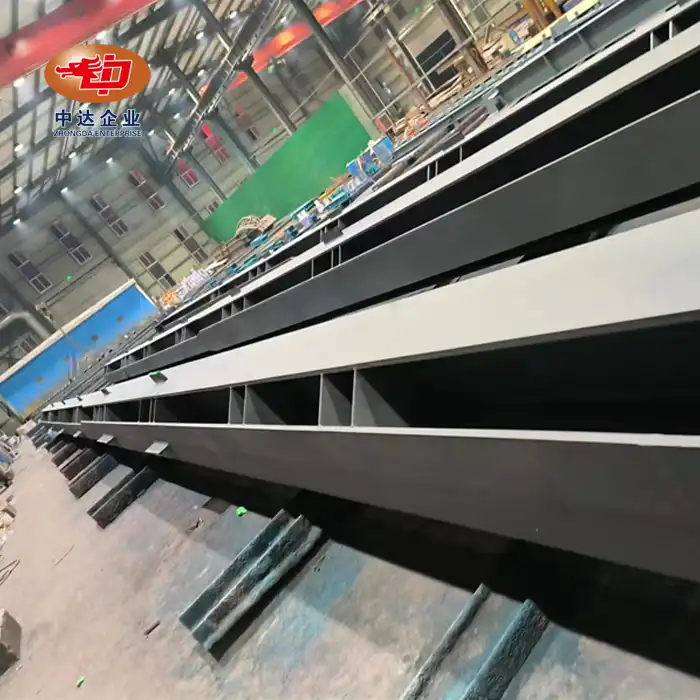
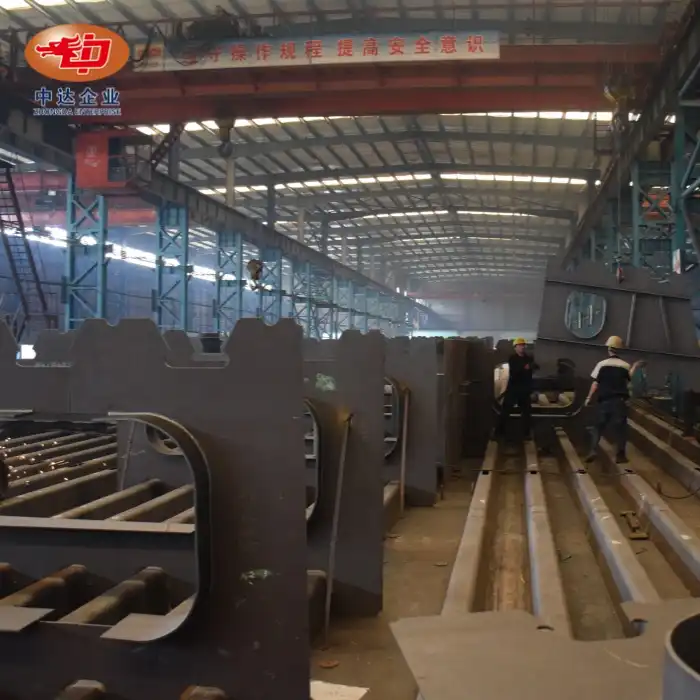
Precision in manufacturing affects how well something is installed in the field and how well it works in the long run. The process starts with design files that are organized in BIM and sent directly to CNC cutting equipment. This gets rid of the need for mistakes in measuring made by hand. Cutting devices that use plasma and oxy-fuel can handle plates up to 100 mm thick and keep their tolerances within 0.2 mm over 12 meters of length. This level of precision is very important when putting together box pieces from different plate parts.
Submerged arc and flux-cored methods are used by automated welding lines to produce consistent weld metal with little distortion. Longitudinal lines that connect flange plates to webs go on for at least 30 meters and can't be interrupted. To keep them from bending, they need to be carefully controlled with heat. The AWS D1.5 Bridge Welding Code specifies how qualified welding processes should be done. Procedure qualification records keep track of the mechanical qualities of the weld metal and heat-affected zones.
Throughout the manufacturing process, quality standards are set up:
Incoming Material Verification for steel box girder: mill papers prove the grades and chemical makes-ups of steel. Ultrasonic testing finds cracks inside thick plates that might spread while they're being used. Before cutting starts, dimensional checks make sure that the width of the plate is within the allowed range.
Welding Inspection: Every weld pass is looked at visually to find surface flaws like undercuts, holes, or partial fusion. Magnetic particle testing finds cracks below the surface that can't be seen with the naked eye. Radiographic examination of the vital areas keeps a lasting record of the quality of the internal weld. Acceptance factors based on ASME Section V make sure that only connections that are free of problems leave the building.
Dimensional Control: Laser scanning records the shape of things as they are in three dimensions, letting you compare the real sizes to the ones that were planned. When deviations go beyond the tolerance bands, corrective steps are taken before the next process can start. This check stops a buildup of small mistakes that could lead to field fit-up fails.
Corrosion prevention is only put on in controlled settings with the right humidity, temperature, and surface preparation. Abrasive blasting cleans SSPC-SP10 metal to a nearly white color by getting rid of all mill scale and rust. Coating thickness scales make sure that dry film builds meet certain minimums. For harsh marine environments, these minimums are usually 250 micrometers for the whole system.
Customization Capabilities for Project-Specific Demands
Standard goods can't handle the unique problems that come up with infrastructure projects. Because we know this to be true, we've built in full customization tools that cover everything from design optimization to fabrication completion. Clients and tech teams work together from the very beginning of initial planning, when different shapes are tested to see which ones are the most efficient and easiest to build.
Variable depth designs improve the spread of material by making the section deeper near the supports, where bending moments are highest, and less deep toward the middle of the span, where lighter loads are carried. Compared to constant-depth options, this method cuts steel mass by 15–20%, which lowers both the cost of materials and the load on the base. Curved horizontal alignments get extra care, and web plates are pre-cambered to match design curves and cut down on field changes as much as possible.
Corrugated web panels are a more complicated choice for projects that want to cut down on weight. The accordion-like bends make the web less likely to buckle without making it thicker. This makes it possible to make plates that are much smaller and lighter. This new idea is especially helpful for long-span cable-stayed bridges, where the self-weight of the superstructure directly affects the size of the cables and the loads on the towers. To make corrugated webs, you need special rolling tools and strict quality control, which can be found in facilities that are set up to make complex things.
Different erection ways can use the same connection information. Mobile cranes can lift sections one at a time with the help of bolted field splices and match-drilled holes that make sure everything is lined up perfectly. For launched construction, where whole bridge lengths are put together on approach embankments and then pushed across pier supports into their final places, welded joints make continuous members. Before production starts, full-scale tests are done on each type of link to make sure it is strong and won't break easily.
Logistics and Installation Considerations
Transportation planning begins months before a package is due. Routes, permits, and security vehicles for oversize loads are all coordinated. Prefabricated segments that are 12 to 30 meters long and weigh 80 to 150 tons are longer and heavier than normal highway measurements. This means that routes need to be carefully surveyed and sometimes temporary road changes need to be made. Barge transport is better for coastal projects because it gets parts straight to bridge sites without having to go around limits on highways.
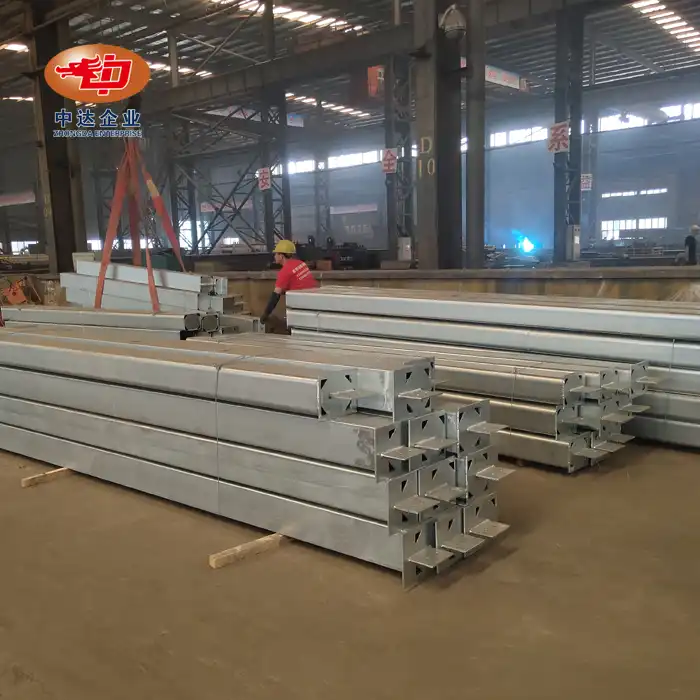
Site logistics for steel box girder influence packaging strategies. Heavy-duty steel frames hold parts in place while they're being moved, spreading the weight so that the sections don't bend, and they also have places for crane rigging to connect. Coating systems are kept safe from damage during storage and handling by protective wrapping. Delivery plans work with erection processes to cut down on the amount of inventory and store room needed on-site. When lead times for manufacturing and shipping are carefully handled, just-in-time delivery is possible.
Installation ways depend on the length of the span and how easy it is to get to the site:
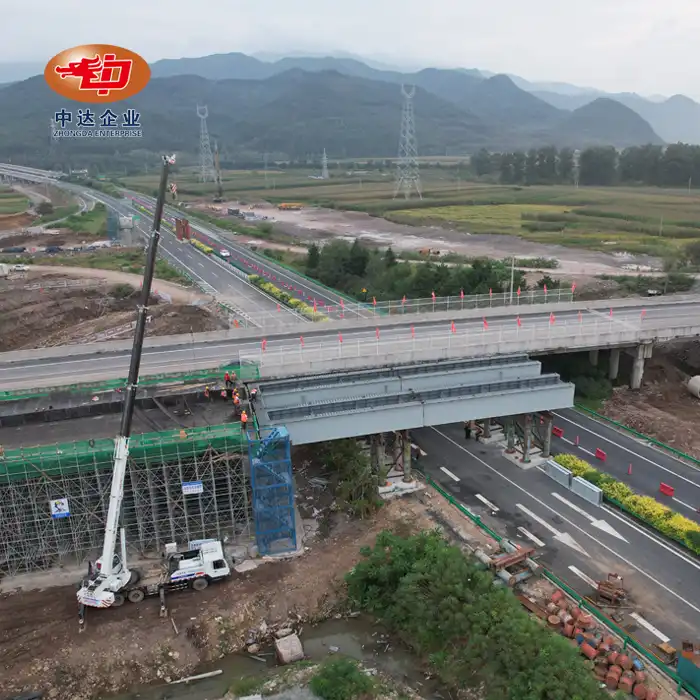
Mobile Crane Erection: Truck-mounted or crawler cranes move individual parts into place. These types of cranes are good for spans under 60 meters, where their weight and reach are enough. Temporary support towers may make it easier to lift parts that are heavy. This method is flexible and can be finished pretty quickly, but big equipment needs to be placed on the ground.
Launching Methods: Superstructure pieces that have been put together can be pushed or pulled across gaps to make longer crossings where crane access is hard to get to. When gradual progress is happening, launching nose attachments lower the cantilever moments. This method keeps river transportation as smooth as possible and gets rid of the need for expensive falsework in the water, but it requires large gathering places behind the abutments.
Floating Crane Placement: Huge river or ocean bridges sometimes use 1,000-ton floating cranes to move fully built spans into place in a single lift. This method greatly speeds up the building process, but it needs special naval tools and good weather windows.
Some of the things that need to be done after installation are finishing fitting of field connections, grouting bearing surfaces, and installing deck systems. Survey teams measure heights and horizontal lines to make sure that the as-built geometry fits the design parameters. Any differences outside of tolerance bands are fixed by changing the heights of the bearings or strategically heating them to sort them out. Any installation of a steel box girder must follow as-built geometry precisely.
Long-Term Maintenance and Lifecycle Management
Preventative repair keeps costs low over decades while increasing the useful life of structures. Inspection systems that follow the AASHTO Manual for Bridge Evaluation set standard conditions and keep track of how fast bridges are breaking down. Visual inspections done every two years find problems like covering breakdown, rust stains, or deformation patterns that need more research. Every six years, detailed checks use non-destructive tests like ultrasonic thickness measurement and magnetic particle crack detection.
Internal box cells need extra care because moisture builds up quickly and speeds up rusting in small areas. Dehumidification systems that keep the relative humidity below 40% stop condensation from forming, which protects inner surfaces that aren't protected in many designs. Access ports let people in for a closer look, but all work inside is governed by limited space safety rules.
As part of preventive maintenance, small damage can be fixed by spot finishing fixes before they get worse all over. Bearing surfaces are oiled and adjusted on a regular basis to keep the load distribution right. Drainage systems need to be cleared so that water doesn't pool on decks or inside boxes. These regular actions don't cost a lot, but they keep expensive repair projects from having to be done.
When big repairs are needed after 25 to 30 years, the basic steel is usually still good, but the coating systems need to be replaced. Abrasive blast cleaning takes off old coats all the way down to the metal, and then modern high-performance systems are used to do a full recoating. In contrast to concrete buildings that may need a lot of fixing or strengthening, steel girders usually only need to be treated on the outside and have their protective coatings replaced in order to reach their full service life potential.
Conclusion
As materials science, manufacturing technology, and computer analysis get better, structural engineering keeps changing. In this process, steel box girder hollow steel sections have proven to be the best choice for difficult bridge projects that need long spans, curved alignments, and quick building. When you combine better rotational stiffness, good load distribution, and the ability to be easily customized, you get solutions to problems that other systems can't match. By using automatic welding, precise geometry control, and full quality assurance, manufacturers can make sure that their goods always meet foreign standards. Strategic methods to buying things that balance initial costs against lifetime value set infrastructure owners up for decades of reliable service with little upkeep. These structural aspects will continue to be important for connecting communities and boosting the economy even as cities grow and transportation networks get bigger.
FAQ
What makes steel box girders superior to concrete alternatives for long-span bridges?
Because it is sealed and hollow, it has hundreds of times more torsional stiffness than concrete pieces of the same weight, which is important for curved lines and eccentric loads. Because steel is stronger than concrete, it has a lower self-weight by about 60%. This means that foundations are not needed and earthquake forces are reduced. Prefabrication makes installation faster, which cuts down on building time by 50% compared to cast-in-place methods. Internal access rooms make inspection and maintenance work safer.
How do you ensure corrosion protection lasts throughout the structure's service life?
Hot-dip galvanizing and high-performance coatings are used together in comprehensive security systems to make multiple shields against water getting in. Epoxy bases and polyurethane topcoats protect surfaces from the outside world, while zinc layers act as a sacrifice. In the right conditions, weathering steel choices form stable, protective patinas that don't need to be maintained. Internal dehumidification systems keep the relative humidity below 40%, which keeps sealed box rooms from condensing. When these methods are used, the coatings usually last for 30 years or more before they need to be replaced.
What lead times should we anticipate from order placement through delivery?
Production times depend on how complicated the project is and how far along the production queue it is, but normal times are between 12 and 16 weeks for standard configurations and 20 to 24 weeks for highly customized variable-depth or corrugated web designs. This time frame includes thorough planning, buying materials, making things, checking for quality, and applying corrosion protection. Oversize load permits and route studies take an extra three to four weeks for domestic shipments and longer for foreign logistics, so transportation planning should start at the same time. Getting suppliers involved early on in the planning process lets you order materials ahead of time, which can cut critical-path lead times by a large amount.
Partner with Zhongda for Your Next Infrastructure Project
For major bridge projects to go ahead, they need production partners with both technical know-how and a track record of getting things done. Shenyang Zhongda Steel Structure Engineering has been specializing in infrastructure for 20 years, so they can offer this exact mix. Our 120,000-square-meter factory uses advanced BIM-driven prefabrication and -60°C Weathering Steel Anti-corrosion Technology to make custom solutions for the world's toughest conditions. We can make steel box girders with spans up to 420 meters and cross-sections ranging from 1.25 meters to 8 meters in height, so your project can go over Arctic rivers, coastal roads, or urban rail lines. You can email our technical team at Ava@zd-steels.com to talk about how Zhongda's track record with China Railway, CSCEC, and other foreign clients can help you speed up the timeline for your bridge project while still ensuring quality that will last for generations.
References
American Association of State Highway and Transportation Officials (2020). AASHTO LRFD Bridge Design Specifications, 9th Edition, Washington D.C.
Chen, W.F. and Duan, L. (2014). Bridge Engineering Handbook: Construction and Maintenance, 2nd Edition, CRC Press, Boca Raton.
European Committee for Standardization (2006). Eurocode 3: Design of Steel Structures - Part 2: Steel Bridges, EN 1993-2, Brussels.
Troitsky, M.S. (1990). Prestressed Steel Bridges: Theory and Design, Van Nostrand Reinhold, New York.
Nakai, H. and Yoo, C.H. (1988). Analysis and Design of Curved Steel Bridges, McGraw-Hill Professional, New York.
Wolchuk, R. (2000). "Steel Plate Shear Walls with Corrugated Webs", Journal of Structural Engineering, Vol. 126, No. 4, pp. 404-413.
_副本_1755847551541.jpg "steel portal frame building")