Steel Box Girder Bridges-Design Guides and Methods
2026-04-16 09:28:38






The steel box girder bridge is the best way to build infrastructure that needs to be very strong and flexible. It is perfect for long spans, complicated shapes, and hard load situations. This high-tech structure uses hollow box-shaped cross-sections to provide unmatched rotational stiffness and load distribution efficiency. This guide goes over the most important design methods, building techniques, and buying strategies that will help everyone involved in a project—from EPC contractors to government engineering teams—specify and build these high-performance structures with confidence in their next infrastructure project.
Understanding Steel Box Girder Bridges
What Defines This Structural Innovation?
A steel box girder bridge has closed-section beams made up of top and bottom flanges that are joined by web plates that are either straight or inclined. This makes a hollow shape that can be rectangular or trapezoidal. This arrangement changes how the bridge acts when it is subjected to eccentric loads and torsional stresses. It is perfect for curved lines, wide deck areas, and places where aerodynamic stability is important. The closed shape produces rotational constants that are several hundred times higher than those of open I-beam profiles. This means that extensive cross-bracing is not needed to keep the structure intact.
Core Components and Structural Advantages
The hollow box shape combines several efficiency benefits into a single part of the structure. Some types of high-performance steel, like ASTM A709 Grade 50W and EN 10025 S460, have yield strengths higher than 345 MPa. The closed section also protects the inside from direct damage. This double benefit slows down rust and increases service life, especially in seaside or industrial areas where chloride exposure speeds up wear and tear. The smooth outside profile reduces wind drag, which is very important for bridges that cross river valleys or straits along the coast where wind speeds hit 12-level resistance limits.


Because of how strong these structures are compared to how heavy they are, they can span anywhere from 100 meters for urban interchanges to over 300 meters for cable-stayed designs. At Zhongda, we can make super-long spans that are up to 2000 meters long. To hold these long reaches, we use PPWS main wires with a thickness of 5.2 mm and a tensile strength of 1770 MPa. With this mix, project teams can cut down on the number of piers needed, which lowers the cost of the base and causes less damage to sensitive waters or protected habitats.
Historical Evolution and Modern Applications
In the middle of the 20th century, metalworking progress led to higher-strength steels and better welding methods made joints more reliable. This sped up the development of box girder technology. It was first used for highway overpasses, but modern projects include railway viaducts, skywalks for pedestrians, and even supports for industrial conveyors in mine operations. The ability to change to complex shapes lets designers follow uneven site boundaries or fit into narrow urban areas without lowering the load capacity or safety margins.
Design Principles and Engineering Standards
Load Distribution and Fatigue Resistance
To make a good design, you need to do accurate load modeling that takes into account things like earthquake forces, dead loads, live traffic patterns, and heat expansion. The closed part spreads the vertical loads across the top and bottom flanges, which lowers the amount of stress that builds up in one place and causes fatigue cracks. Orthotropic deck systems, which are often made up of longitudinal ribs and crosswise floor beams, make the structure even stiffer while keeping its own weight low. Miner's rule and stress-range histograms are used in fatigue analysis to make sure that weld details and connection zones keep their safety factors over 100-year design lives.
Because of seismic concerns, pier links in a steel box girder bridge need to have flexible details that let controlled energy dissipate during ground motion events. When base isolation bearings or yielding steel parts take in horizontal forces, they keep the top from breaking in weak ways. These rules are in line with the AASHTO LRFD Bridge Design Specifications and Eurocode 8, which require buildings in earthquake zones to have strict dynamic analysis and capacity design rules.
Material Selection and Cross-Sectional Configuration
The strength, weldability, and weather risk of a steel grade are all taken into account. Different types of weathering steel form protective oxide layers that stop rust in its tracks, as long as draining systems keep water from building up on the inside surfaces. Our -60°C Weathering Steel Anti-corrosion Technology at Zhongda uses dehumidification systems and S-type wire wrapping tape to keep the relative humidity inside below 40%. This stops rust from forming inside even in hard Arctic temperatures.
The cross-sectional shape strikes a balance between torsional torque and the cost of production. When it comes to structural stability, trapezoidal shapes are the best way to distribute material, while rectangular curves make it easier to connect the forms for composite concrete decks. The thickness of a web plate is usually between 12 and 25 millimeters, and there are spread stiffeners inside to keep the plate from breaking in one place when heavy wheels are applied. Our CNC machines are very good at cutting very thick plates with an accuracy of within ±0.2mm. This makes sure that the parts fit together tightly during assembly and cuts down on the need for expensive changes to be made in the field.
Global Compliance and Quality Assurance
Following international standards makes sure that all global supply lines and legal systems can work together. In the US, cable-stayed bridges must be built according to the FHWA-NHI-07-096 standards. In Europe, EN 1090 approval makes sure that the building and putting up of bridges are legal. Our production processes are based on ISO 9001:2015 quality control systems, which include non-destructive testing methods like ultrasound inspection and magnetic particle examination at key weld joints. These steps make sure that the structural soundness of parts is checked before they leave our 120,000 m² building. This lowers the chance of having to do expensive repairs or delays in service on-site.
Construction and Maintenance of Steel Box Girder Bridges
Fabrication Processes and Precision Assembly
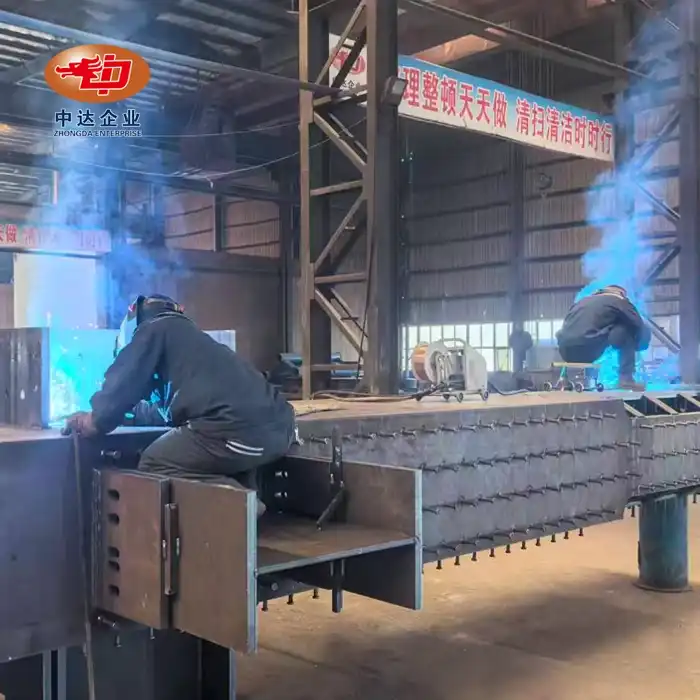
The process of making something starts with CNC cutting steel plates to exact sizes. Next, longitudinal seams and crosswise diaphragms are welded by robots. Our three-axis drilling equipment places bolt holes with an accuracy of ±2mm, and it uses 3D laser scanning to check the line against digital models. Each modular building section can be up to 12 meters long. This makes them easier to ship and speeds up the time it takes to put up on-site. With an output of 802 tons per month, we can keep up a regular shipping schedule for big projects that need hundreds of pieces over the course of several years.
Some quality tests are measuring the amount of the coating, checking the dimensions, and taking a radiograph of the weld. The AWS D1.5 Bridge Welding Code requires specific controls on heat input and preheat temperatures to keep thick parts from breaking because of hydrogen. For surface treatment, zinc-rich epoxy primers are put on in controlled conditions to get dry film thicknesses that meet the standards for the C5 corrosive category in marine or industrial settings.
Erection Techniques and Safety Protocols
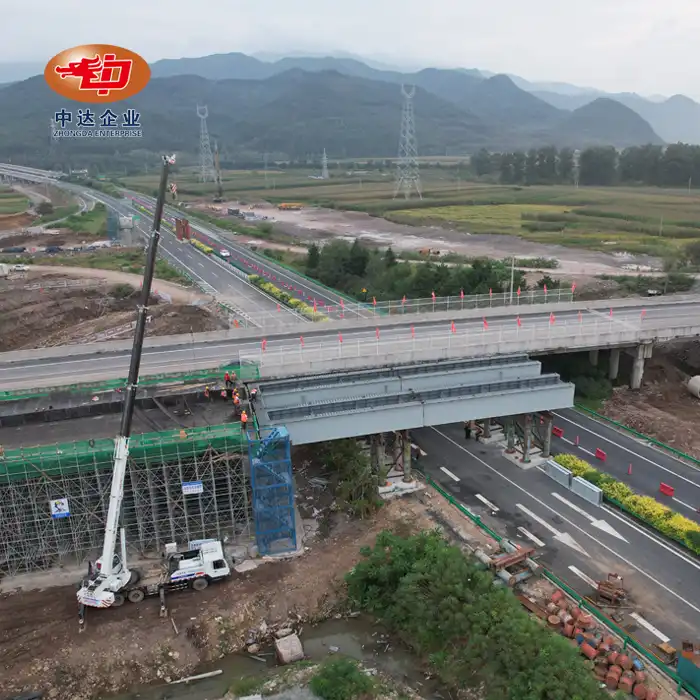
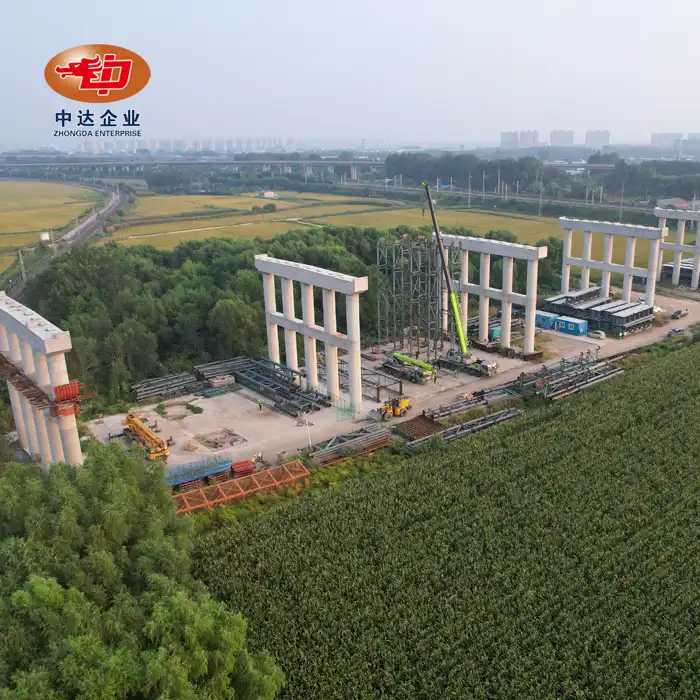
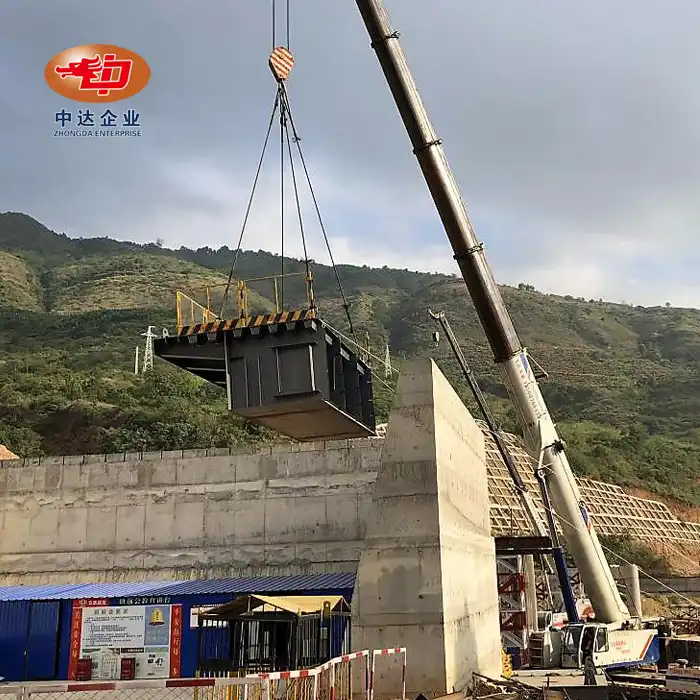
On-site assembly for a steel box girder bridge employs launching gantries or heavy-lift cranes that can handle 50-ton pieces are used for on-site assembly. Launching methods move finished spans across piers in small steps, so they don't get in the way of traffic or waters below. While the final bolting or welding of field splices is going on, temporary supports and hydraulic jacks keep the alignment. Fall protection systems, confined space entry methods for internal inspections, and real-time structural tracking to find any changes during important lifts are all required by safety guidelines.
Accelerated Bridge Construction (ABC) methods cut down on project times by building whole bridge parts off-site and then putting them together during planned overnight closures. This method lowers the risk of workers being hurt by traffic and keeps economic effects on business areas to a minimum, which is important for urban interchanges and toll facilities that serve busy freight routes.
Lifecycle Maintenance and Corrosion Management
Regular checks focus on areas with a lot of stress, weld toes, and interior box spaces where water can build up and cause rust. Integrated inspection paths and fixed lighting systems make it easier to get to places and allow for full visual checks without having to use expensive scaffolding or close lanes. Installed dehumidification equipment inside the box keeps the air dry, and regular coating touch-ups extend the life of the protected film between major painting rounds.
Ultrasonic thickness gauges and strain sensors that are built in during production are used to track the spread of fatigue cracks. Data analytics find patterns that tell you when to fix cracks before they get too big. This proactive approach cuts down on the need for emergency repairs and protects the value of assets over many years. It is in line with lifecycle cost models that value long-lasting materials and designs that are easy to keep.
Lead times for fixing parts depend on how easy it is to get the materials and how complicated the assembly is. Building relationships with providers who keep extra stock on hand and offer flexible production plans makes it easy to get replacements quickly when they're needed. Zhongda's 70% client retention rate shows how committed we are to quick help after delivery, such as expert consultations and faster production for retrofit projects.
Comparison and Decision-Making in Material and Design Selection
Steel Box Girders Versus Concrete Box Girders
Weight has a big effect on how the base is built and how well it works in earthquakes. Steel sections are about one-fifth the weight of similar concrete girders. This lowers the earthquake mass and lets smaller pile groups work in soft soil. Some benefits of constructability are faster building speeds and smaller crane capacities, which mean lower rental costs for equipment and shorter construction windows. Lifecycle cost models have to take into account that steel is more expensive, but that this is balanced by the fact that it requires less investment in the substructure and that upkeep is easier when the inside is open.
Concrete box girders are great for situations where the load is compressed, and they don't need any extra coats to be fire resistant. They work well for projects that need to get local materials like aggregate instead of steel from other countries, or that want an aesthetically pleasing end with visible concrete. Span length limits usually mean that concrete uses can only go up to 150 meters without post-tensioning. Steel, on the other hand, can go up to 300 meters with standard manufacturing methods.
Steel Box Girders Versus Plate Girders and I-Beams
Box sections and open shapes are different in terms of their torsional stiffness. Curved lines and wide decks create strong bending moments that open I-beams can't fight without a lot of lateral bracing, which makes the structure more complicated to make and heavier on its own. Box girders get rid of these extra systems, which makes the process of putting them up easier and makes link points less likely to become weak spots where stress cracks start.
Box girders are harder to make for a steel box girder bridge because they need more complicated welding processes and internal stiffener placement than plate girders. But the aerodynamic shape lowers shaking caused by wind, which lowers the chance of serviceability problems or damage from vortex shedding over time. Box sections provide better long-term performance for projects that cross exposed slopes or seaside zones, which makes the extra work needed to make them worthwhile.
Decision Criteria for Project Stakeholders
For estimates of return on investment, you need to take into account the original capital spending, the effects on building time, and the present value of upkeep costs over the design life. When span lengths are longer than 150 meters, when building plans are tight and parts need to be put together quickly, or when seismic zones require lightweight superstructures, steel box girder bridge solutions give the best return on investment. With the help of structure analysis software that models dynamic behavior and lifecycle performance under site-specific conditions, engineering teams can do thorough parametric studies that compare multiple options.
Procurement Guide and Trusted Suppliers
Selecting Reputable Manufacturers and Fabricators
Certification files are the best way to tell if someone is good at fabrication. The ISO 9001:2015, ISO 14001:2015, and ISO 45001:2018 standards show that a company has strong methods for managing quality, the environment, and safety. The EN 1090 and AWS certificates make sure that you know how to build structures and keep track of materials. Potential buyers should check out manufacturing sites to see how big the cranes are, how accurate the CNC equipment is, and how they test without damaging the work to make sure the quality is always the same.
Shenyang Zhongda Steel Structure Engineering Co., Ltd. runs the biggest steel workshop in Northeast China. It has a 50-ton crane and uses modern BIM-driven prefabrication processes. Our 60,000-ton annual capacity lets us work on multiple big projects at the same time, and our status as an AWS qualified fabricator guarantees that we follow strict American welding codes. We have completed over 60 important projects, such as the Shenyang Dongta Cross-Hunhe River Bridge and foreign partnerships in Australia. These projects show that we can perform difficult structural assemblies on time and as planned.
Pricing Insights and Lead Time Considerations
Cost causes include changes in the prices of raw materials, the difficulty of customizing products, and the challenges of transporting them. High-strength steel types cost more, but the lower cross-sectional needs often cancel out the difference in unit price. Customization requests, like changing cross-sections or needing specific connection details, add to the time it takes for planning and construction, which makes wait times longer than usual.
Lead times for modular box girder segments are usually between 12 and 18 weeks, which includes finalizing the design, getting the materials, building the segments, and checking the quality. Marine transportation stretches delivery windows for foreign projects and is cheaper than land freight for heavy parts that are too big to fit on a truck. Setting up clear lines of communication and production plans based on milestones helps keep delays to a minimum and makes sure that suppliers' work is in sync with the ready of the site for assembly.
Engineering Support and Bespoke Fabrication
By bringing in source knowledge early on in the planning phase, collaborative design teams improve the results of projects. Advanced 3D models and finite element analysis find the best cross-sectional shapes, which uses less material and improves performance at the same time. Suppliers that offer OEM and ODM services tailor solutions to fit specific site limits, weather conditions, or aesthetic tastes. This makes sure that the solutions fit in perfectly with the overall project goals.
Zhongda's tech team helps with every step of a project, from the initial planning stages to the final installation and start-up. Our BIM-driven processes make it easier to work together with architects, contractors, and government bodies, which speeds up approvals and lowers the risk of having to do more work. With this end-to-end engagement model, you can build long-lasting relationships based on shared success and constant improvement.
Conclusion
To choose the right structural system for long-span crossings, you need to carefully look at performance measures, lifecycle costs, and the supplier's abilities. When it comes to torsional stiffness, aerodynamic stability, and ease of construction, steel box girder bridges are the best. They can handle the toughest building problems. By following global building standards, using cutting-edge fabrication technologies, and working with skilled manufacturers, project partners are sure to build strong structures that will last for generations and serve communities and industries.
FAQ
How Long Can a Steel Box Girder Bridge Last?
Service life is based on the quality of the materials, the protection coatings, and how well they are maintained. Structures that are well-built and well-kept often last longer than 100 years. High-performance weathering steels form stable oxide layers that stop rusting, and systems inside the box keep wetness from building up inside. When wear cracks or coating degradation are found during regular checks, they can be fixed quickly to protect the structure's integrity and increase its useful life beyond the original design horizons.
Are Steel Box Girders More Environmentally Sustainable Than Concrete?
A lot of energy goes into making steel, but more than 90% of it is recycled, which lowers its environmental impact over its whole life. Less self-weight means less need for foundations and less material, which means less carbon is stored in substructures. Rapid building reduces damage to the site and traffic problems, which is good for social survival. To find out the net environmental effects of different projects, full lifespan studies that compare steel and concrete must take into account where the materials come from, how far they have to be transported, and how easily they can be recycled at the end of their useful lives.
What Challenges Arise in Welding Box Girder Sections?
For precise control of heat input during thick plate welding, distortion and leftover loads that hurt wear performance must be avoided. High-strength steels are more likely to crack when hydrogen is present, so low-hydrogen electrodes and controlled interpass temperatures are needed. Because of the limited access inside the closed part, welding ergonomics and inspection processes are more difficult. These problems can be solved by using automated welding systems, experienced welders certified to AWS D1.5 standards, and strict NDT procedures. This makes sure that the joints are strong and will last for a long time.
Partner with Zhongda for Superior Steel Box Girder Bridge Solutions
Zhongda Steel uses cutting-edge technology and 20 years of experience in manufacturing to make steel box girder bridge parts that meet the strictest global standards. We are the reliable manufacturer for your important infrastructure projects because we can make 60,000 tons of steel each year, our quality systems are ISO-certified, and we have a track record in foreign markets. From the first design meeting to the final delivery, our engineering team works closely with clients to make sure that standards are met, logistics are streamlined, and projects are completed on time. Get in touch with us right away at Ava@zd-steels.com to talk about your project needs and find out how our custom solutions can speed up the building process without sacrificing quality.
References
American Association of State Highway and Transportation Officials. (2020). LRFD Bridge Design Specifications, Ninth Edition. Washington, DC: AASHTO.
European Committee for Standardization. (2006). Eurocode 3: Design of Steel Structures—Part 2: Steel Bridges. Brussels: CEN.
Troitsky, M.S. (1990). Orthotropic Bridges: Theory and Design, Second Edition. Cleveland: James F. Lincoln Arc Welding Foundation.
Wolchuk, R. (1999). Steel Orthotropic Decks: Developments in the 1990s. Transportation Research Record 1688, Paper No. 99-0685.
Federal Highway Administration. (2007). Design of Cable-Stayed Bridges for Pedestrian Loads (FHWA-NHI-07-096). Washington, DC: U.S. Department of Transportation.
Xanthakos, P.P. (1994). Theory and Design of Bridges. New York: John Wiley & Sons.
YOU MAY LIKE
_副本_1755847551541.jpg "steel portal frame building")