What is the Difference Between a Box Beam and a Box Girder?
2026-06-12 09:27:46






When making tough choices about buying equipment, it's important to understand basic terms. A box beam is a smaller, hollow structural part with a rectangular cross-section that is often used in building frames, mezzanines, and light industrial settings. A steel box girder, on the other hand, is a stronger engineering part. It is a fully welded, closed-section structural element that is made for heavy-duty uses like highway interchanges, long-span bridges, and big infrastructure projects. Compared to standard box beams, the steel box girder is more strong in twisting, can hold more weight, and is more aerodynamically stable. Both girders and conventional beams have hollow shapes that make them stronger for their weight, but girders are much more complicated to design, require more specific materials, and have stricter manufacturing rules. This is an important difference for procurement professionals who are looking at specifications and suppliers' abilities.
Understanding the Basics: What Are Box Beams and Box Girders?
The families of box beams and box girders are both hollow structure parts, but they are used for very different things in the building industry. Knowing these differences will help you choose the right part, deal well with sellers, and make sure that strict technical standards like AASHTO LRFD and Eurocodes are met.
Defining Box Beams: Versatile and Economical
Box beams are simple structural solutions that can be recognized by their rectangular hollow cross-sections. These members are made by bonding flat steel plates together or rolling pieces into shape. They work great in situations where they need to hold a modest amount of weight and distribute stress in a reliable way. You can find box beams holding overhead cranes in factories, making up the framework of warehouse mezzanines, or using as columns in mid-rise commercial buildings. Their popularity comes from how simple they are. Standardized sizes, easy-to-follow assembly steps, and the ability to use inexpensive materials make them suitable for a wide range of business and industry projects.
As a general rule, structural steel types like ASTM A36 or A572 Grade 50, which have yield strengths between 250 and 345 MPa, are used to make box beams. Fabrication standards are still not as strict as they are for making specialized girders, and basic shop primer coats that are good for indoor or covered settings are often used to prepare the surface.


Defining Steel Box Girders: Engineered for Extreme Demands
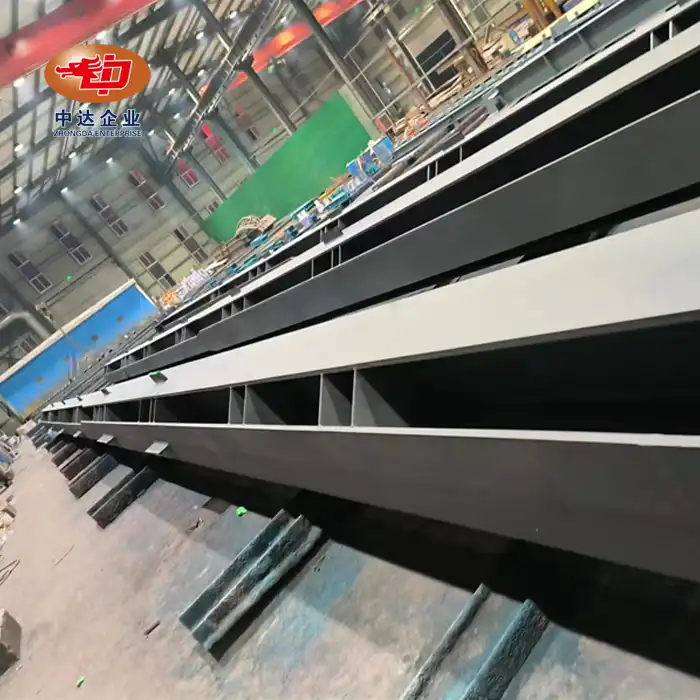
The steel box girder is a completely different type of engineering. These parts are made to be the main load-bearing parts of bridges and other heavy structures. They have fully welded closed sections with top and bottom plates linked by webs that can be straight or angled. The enclosed shape makes the structure very stiff in the rotational direction, which is very important when structures have to deal with bent alignments, eccentric loads, or wind forces that would make open parts like I-beams unstable.
The requirements for materials mirror these higher standards. High-performance structural steels like Q345D (which has a yield strength of at least 345 MPa) and Q420D for key connection parts have the tensile strength and impact toughness needed in areas with high temperatures and earthquakes. Precision CNC cutting with limits of ±0.2mm, automatic submerged arc welding to AWS D1.5 standards, and full non-destructive testing procedures, such as ultrasound and radiography inspections, are all part of advanced manufacturing.
Why the Closed Section Matters?
The closed-cell design changes the way structures behave in a basic way. An open I-beam section bends easily under rotational loads and needs a lot of horizontal bracing, but a box girder naturally opposes these forces because its edge is continuous. This quality is very important for curved bridge decks where heavy traffic creates moments of tipping or for cable-stayed designs where aerodynamic stability stops dangerous swings in high winds.
Comparative Analysis: Box Beam vs. Steel Box Girder
General building rules, such as AISC 360 (Specification for Structural Steel Buildings), spell out how box beams should be designed. Engineers use simple assumptions to figure out bending moments and shear forces. They choose parts from standard lists based on simple load combinations.
Design Philosophy and Engineering Standards
When designing steel box girders, you need to follow specific bridge codes, such as the AASHTO LRFD Bridge Design Specifications in North America or Eurocodes 3 and 1993-2 in other countries. These models take into account a wide range of difficult load situations, such as changing traffic patterns, differences in temperature, stresses caused by settlement, and wear cycles that go over 2 million times. Engineers model stress densities at diaphragm links and check the local buckling stability of thin webs under combined bending and shear. This makes finite element analysis normal, not unusual.
Material Composition and Metallurgical Requirements
The different steel types that rule each part show how they are used in different situations. Standard box beams are made from common structural steel that has basic mechanical qualities like being able to be welded well, being ductile when needed, and being cheaply available through area steel service centers.
Premium construction steels with better qualities are used in steel box girders. Manufacturers like Shenyang Zhongda often use Q345D grade steel because it has a higher yield strength and better Charpy V-notch impact protection at temperatures as low as -20°C, which is important for bridges in northern areas. Q420D steel shows up in areas with a lot of stress because it has yield strengths close to 420 MPa and can still be welded because the carbon values are kept below 0.45%.
Weathering steel types (ASTM A709 Grade 50W or similar) don't need to be painted over and over again because they form stable protected rust patinas. This cuts lifecycle costs by about 30% over 75-year service spans. This metalworking invention solves a problem that has been bothering the industry for a long time: getting to maintenance areas. Currently, painting busy railroad or highway bridges costs a lot of money and requires careful management of dangerous work zones.
Load Capacity and Structural Performance Metrics
Putting numbers on differences in success makes buying choices clearer. In building uses, a standard 300mm x 200mm x 8mm wall-thickness box beam can safely hold loads of 50–80 kN/m spread out over 10 meters of spans. This is enough for industrial floors or equipment levels.
Steel box girders work on a completely different level. With parts with depths ranging from 1.25 to 8 meters, spans longer than 420 meters can be built in either a continuous or cable-stayed style. For the 18,000-ton Shenyang Dongta Cross-Hunhe River Bridge, Zhongda made single girders that can hold section weights of up to 180 metric tons. When compared to flat-plate designs, corrugated web technology cuts self-weight by about 20% while keeping shear capacity. This is a huge benefit for long-span projects where dead load determines base size and earthquake reactions.
Cost Structures and Procurement Economics
The way prices change for these parts is very different. Box beams are traded as goods, and their prices are clearly set by the market based on the cost of hot-rolled steel plate, the rates charged by manufacturing shops, and the cost of freight within the area. Usually, procurement managers get their steel from area service centers, and they get standard pieces within two to four weeks.
Engineered-to-order capital goods are steel box girders. The price includes the time spent on engineering design, the cost of special materials (50–80 mm thick premium steel plates), high-tech tools for making things (CNC plasma tables, automatic SAW lines), and lots of quality paperwork (mill certificates, weld process specs, NDT reports). Lead times range from 12 to 30 weeks, based on the size of the project. However, prefabrication techniques and the shipping of modular segments cut on-site building times by about 50% compared to cast-in-place concrete options. The focus of procurement talks is less on unit price and more on value engineering, which includes finding the best cross-sections, lining up manufacturing schedules with construction plans, and forming design-build partnerships that make sure everyone in the supply chain has the same goals.
Practical Applications and Construction Processes
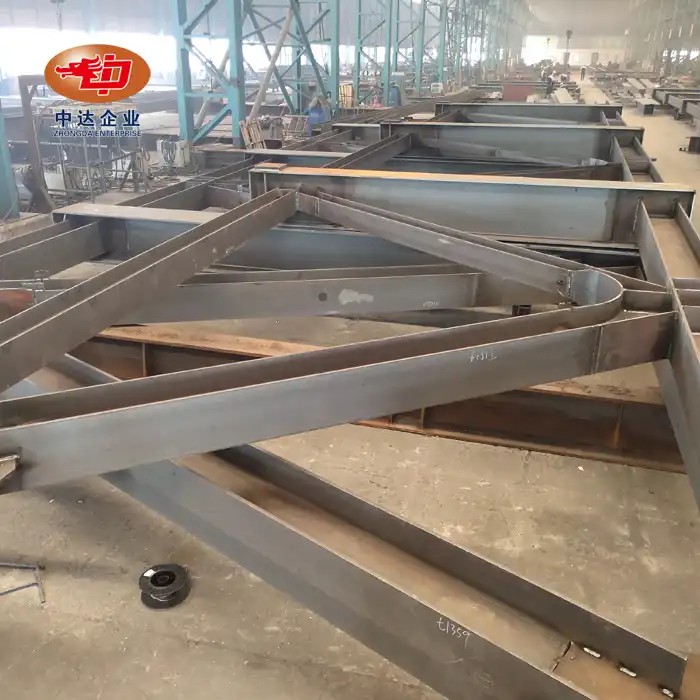
Cutting the steel into precise pieces is the first step in making a steel box girder. CNC oxy-fuel or plasma cutting tools can cut steel plates that are up to 100 mm thick, and they can keep the edge preparation limits within ±0.2 mm so that they can be welded later. Plate edges are beveled at certain angles (usually between 30 and 45 degrees) to make sure that full-penetration groove welds achieve 100% of the power of the parent material.
Fabrication: From Raw Plate to Finished Component
Then, automated production lines put together web plates and flanges using jigs that keep the shape stable during the welding heat cycle. Submerged arc welding (SAW) and flux-cored arc welding (FCAW) can produce high-quality weld metal at rates of more than 15 kg/hour, and constant seam tracking systems make sure that the metal always goes through. Post-weld heat treatment reduces leftover loads in joints that are tightly held together. This keeps the joints from distorting and makes them more resistant to wear.
Quality control is built into every step. Ultrasonic testing confirms that all key joints are properly welded, and measurement scans using a total station show that the actual shape of the girders fits the shapes in the BIM models within 3 mm of each other across 25-meter sections. Surface preparation follows SSPC-SP guidelines, and zinc-rich epoxy coats or hot-dip galvanizing provide rust protection for harsh industrial or marine settings (C4/C5), ensuring service lives of more than 30 years without the need to recoat.
Installation: Modular Assembly Accelerates Schedules
On-site assembly methods use the fact that steel box girders are already made to cut down on building times. Heavy trucks or ships move 12–30-meter girder units in segmented building processes, where 500-ton hydraulic gantries or crawler cranes place them in place. For field splices, high-strength fixed connections (ASTM A325 or A490 bolts) are torqued to certain preloads, or full-penetration groove welds are done under close quality control.
Accelerated Bridge Construction (ABC) methods use these strengths to their advantage. The Minnesota Department of Transportation found that replacing old, broken-down concrete bridges with prefabricated steel box girder systems cut building times by 60%. This meant that traffic jams and the related economic effects, which were estimated to be thousands of dollars per hour of road shutdown, were avoided. In the same way, curved junction flyovers in busy urban areas can be installed at night, when traffic stops for six hours and pre-assembled beam pieces weighing 80 to 120 tons can settle into place with accuracy within 10 mm horizontally and 5 mm vertically.
Applications Across Infrastructure Sectors
Steel box girders are useful in a variety of fields that face different operating difficulties. When building highway bridges, longevity is important because they have to withstand heavy truck traffic and salt used for deicing. This makes weathering steel options appealing for state DOTs with limited upkeep funds. Railway viaducts need to be very resistant to wear so they can survive millions of axle-load cycles. Zhongda's Q345qD steel standards meet this need by controlling the amount of sulfur and phosphorus in the steel, which makes it harder to break.
More and more, infrastructure for renewable energy depends on these building solutions. Access roads to wind farms in remote areas need bridges that can be put up quickly and with little heavy equipment. Modular steel box girders that come in bolt-together kits meet this need. Custom-section girders are used to support solar farm support structures that span irrigation ditches or environmentally sensitive marshes. These girders reduce the number of foundations needed and their impact on the environment while holding panel loads over 40–60 meter clear lengths.
Another area that is growing is port and landing services. To keep wheels from getting stuck, container crane tracks need girders with very tight straightness specs (±L/5000). CNC manufacturing and post-weld stress relief can make this possible. Girders can span 30 meters or more without any middle columns, which makes it possible for cold storage buildings to have more racks and make it easier for forklifts to move around, both of which are important for transport efficiency.
How to Choose Between a Box Beam and a Box Girder for Your Project?
The choice process starts by figuring out how much fundamental demand there is. Box beams are good for projects that need to build frames, equipment supports, or extra support inside existing buildings because they can handle loads that are evenly spread out below 100 kN/m and loads that are concentrated below 200 kN. For these uses, standard parts from local wholesalers work just fine, so no special engineering is needed.
Project Scale and Load Requirements
When building infrastructure that crosses rivers, roads, or hills, the needs go straight up to steel box girder area. When span lengths are longer than 30 meters, live load types include HS-20 truck loading or AREMA E-80 rail loading, and bending requirements that limit L/800 under service loads, girder shapes are needed to make the structure stiffer and stronger. Closed-section designs are the only ones that can guarantee rotational stability when the horizontal lines are curved, the supports are warped, or the cross-sections get wider.
Environmental and Operational Contexts
Conditions of exposure have a big effect on the choice of materials and protection measures. Box beams in climate-controlled factories don't need much protection from corrosion—shop paint coats are enough as long as the humidity level stays low and there are no flying contaminants.
When steel box girders are exposed to saltwater environments near the coast, chemical atmospheres in factories, or temperature changes in the Arctic, they need complete anti-corrosion plans. Combining hot-dip galvanizing (which creates an 85-micron zinc coating thickness) with epoxy topcoats, Zhongda's dual-layer protection systems offer corrosion resistance rated for ISO 12944 Category C5-M environments, protecting structures for 30 years or more without any maintenance in between. This method directly handles buying problems related to lifetime cost modeling, which can be very expensive for infrastructure budgets if upkeep is put off or parts are replaced before they're needed.
Supplier Evaluation: Certifications and Capabilities
To find box beams, you just need to make sure that the seller is qualified by checking for AISC certification, shop capacity for traffic and delivery times, and basic quality systems like ISO 9001. Since products are now all the same, it is still possible to compare prices between different manufacturers in the same area.
When buying steel box girders, you need to do more research into the engineers' skills and the quality of the infrastructure. If a maker is certified to EN 1090 Execution Class 4, it means they can meet strict limits and weld quality standards for important buildings. The certifications of an AWS Certified Welding Fabricator prove the skills of staff and the limits in place to make sure that mistakes don't happen. Supply chain audits should check that the company has the right design optimization tools (BIM integration, finite element analysis), modern NDT equipment (phased-array ultrasonics, magnetic particle inspection), and load-testing facilities to make sure the products work well before they are shipped.
Customization and Logistical Flexibility
Shenyang Zhongda is a good example of this wide range of skills because it has the Class I Steel Structure Professional Contracting Qualification, as well as ISO 9001/14001/45001 certifications and follows foreign standards (EN 1090, AWS D1.5, JIS). Their 60,000-ton yearly production capacity lets them work on multiple big projects at the same time, and their vertically integrated operations, which include R&D, building, and maintenance, make it easier for everyone to talk to each other and be held accountable, which is very important when project delays have fines that go over daily values.
With standard box beams, you can only change the length and a few easy joining details. Fabricators have to work with the plate widths and sizes that come with rolling tools. Steel box girders work best when they are optimized for a specific job. Variable-depth sections slope from areas with the most negative moments at the piers to areas with the least positive moments in the middle of the span. This lowers the cost of materials while increasing the efficiency of the structure.
Conclusion
It's not just a matter of words when you choose between box beams and steel box girders. It's a basic buying choice that affects how well the project works, how much money is spent, and the long-term value of the asset. When used in the ways they were meant to, box beams do a great job of supporting buildings and factories at a low cost. Big structures like bridges, transit systems, and big industrial projects need steel box girders because they can handle a lot of weight, don't bend, and last a long time.
Procurement success depends on matching structure solutions to the needs of the project and checking the skills of suppliers to ensure quality, on-time delivery, and long-term value. As infrastructure investment speeds up across North America, design teams with clear technical information and strong relationships with suppliers set up their projects for long-term success that can be measured in decades of reliable service.
FAQ
Can steel box girders adapt to unique project geometries?
Of course. These days, it's possible to make steel box girders with different depth sections, bent horizontal lines, and twisted support conditions. The BIM-integrated planning method used by Zhongda makes the best use of cross-sections to distribute loads in each project. It can handle beam heights ranging from 1.25 meters to 8 meters and lengths up to 420 meters. Custom perforated web shapes cut weight by 20% while keeping shear strength, which is great when design is limited by shipping or base issues.
How do maintenance requirements compare between steel and concrete girder systems?
Steel box girders that are properly protected against rust don't need much upkeep. They should be inspected every 5–10 years to make sure the connections are still strong and the coating is still in good shape. Some problems that concrete girders have to deal with are chloride entry, which corrodes the rebar, freeze-thaw damage that needs to be fixed, and an alkali-silica reaction in some materials. Comprehensive anti-corrosion systems, such as Zhongda's dual-layer galvanizing plus epoxy coats, make steel last longer than 30 years before it needs to be re-coated. In harsh conditions, however, concrete repairs usually start within 15 to 20 years.
What supplier qualifications matter most when procuring critical structural components?
Focus on badges that show technical know-how and quality systems, like ISO 9001 for management, EN 1090 EXC4 for standards and weld quality in fabrication, and AWS Certified Fabricator credentials for staff qualifications. Make sure that your company has technical tools that can optimize designs and coordinate BIM. Check how much can be made by taking walks of the building and looking at the accuracy of the CNC equipment, the infrastructure for automatic welding, and the NDT capabilities. Ask for examples from projects with similar tasks to make sure the contractor can deliver on time and provide good technical help after the delivery.
Partner with Zhongda: Your Trusted Steel Box Girder Supplier
To buy complicated infrastructure, you need a manufacturing partner that is both technically excellent and has a track record of getting things done. We at Shenyang Zhongda Steel Structure Engineering Co., Ltd. offer this mix. Our 60,000-ton yearly production capacity, ISO 9001/EN 1090/AWS certifications, and 70% client renewal rate show that we are dedicated to quality and relationship. Our steel box girder options use high-strength steels like Q345D and Q420D, improved anti-corrosion protection that guarantees 30+ years of service life, and forms that can be changed to fit any length up to 420 meters. We bring technical greatness to your most difficult infrastructure needs, as shown by our work on the 18,000-ton Shenyang Dongta Bridge and other major projects on four continents. Email our team at Ava@zd-steels.com to talk about unique manufacturing choices, reasonable prices, and shipping plans that fit your project's needs. Let's build long-lasting infrastructure together.
References
American Association of State Highway and Transportation Officials. (2020). LRFD Bridge Design Specifications, 9th Edition. Washington, DC: AASHTO.
Barker, M.G., & Schrage, S.D. (2018). High-Performance Steel Design Manual, 3rd Edition. Federal Highway Administration Publication FHWA-HIF-18-065.
Chen, W.F., & Duan, L. (2014). Bridge Engineering Handbook: Construction and Maintenance, 2nd Edition. Boca Raton: CRC Press.
European Committee for Standardization. (2006). Eurocode 3: Design of Steel Structures—Part 2: Steel Bridges (EN 1993-2). Brussels: CEN.
Kulicki, J.M., et al. (2019). "Guidelines for Steel Girder Bridge Analysis" in NCHRP Report 725, 2nd Edition. Transportation Research Board, National Academies Press.
Zhao, X.L., & Zhang, L. (2017). "State-of-the-Art Review on FRP Strengthened Steel Structures" in Engineering Structures, Volume 126, Pages 617-629. Elsevier Ltd.